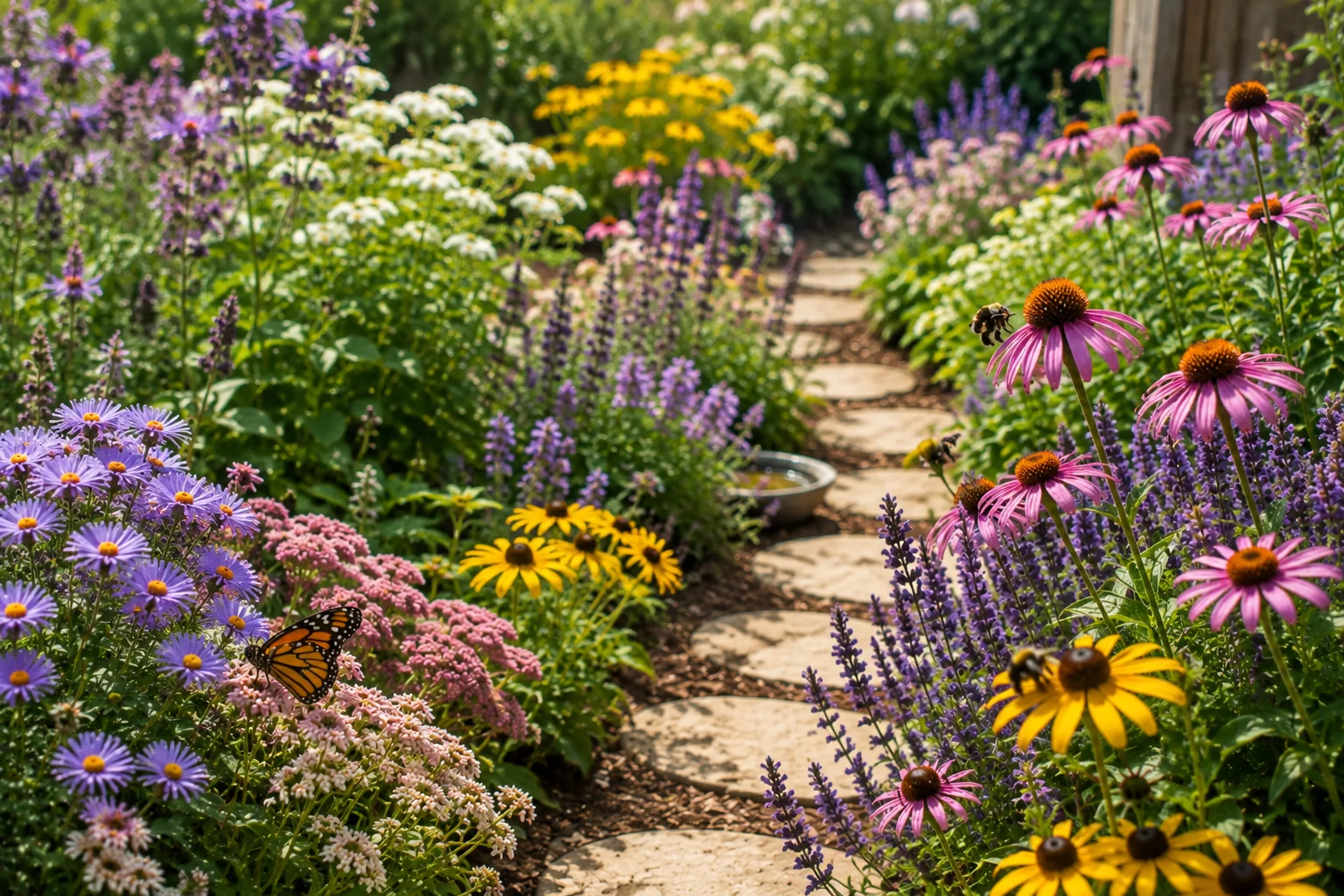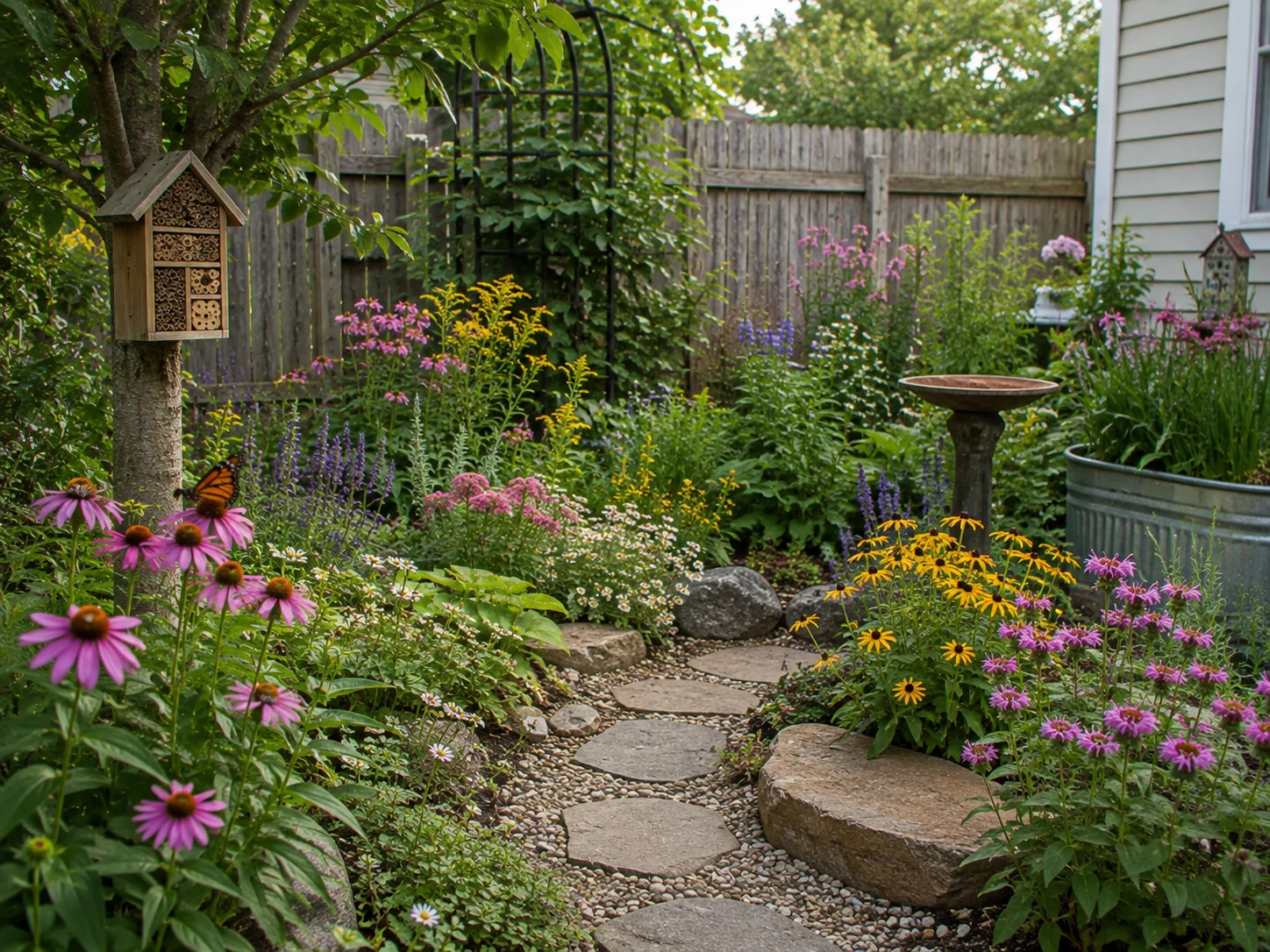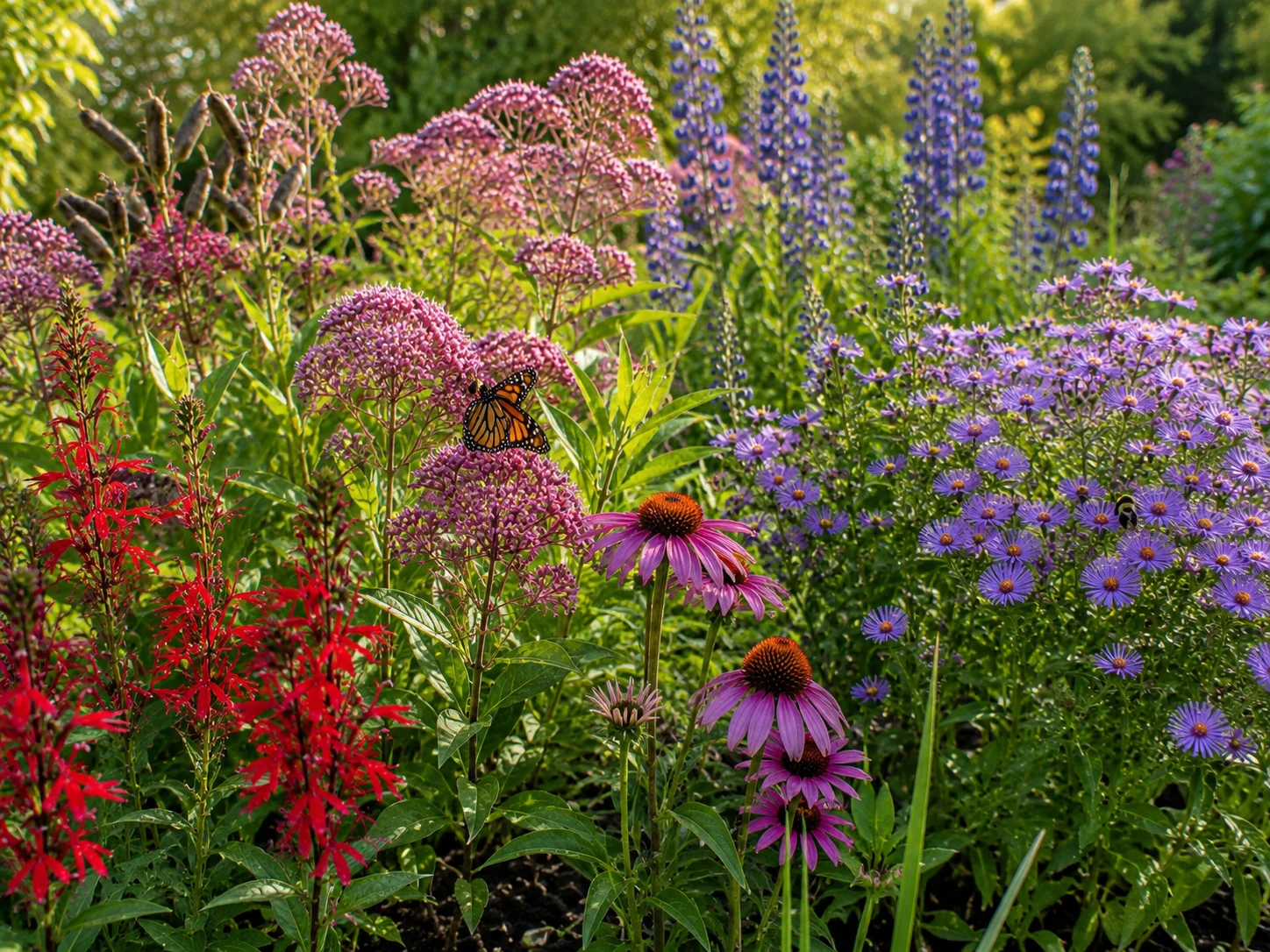

A single pollinator garden, however well planted, is an island.
It provides food and sometimes nesting habitat for the bees, butterflies, and beneficial insects that find it. But the landscape surrounding it — the mown lawns, the bare driveways, the clipped hedges, the chemically treated turf — offers those same insects nothing. They must cross that hostile territory to reach the next patch of habitat, expending energy on a journey that may cover hundreds of metres with no food, no cover, and no shelter along the way. For smaller native bee species with limited foraging ranges, some patches of suburban landscape are simply too isolated to reach from surrounding habitat at all.
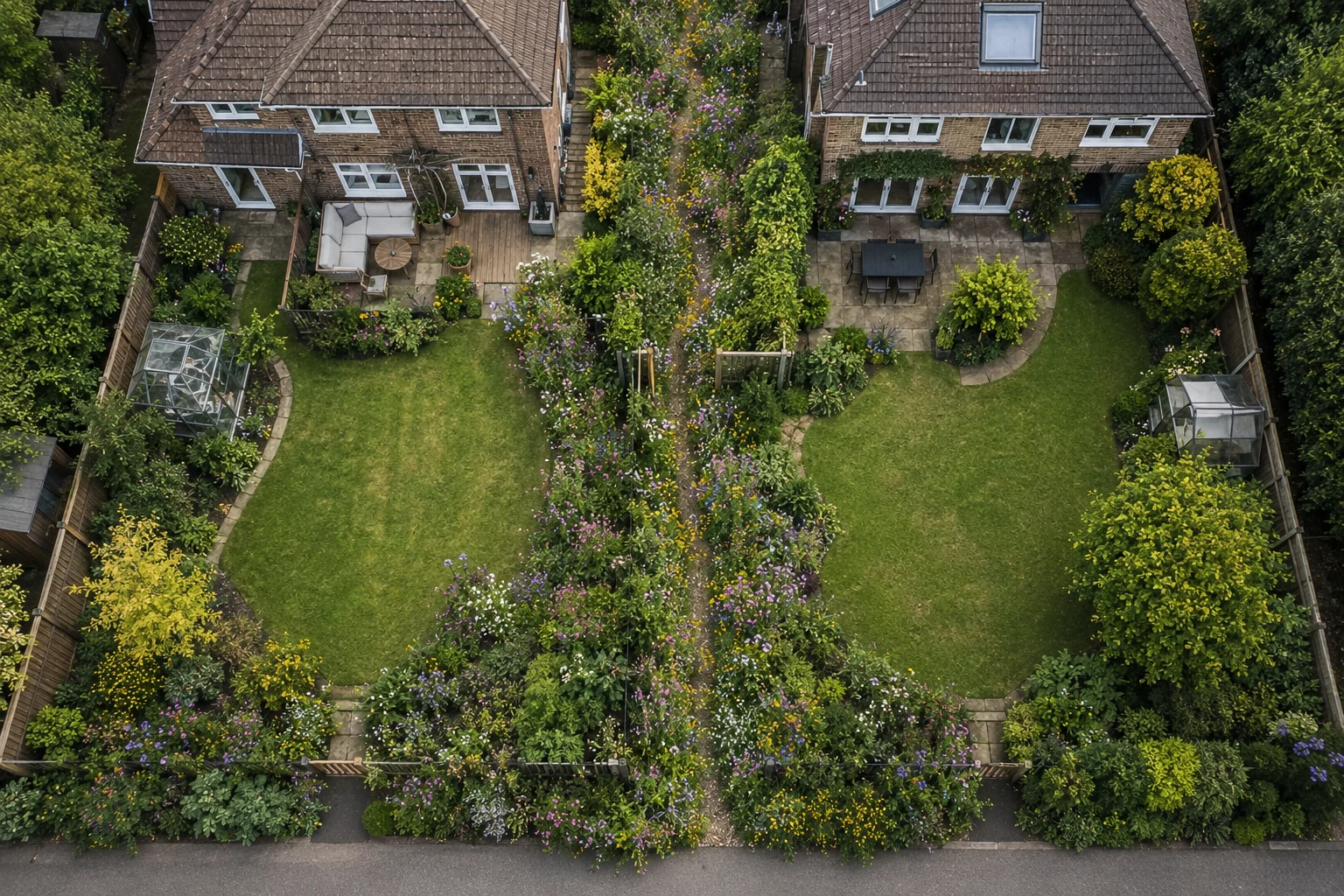
A pollinator corridor changes this. Rather than creating one excellent garden feature in isolation, a corridor connects planting across the length and width of the property — through the front yard, along the side paths, across the back boundary — so that pollinators moving through the landscape have a continuous thread of habitat to follow rather than a series of isolated stops separated by hostile terrain.
The concept comes directly from landscape ecology. Habitat corridors — connected strips of appropriate habitat linking larger patches — are one of the most well-established tools in conservation biology for maintaining wildlife populations in fragmented landscapes. The US Fish and Wildlife Service has identified urban and suburban habitat connectivity as a priority for pollinator conservation, and several state wildlife agencies have developed specific suburban corridor programs as a result.
This post gives you the practical framework for building a pollinator corridor through a typical suburban property — how to assess what you have, how to identify the connections that need to be made, which plants create the most effective corridor, how to sequence the planting, and how to connect your corridor to the wider neighborhood landscape in ways that multiply its ecological impact.
What a Pollinator Corridor Actually Is — And What It Isn’t
Before designing anything, it is worth being specific about what a pollinator corridor is and what distinguishes it from simply having several planted areas in different parts of the garden.
A corridor is defined by connectivity — the planted areas are physically linked, or close enough that the gap between them is crossable without significant energy expenditure. For a honeybee foraging up to three miles from the hive, a ten-metre gap of lawn between two planted areas is trivially crossable. For a small native mining bee with a foraging range of 300 metres, that same gap may represent a meaningful proportion of her daily range. Corridor design for pollinators must consider the full range of species that will use it, not just the most capable ones.
A corridor is also defined by continuity — it provides habitat at every point along its length, not just at the endpoints. A strip of lawn connecting two planted areas is not a corridor. A strip of low flowering ground cover, closely mown grass with clover and self-heal, or a gravel path with flowering plant margins is a corridor because it provides food and cover continuously along its entire length.
Finally, an effective corridor provides seasonal continuity — something is flowering, nesting, or providing shelter at every point along its length at every time of year when pollinators are active. A corridor that blooms spectacularly in June and is bare in April and August fails its ecological function at two of the three most critical points in the pollinator season.
With these three criteria in mind — spatial connectivity, physical continuity, and seasonal continuity — the design work becomes much more concrete than a vague intention to “plant for pollinators across the whole garden.”
Step 1: Map What You Already Have
The most productive starting point is not buying plants. It is an honest assessment of what habitat already exists on your property and where the gaps are.
Walk the perimeter of your property with a notebook or your phone and photograph every area that currently provides any pollinator value: existing flower beds, unmown areas, herb plantings, shrubs that flower, fruit trees, any area of ground that is not chemically treated, and any features that provide nesting habitat such as south-facing bare soil, rock piles, or decomposing wood.
Then map the gaps — the sections of the property where pollinators moving through the landscape find nothing useful. This is typically: the mown lawn between planted areas, the paved driveway, the bare soil at the base of a fence, the side path between house and boundary, and any section of the property boundary that is a plain wooden fence or clipped monoculture hedge.
Now look at the map you have created and ask one question: if you were a bumblebee flying through this property from the street to the back fence, where would the food and cover be continuous, and where would you have to cross bare hostile territory?
The answer to that question is your corridor design brief. The goal is to eliminate — or at least substantially narrow — every gap you identified, using the planting approaches described below.
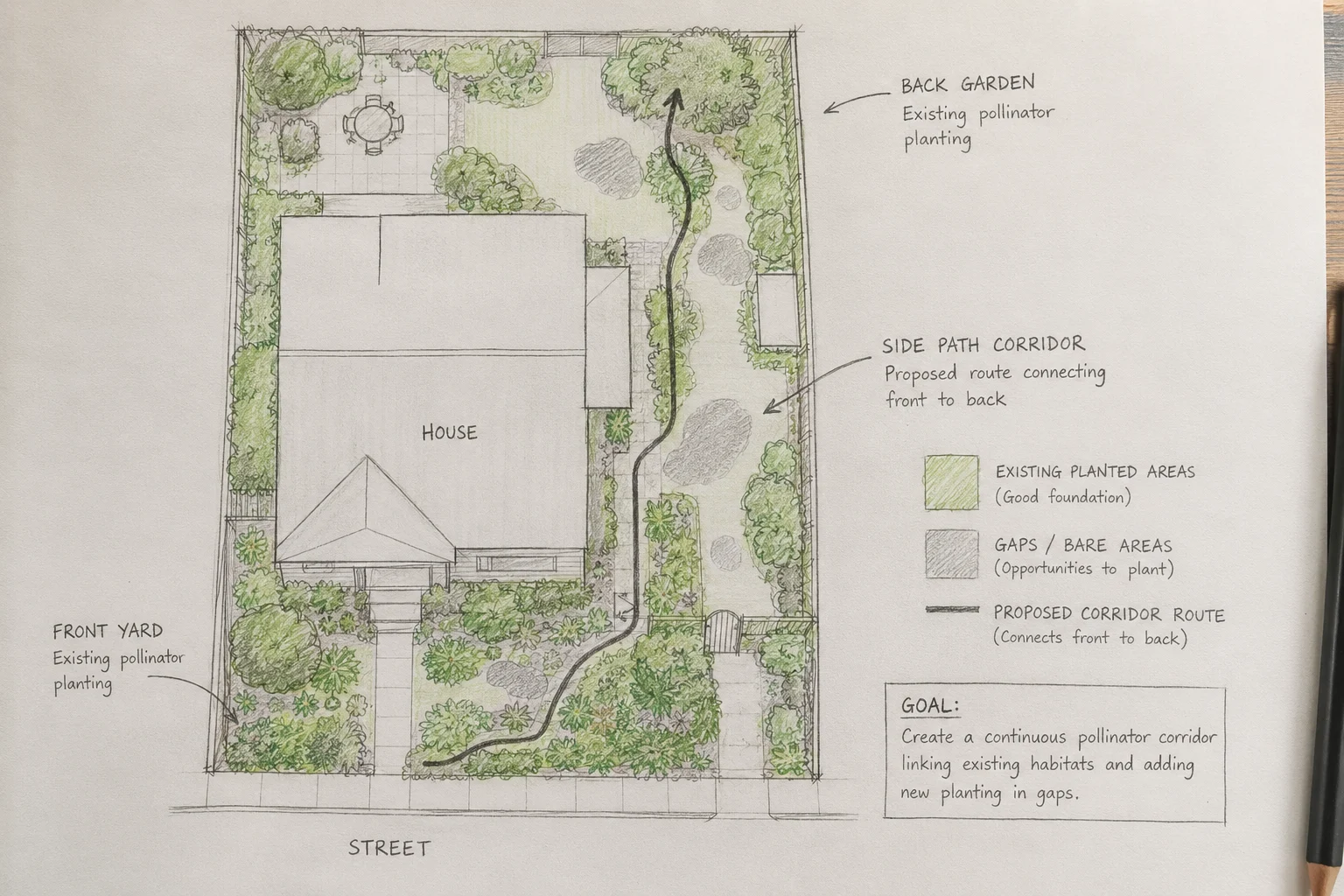
Step 2: Identify the Corridor Route
In most suburban properties, the natural corridor route runs in one of two configurations.
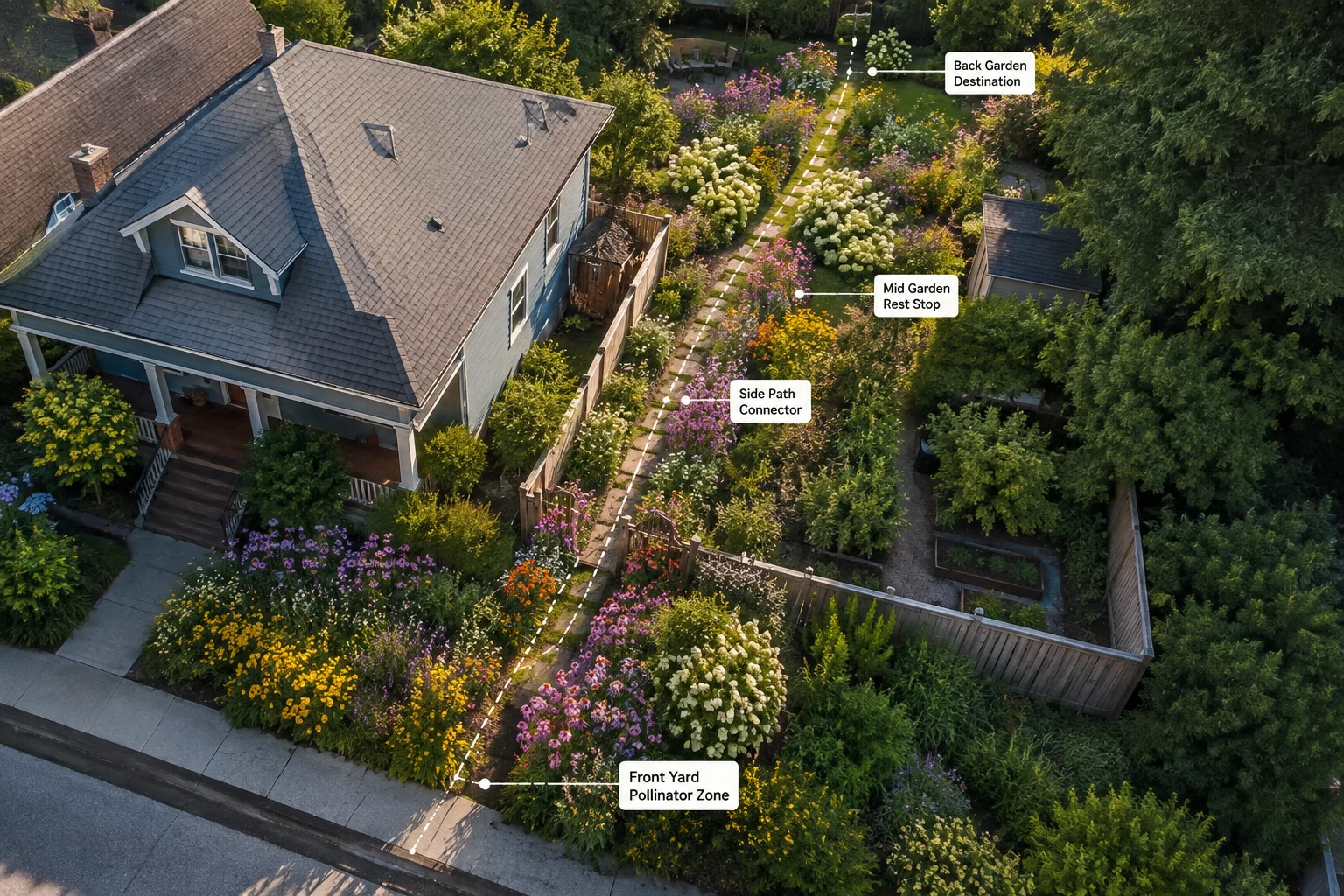
The through-garden corridor runs from the front boundary through the front garden, through or around the house, along one or both side paths, and into the back garden. This is the most ecologically valuable route because it connects the street-facing landscape — which is part of the wider neighborhood foraging network — directly to the back garden habitat, creating a continuous thread through the entire property.
The boundary corridor runs along the back and side boundaries of the property — typically where the fence line provides a structure for climbing plants and where a planting bed of some depth can be established without disrupting the functional centre of the garden. This is the easier route to implement in most established gardens and produces strong results even without connecting to the front yard.
Both routes are worth pursuing where the property allows. Where space or existing structures make the full through-garden route difficult, begin with the boundary corridor and extend toward the front over subsequent seasons.
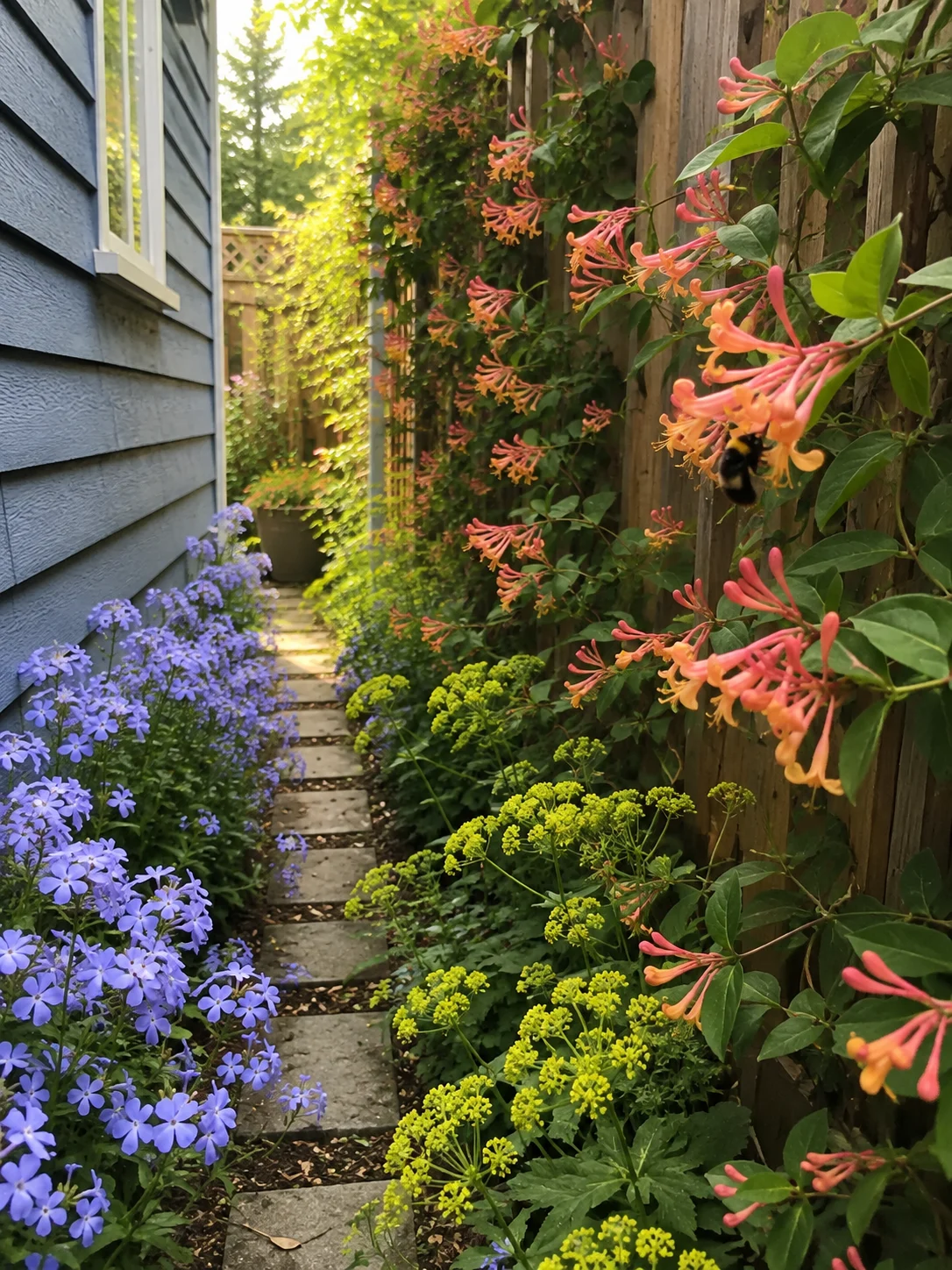
The side path — the narrow passage between the house wall and the side fence or boundary — deserves specific attention as a corridor element. It is almost always underused, frequently shaded by the house wall or neighbouring buildings, and often treated as a service access route rather than a garden space. A side path planted with shade-tolerant pollinator species along one or both edges becomes one of the most effective corridor segments on the entire property because it is narrow, enclosed on two sides, and produces a concentrated scent and flower signal that insects follow reliably.
Step 3: Choose Plants That Build the Corridor
Corridor planting follows the same mass planting principles that apply to any bee garden design — but with an additional emphasis on continuity along the length of the corridor rather than just density at individual points.
The core principle: every five to ten feet of corridor length should have something in flower throughout the active season. This means selecting species with staggered bloom times and planting them in sequence along the corridor route so the flowering sequence moves through the corridor like a wave — crocus at one end in February, alliums further along in May, catmint reaching peak in June, agastache continuing in August, asters finishing in October.
For the front boundary and front yard corridor section:
Native viburnums (Viburnum dentatum, arrowwood viburnum) provide structural height, late spring bloom, and berries for birds through autumn. Serviceberry (Amelanchier species) flowers in early April when almost nothing else is available and provides edible fruit through June. Low-growing creeping thyme, white clover, and native violets planted through or alongside the lawn strip create the continuous ground-level corridor that connects larger planted features.
For the side path corridor section:
Native coral honeysuckle (Lonicera sempervirens) trained along a fence or wall provides tubular red-orange flowers from spring to autumn and tolerates the partial shade of a side path better than most climbing plants. Wild ginger (Asarum canadense) provides dense evergreen ground cover in deeply shaded positions. Native ferns and woodland wildflowers — Virginia bluebells (Mertensia virginica), wild blue phlox (Phlox divaricata), and golden Alexanders (Zizia aurea) — flower in the early spring window when the side path receives more light before the surrounding canopy closes.
For the back boundary corridor section:
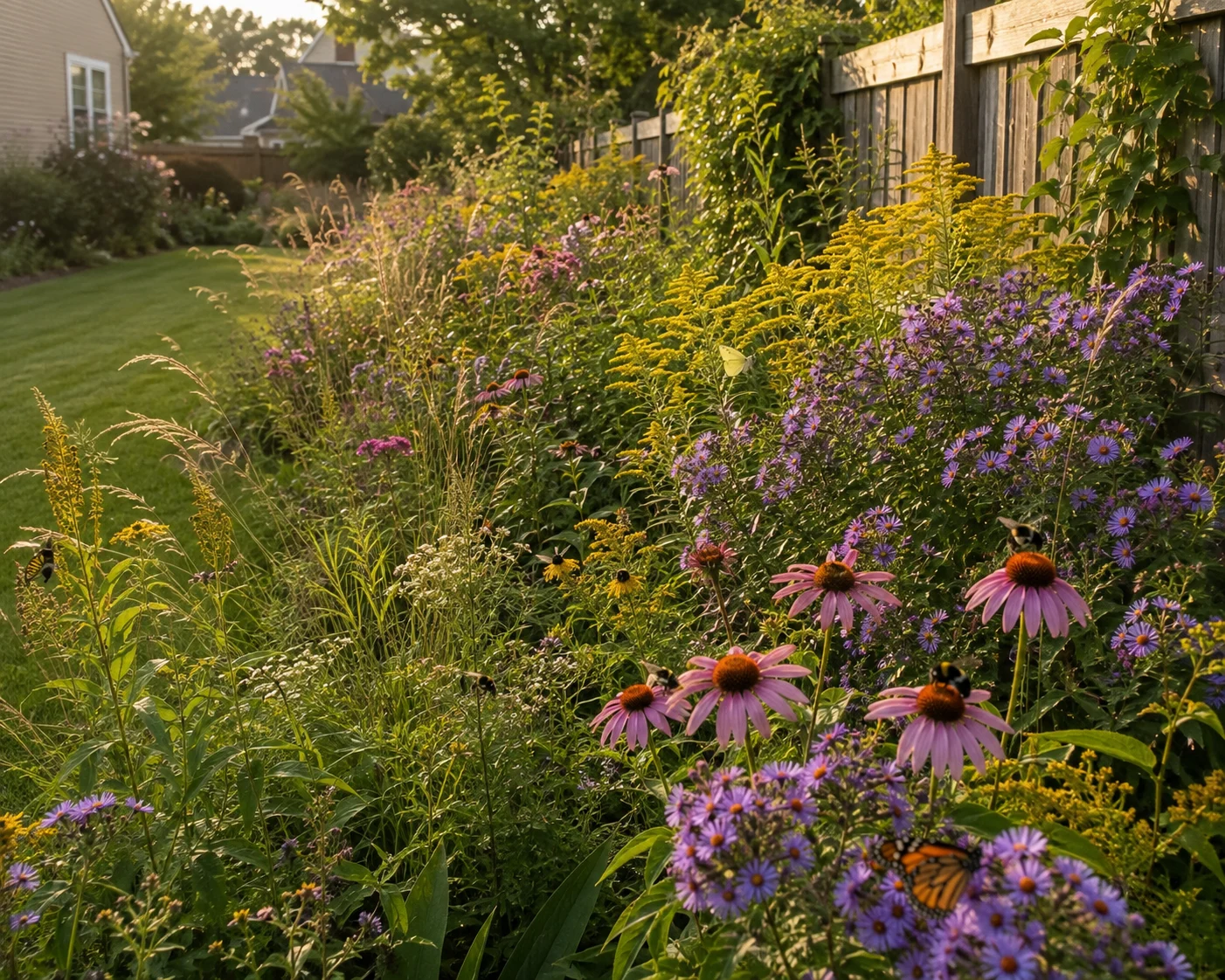
Native buttonbush (Cephalanthus occidentalis) fills the July–August dearth that most corridors fail to address. Native goldenrod (Solidago species — choose a compact clump-forming species for a managed border context, not a roadside spreader) provides the critical late-summer and autumn flow that builds winter reserves for both managed and wild bees. Native asters (Symphyotrichum species) extend the corridor into October.
Step 4: Close the Lawn Gap
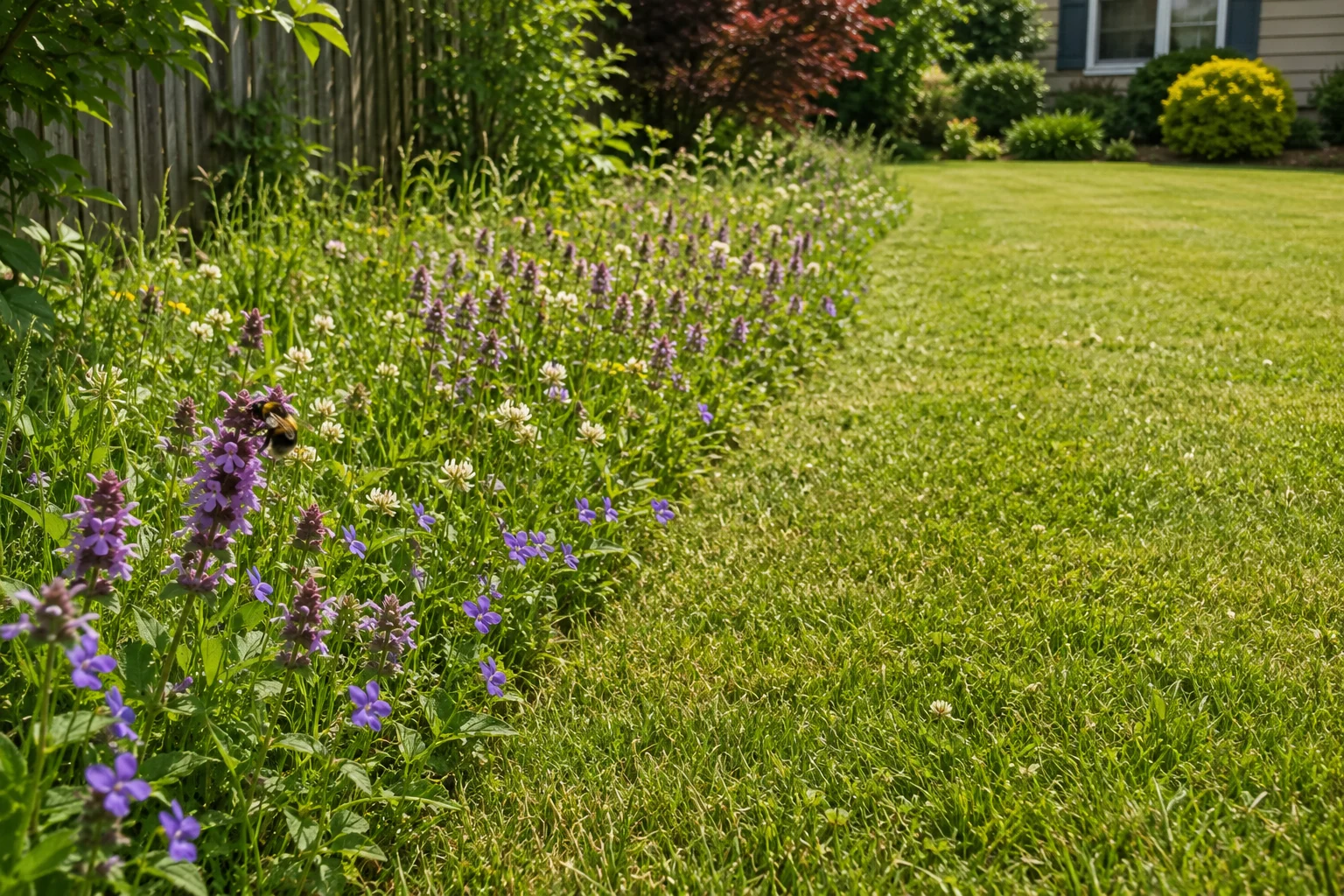
The lawn is the most common obstacle in a suburban pollinator corridor — a wide expanse of managed turf that pollinators must cross without any food or cover. Closing the lawn gap is often the most impactful single intervention in the entire corridor project.
The most effective approach combines three techniques simultaneously rather than relying on any one alone.
Oversow with white clover. A single pound of white clover seed (Trifolium repens) scattered into an existing lawn and raked lightly covers approximately 1,000 square feet and begins flowering within six to eight weeks of establishment. White clover is worked continuously by honeybees, bumblebees, and native bees, fixes its own nitrogen improving soil fertility, and tolerates mowing at four inches without losing its flowering capacity. It does not compete aggressively with established grass. It is, in terms of cost per ecological unit, one of the highest-return pollinator investments available to any suburban gardener.
Raise the mowing height to four inches. At this height, white clover, self-heal (Prunella vulgaris), bird’s-foot trefoil (Lotus corniculatus), and native violets — all of which exist in most suburban lawns in seed form even when suppressed by short mowing — can flower between cuts. The lawn begins to function as a low-level corridor feature rather than a barrier.
Designate a no-mow strip. Along one edge of the lawn — ideally the edge that runs parallel to the main corridor route — leave a strip of 18–24 inches unmown from May through August. Edge it cleanly with a mown border so it reads as intentional rather than neglected. Within two to three seasons this strip develops a genuinely diverse plant community that provides ground-nesting habitat as well as food.
The science behind this approach is supported by research from the Xerces Society for Invertebrate Conservation, which has documented significant native bee diversity in lawns that include a diversity of flowering plants and unmown sections, compared to managed monoculture turf.
Step 5: Add Nesting Habitat Along the Corridor
A corridor that provides food but no nesting habitat is a feeding station rather than a habitat network. The most ecologically complete corridors include nesting opportunities for both ground-nesting and cavity-nesting native bees distributed along their length.
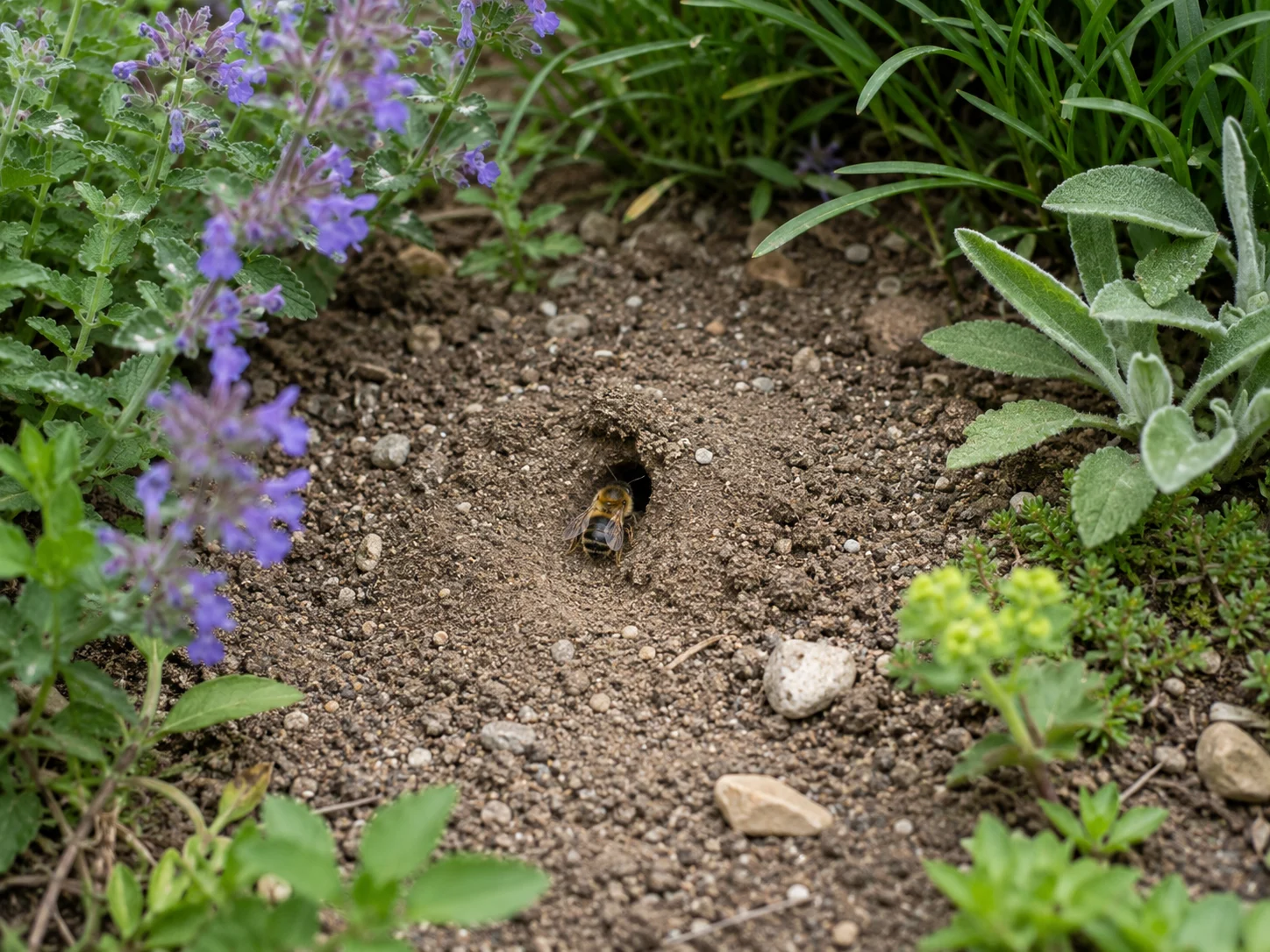
For ground-nesting bees — which represent approximately 70% of North American native bee species — the requirement is simple: south-facing bare or sparsely vegetated loose soil with good drainage. Designate several 12-inch square patches of intentionally bare soil at south-facing positions along the corridor route. Remove mulch, loosen the soil to six inches depth, and leave it completely unplanted. One patch per ten feet of corridor is a reasonable density.
For cavity-nesting bees — mason bees, leafcutter bees, small carpenter bees — leave hollow and pithy perennial stems standing through winter rather than cutting them to the ground in autumn. Stems of bee balm, goldenrod, coneflower, and sunflower provide natural nesting cavities. Add a simple bundle of paper tubes or hollow bamboo canes in a protected position along the corridor as a supplemental nesting resource.
Leaf litter and brush piles at sheltered positions along the corridor boundary provide overwintering habitat for bumblebee queens and other insects that spend winter in protected ground-level cover. A small pile of leaves and coarse woody material in a corner of the side path or against the back fence requires no management and provides habitat that cannot be replicated by any purchased product.
Step 6: Connect Beyond Your Property
A corridor that stops at your property line is still an island. The most ecologically significant corridors extend beyond individual gardens into a connected neighborhood network — and building that network does not require organizing a neighborhood association or seeking permission from anyone.
The simplest approach: talk to the neighbors whose properties adjoin yours and share what you are doing. Show them the planting, explain the concept, and offer to give them plants from divisions of your own established specimens. A neighbor who plants even a modest strip of flowering plants along the boundary that meets your corridor immediately doubles the corridor’s effective length. Two neighbors on either side of you who do the same creates a connected strip that may extend one hundred metres or more.
The National Wildlife Federation’s Garden for Wildlife program provides free resources, habitat certification for individual gardens, and tools for creating neighborhood wildlife habitat networks — including materials that make it easier to share the corridor concept with neighbors in accessible, non-technical language.
Beyond individual neighbor conversations, several cities and counties across the US have established formal pollinator corridor programs — particularly along road verges, utility easements, and municipal green spaces — that backyard gardeners can connect to simply by planting appropriate species along the street-facing boundary of their property. Research whether your municipality has an active program before finalizing your front yard planting selections.
The Corridor Plant Quick Reference
This condensed plant list covers the key species for each corridor section, organized by bloom season to help plan sequential flowering along the full route.
Early spring (February–April): Serviceberry, Virginia bluebells, golden Alexanders, wild blue phlox, native violets, crocus (in lawn or borders), pasque flower (Pulsatilla vulgaris or native species).
Late spring (May–June): Arrowwood viburnum, coral honeysuckle, catmint, native columbine (Aquilegia canadensis), wild geranium, penstemon, native alliums.
Midsummer (July–August): Buttonbush, mountain mint, purple coneflower (Echinacea purpurea), bee balm (Monarda species), native milkweed, anise hyssop, agastache.
Late summer and autumn (September–October): Native goldenrod (compact clump-forming species), New England aster, smooth aster, native ironweed, Joe-Pye weed, sedum.
Year-round corridor support: White clover in lawn, creeping thyme in path margins, native grasses for structure and nesting material, leaf litter and bare soil patches for nesting.
For a more detailed treatment of bloom sequencing for year-round corridor productivity, the full four-season framework in The Four-Season Pollinator Garden: A Beekeeper’s Blueprint for Nonstop Bloom applies directly to corridor planting planning.
Making It Work Over Time
A pollinator corridor is not a single planting event. It is a managed system that develops over three to five years as plants establish, self-seed, and create the overlapping, multi-layered structure that provides the most complete habitat.
In year one, prioritize establishment and connectivity — get plants in the ground at every point along the corridor route, even if the initial planting is sparse. Fill gaps with fast-establishing annuals: borage, phacelia, and cosmos all establish within eight weeks from direct sowing and provide significant forage while perennials develop their root systems.
In year two, assess where the corridor is working and where it has gaps — both in physical planting and in bloom timing. Add species to address specific months where nothing is flowering. Begin dividing established perennials and moving divisions to strengthen weaker corridor sections.
By year three, a well-managed corridor begins to self-maintain — self-seeding, spreading, and filling gaps with less intervention. Management shifts from establishment to editing: removing species that are spreading too aggressively, encouraging those that are establishing well, and adding new species to fill ecological niches the corridor does not yet support.
The connection between the corridor concept and the detailed management of individual planted areas — particularly the drift planting method that makes corridor segments most effective for bee detection and use — is in The Drift Method: How to Design a Garden That Guides Bees From Bed to Bed.
Conclusion: One Garden, One Corridor, One Part of Something Larger
A pollinator corridor through a suburban garden is a small act with disproportionate ecological effect.
The fragmentation of suburban landscapes — the way mown lawns, paved surfaces, and monoculture plantings isolate individual gardens from each other and from the wider landscape — is one of the primary drivers of native bee decline in North America. A corridor that runs through your property and connects to your neighbors’ plantings does not solve that problem alone. But it contributes to the network of connected habitat that, when enough individual gardens participate in it, begins to function as a genuine landscape-scale resource for the pollinators that share the suburban environment with us.
The steps are concrete: map what you have, identify the route, close the lawn gap, plant for continuous bloom, add nesting habitat, and reach out to neighbors. None of them require significant expense, specialized knowledge, or a large property. They require only the decision to think about the garden as part of a larger system rather than as a self-contained space.
That shift in perspective — from garden as island to garden as corridor — is what makes the difference between a beautiful collection of bee-friendly plants and a functioning piece of pollinator habitat. 🌿🐝