
Opening a beehive in winter is one of the few beekeeping interventions that can actively make things worse. A healthy overwintering cluster maintains an interior temperature of 80–95°F (27–35°C) at the cluster core, generated entirely through the metabolic activity of the bees themselves — specifically, by isometrically contracting their flight muscles without moving their wings, a form of thermogenesis similar to shivering. Breaking that cluster by opening the hive on a cold day forces the bees to divert significant energy to rebuilding their thermal envelope rather than maintaining it, and on very cold days the break in cluster integrity can be genuinely dangerous for a small or weakened colony.
This does not mean winter is a hands-off period. It means the checks you do in winter are performed from the outside — and that learning to read what those external checks tell you accurately is a distinct and valuable skill, separate from the frame-by-frame inspection work of the warmer months.
This post covers every legitimate external winter hive check available to a beekeeper managing standard Langstroth equipment in USDA hardiness zones 4–8. For each check, we will describe exactly what you observe, what it means, and — critically — where the limits of that interpretation are. Experienced beekeepers know what external checks can tell you and what they cannot, and that distinction matters as much as knowing what to look for.
What External Winter Hive Checks Can and Cannot Tell You
Before getting into the specific checks, this framing is important — and it is the framing that separates accurate winter beekeeping guidance from vague reassurance.
External winter checks can reliably tell you: whether the colony appears alive, approximately where the cluster is within the hive, whether there is an acute ventilation problem, whether the entrance is blocked, whether the hive has been disturbed by a predator, and approximately whether stored honey is critically low relative to the cluster position.
External winter checks cannot reliably tell you: the exact size of the cluster, the precise quantity of remaining stores, whether the queen is alive, whether there is disease present, whether the cluster has adequate protein stores, or whether the colony is on a trajectory to survive to spring.
This is not a failure of the external check method — it is an honest acknowledgment of what it is. A beekeeper who understands these limits makes better decisions than one who over-interprets what the outside of a hive tells them. Keep this framework in mind throughout everything that follows.
The Heft Test: Estimating Winter Stores
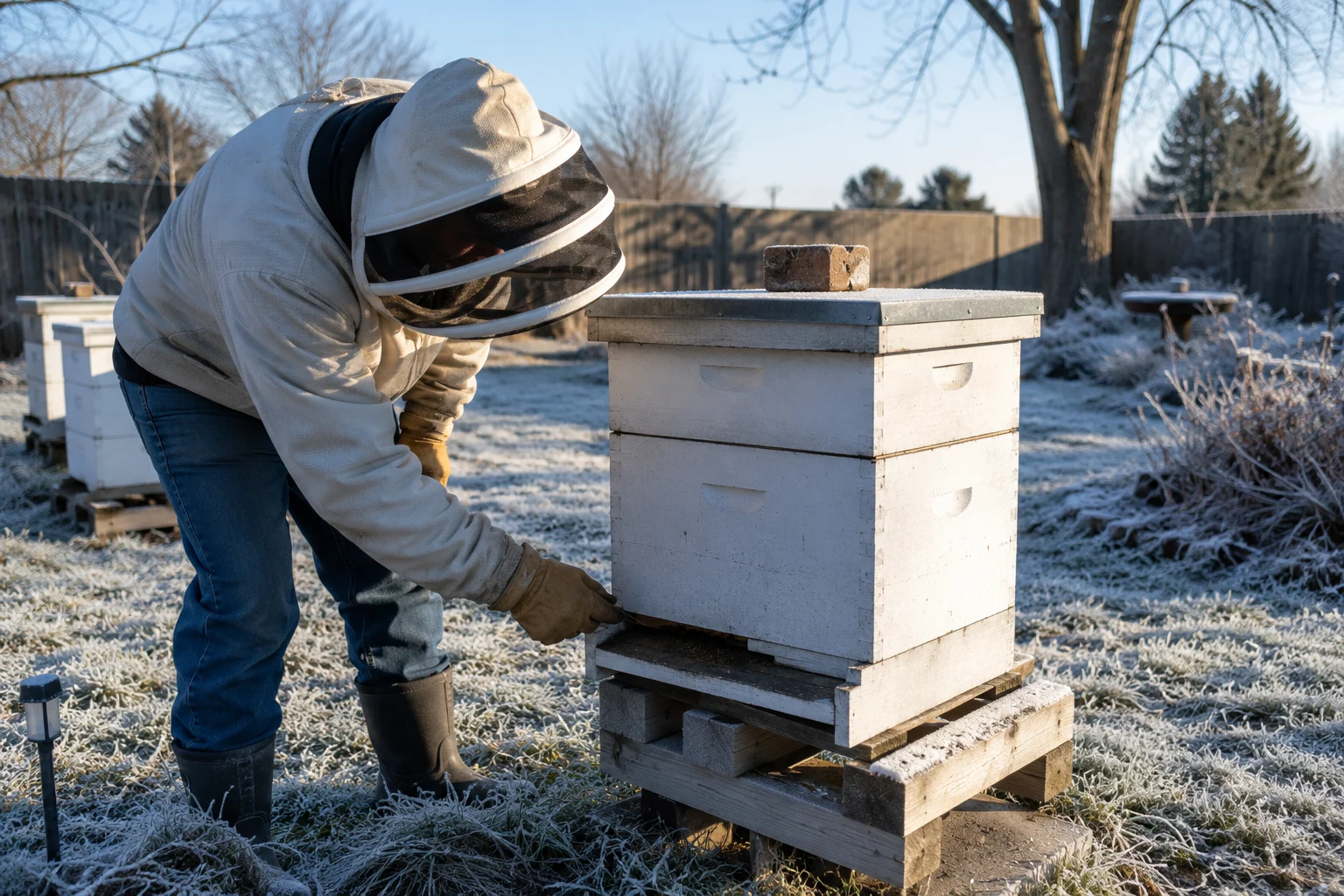
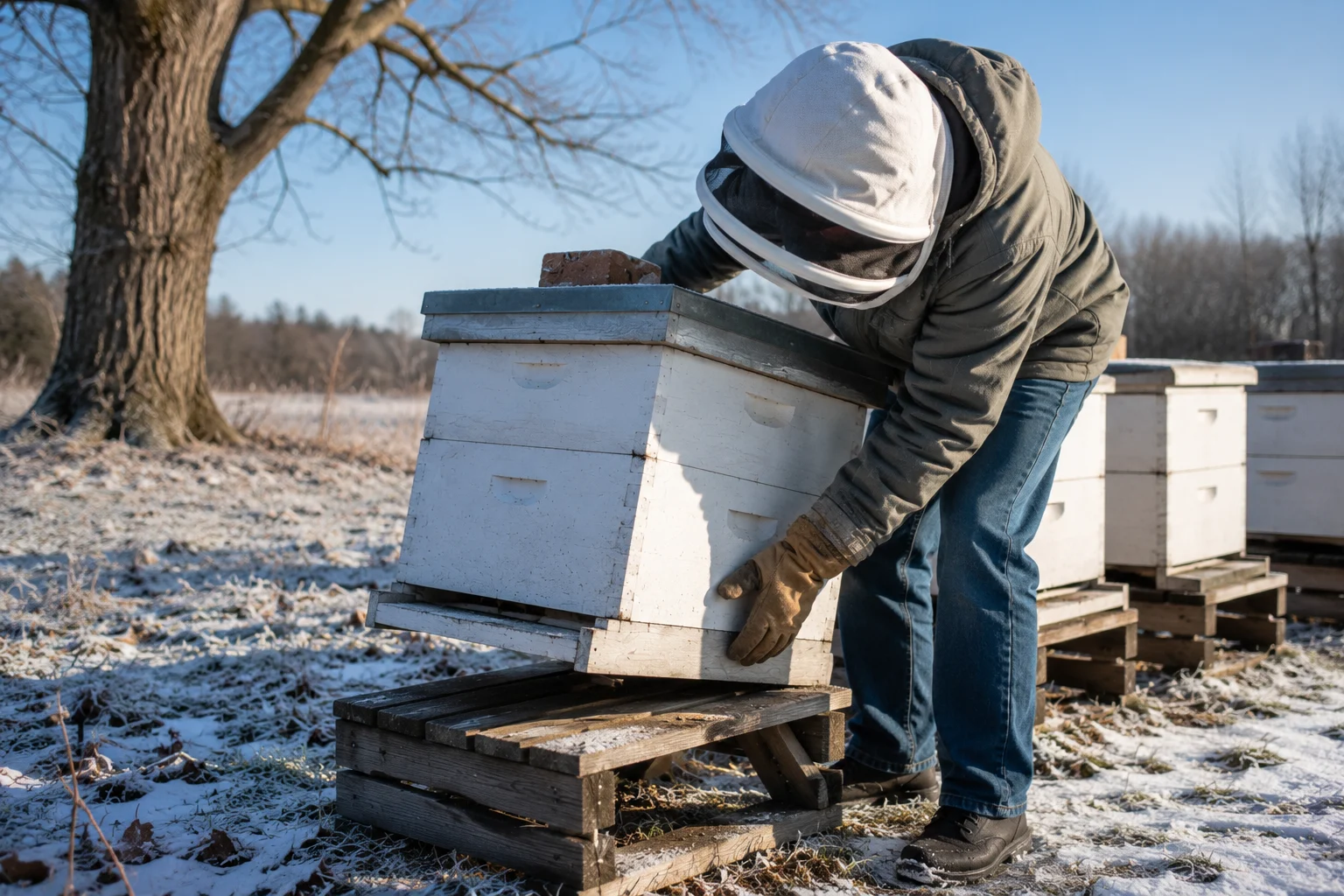
The most important single external check in winter is also the simplest. Lift the back of the hive slightly — just a few inches — and assess its weight. Do this consistently at the same time of day, since morning weights are fractionally lower after a night of cluster respiration consuming carbohydrates.
A ten-frame Langstroth hive going into winter in zones 4–6 should have a minimum of 60–80 lbs (27–36 kg) of honey stores above and beside the cluster to survive through to early spring without supplemental feeding. In zone 7 and warmer parts of zone 8, where winters are shorter, 40–60 lbs (18–27 kg) may be sufficient. These figures come from the Honey Bee Health Coalition’s Varroa Management and Colony Health Guide, which remains the most rigorously current consensus document on winter store requirements for US beekeepers.
What the heft tells you in practice is relative rather than absolute. If the hive felt substantially heavier in October than it does in January, the colony has been consuming stores — which is expected. If it feels dramatically lighter than it did two weeks ago, consumption has accelerated, which warrants investigation and potentially emergency feeding if temperatures allow.
A hive that feels dangerously light — where lifting the back requires almost no effort — is a hive at immediate starvation risk. Emergency fondant or dry sugar on the inner cover can be provided without opening the hive body, and this is the one winter intervention that should not wait for warmer temperatures.
One important clarification about the heft test: it cannot distinguish between a heavy hive with honey well-positioned above the cluster, and a heavy hive where the honey is stored in a position the cluster cannot reach without breaking cluster integrity in cold temperatures. This is the condition known as isolation starvation — a colony that starves surrounded by honey because the honey is too far from the cluster for the bees to move to it safely during a cold spell. Isolation starvation is one of the most common winter losses in the northern US, and it is not detectable by heft alone. It is addressed partly by proper pre-winter preparation — covered in How to Prepare Your Beehive for Autumn: A Practical 10-Step Checklist — and partly by ensuring the cluster enters winter positioned in the lower third of the hive with stores directly above and to the sides.
Listening to the Cluster: The Knock Test
On a cold day when the bees are clustered and silent, a gentle knock on the side of the hive — one firm rap with a knuckle — will cause the cluster to respond with a brief burst of buzzing that subsides within a few seconds. This is the fastest and most reliable confirmation that a colony is alive during a cold snap when no bees are flying and no external activity is visible.
The sound you are listening for is a collective response: a distinct, relatively loud buzz from the interior that lasts 2–5 seconds and then fades as the cluster settles. A healthy cluster in a cold but viable hive produces this response consistently to a single knock.
Several important caveats:
A very small or very cold cluster may respond weakly or not at all to a single knock. This does not necessarily indicate a dead colony. Repeat the knock after a few minutes. If there is no response to three separate knocks over the course of ten minutes on a cold day, the colony may have died — but confirm by other means before concluding this definitively.
A healthy cluster in moderate winter temperatures (above approximately 45°F / 7°C) may be partially moving and the response will be different — more diffuse and less dramatic — than the tight cluster response on a very cold day. Do not interpret a muted response in mild weather as a sign of weakness.
The knock test tells you only that bees are present and alive. It tells you nothing about cluster size, queen status, disease, or stores. A colony that responds vigorously in January can still fail before March if stores are inadequate or varroa damage to the winter bee population was severe.
Reading the Entrance: Dead Bees, Moisture, and Cluster Position
The hive entrance provides several categories of information throughout winter, and learning to distinguish normal from abnormal is the core skill of the external check.
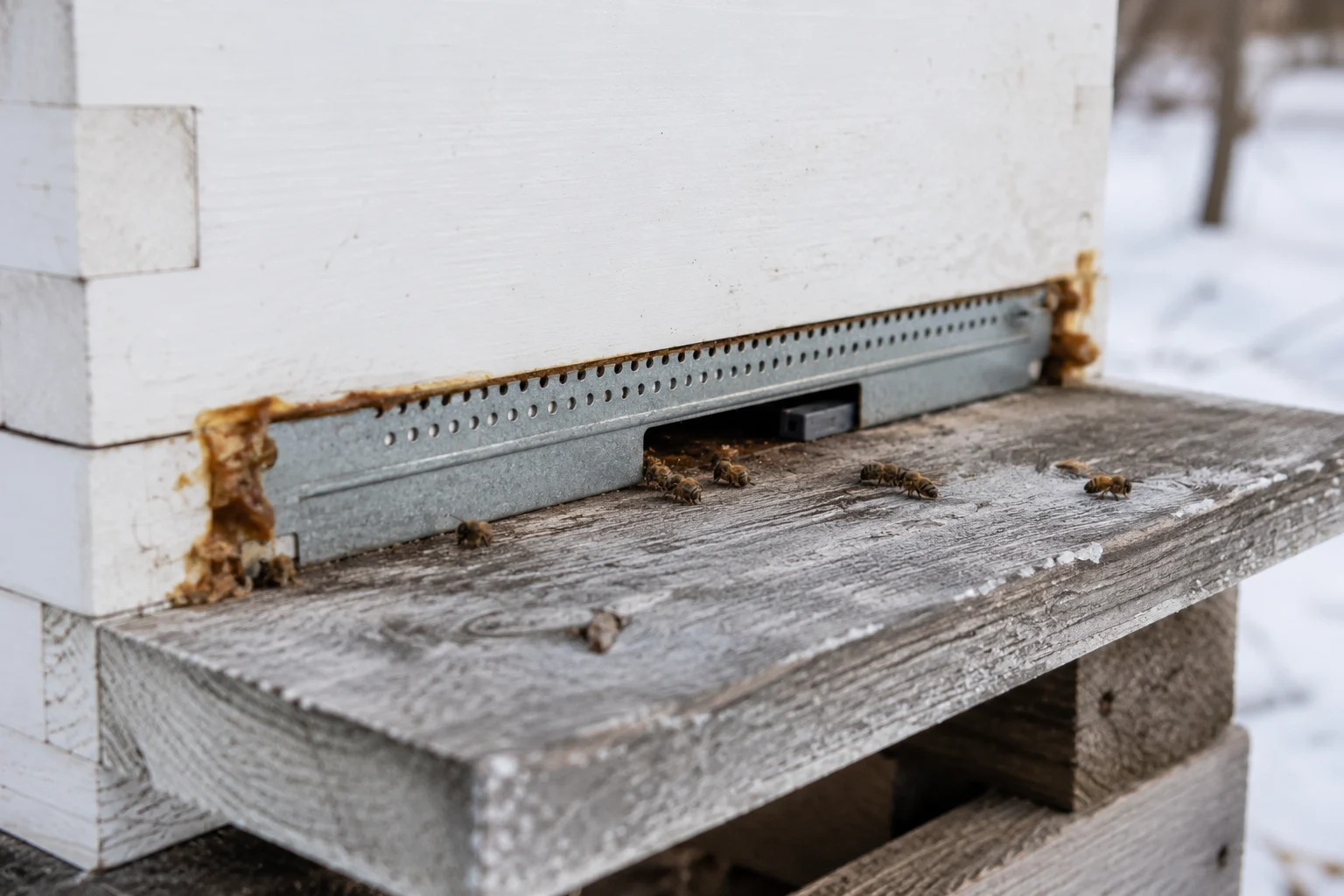
Dead bees at the entrance are entirely normal through winter. The winter cluster has a continuous turnover of individuals — bees die within the cluster and are removed to the entrance or to the floor of the hive by undertaker bees during any warmer periods when bees can fly. A consistent trickle of dead bees at the entrance through the winter months is a sign of an active, functioning colony. The relevant question is not whether dead bees are present but whether the quantity has changed significantly.
A sudden large increase in dead bees at the entrance — particularly if accompanied by bees that appear distorted, crawling rather than flying, or K-wing (wings splayed at an abnormal angle) — can indicate a disease or varroa-associated issue. K-wing bees in winter are strongly associated with Deformed Wing Virus expression, which is a marker of high varroa infestation from the previous season rather than something that can be addressed mid-winter.
A completely blocked entrance — either from dead bees accumulating on cold days or from mouse entry — requires immediate intervention regardless of temperature. A blocked entrance prevents the ventilation the cluster needs and can cause fatal moisture buildup inside the hive. Clear the entrance using a hooked wire tool without disturbing the interior. The mouse-proofing measures that prevent this problem are detailed in The Ultimate Guide: How to Mouse-Proof Your Beehive Before Winter.
The vertical position of the cluster can sometimes be estimated from entrance observations on cold days. In a properly clustered colony, the cluster forms at or near the bottom of the hive in early winter when stores are full, and moves upward through the winter as it consumes the honey directly above it. If bees are visible at or very near the top of the upper box on a cold day — not flying, but clustered against the inner cover — this is a warning sign that the cluster has consumed most of the stores beneath it and may be approaching the top of the available food. This situation warrants emergency feeding.
Propolis sealing at the entrance is a normal and healthy sign. Bees propolis reduce the entrance opening through autumn and winter, reducing airflow and maintaining their preferred microclimate. Do not mistake propolis sealing for a problem. Do not remove it.
Ventilation and Moisture: The Most Overlooked Winter Check
Moisture is a significant killer of overwintering colonies in the northern US, and it operates differently from starvation — it is invisible from outside the hive unless you know specifically what to look for.
The cluster respires continuously through winter, releasing water vapor as a byproduct of metabolic activity. This moisture must exit the hive. If it cannot — because the hive is poorly ventilated, because condensation is accumulating on the inner cover and dripping back onto the cluster, or because the upper entrance is blocked — the cluster environment becomes cold and wet rather than cold and dry, which is dramatically more lethal to the bees.
A properly ventilated Langstroth hive for US winter conditions typically includes: a bottom entrance reducer (set to the smallest opening in northern zones, or partially open in zone 7–8), a screened bottom board with the varroa drawer removed to allow upward airflow (this is a subject of genuine ongoing debate among experienced beekeepers — some prefer solid floors; both approaches can work), an upper entrance or upper ventilation hole, and a moisture quilt box or Vivaldi board above the top box to absorb condensation before it falls back to the cluster.
The external check for ventilation: look at the upper entrance or upper ventilation hole on a cold day. A small amount of steam or water vapor exiting the upper entrance on very cold mornings is normal and indicates the cluster is alive and respiring. Ice or frost accumulation around the upper entrance hole indicates excessive moisture inside the hive and warrants investigation when temperatures allow. Heavy frost on the underside of the inner cover (visible if you briefly lift the cover on a mild day) indicates condensation buildup that needs addressing.
A word on the “tilt the hive forward” method: Some beekeeping guides recommend tilting Langstroth hives slightly forward for winter to help condensation drain toward the entrance. This is a legitimate approach when the floor is solid and condensation drainage is a concern. It does not substitute for upper ventilation.
Snow and Cold Weather: What Requires Action and What Doesn’t
Several winter weather situations generate unnecessary beekeeper anxiety. Accurate information about each one reduces unnecessary interventions.
Snow covering the entrance requires prompt action. Clear the entrance carefully with a stick or hooked wire. A snow-blocked entrance prevents the bees from taking cleansing flights on the next warm day, prevents ventilation, and can cause carbon dioxide buildup and suffocation in a severe blockage. This is one situation where a check after any significant snowfall is genuinely important.
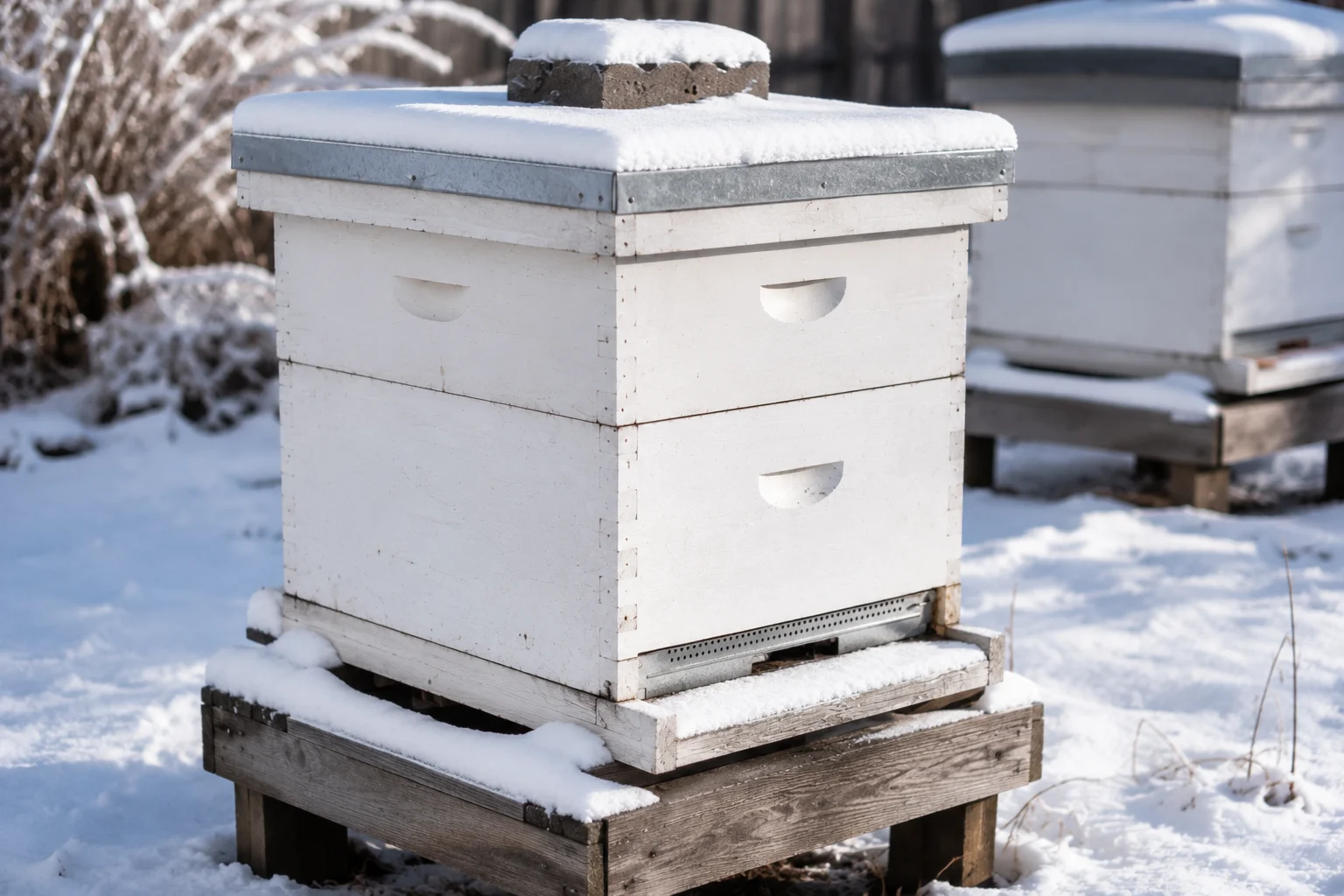
Snow on top of the hive requires no action. The hive roof handles normal snow loads. The insulating effect of snow can actually be mildly beneficial in extreme cold. Do not clear snow from the hive roof unless there is a structural concern about the weight on a damaged or non-standard roof.
Extended cold below 10°F (-12°C) in zones 4–5 warrants a check for entrance blockage and confirmation that the hive is upright and undisturbed by wind or wildlife. It does not warrant opening the hive. Colonies in a healthy cluster can survive temperatures well below 0°F (-18°C) inside a standard Langstroth with adequate stores and ventilation.
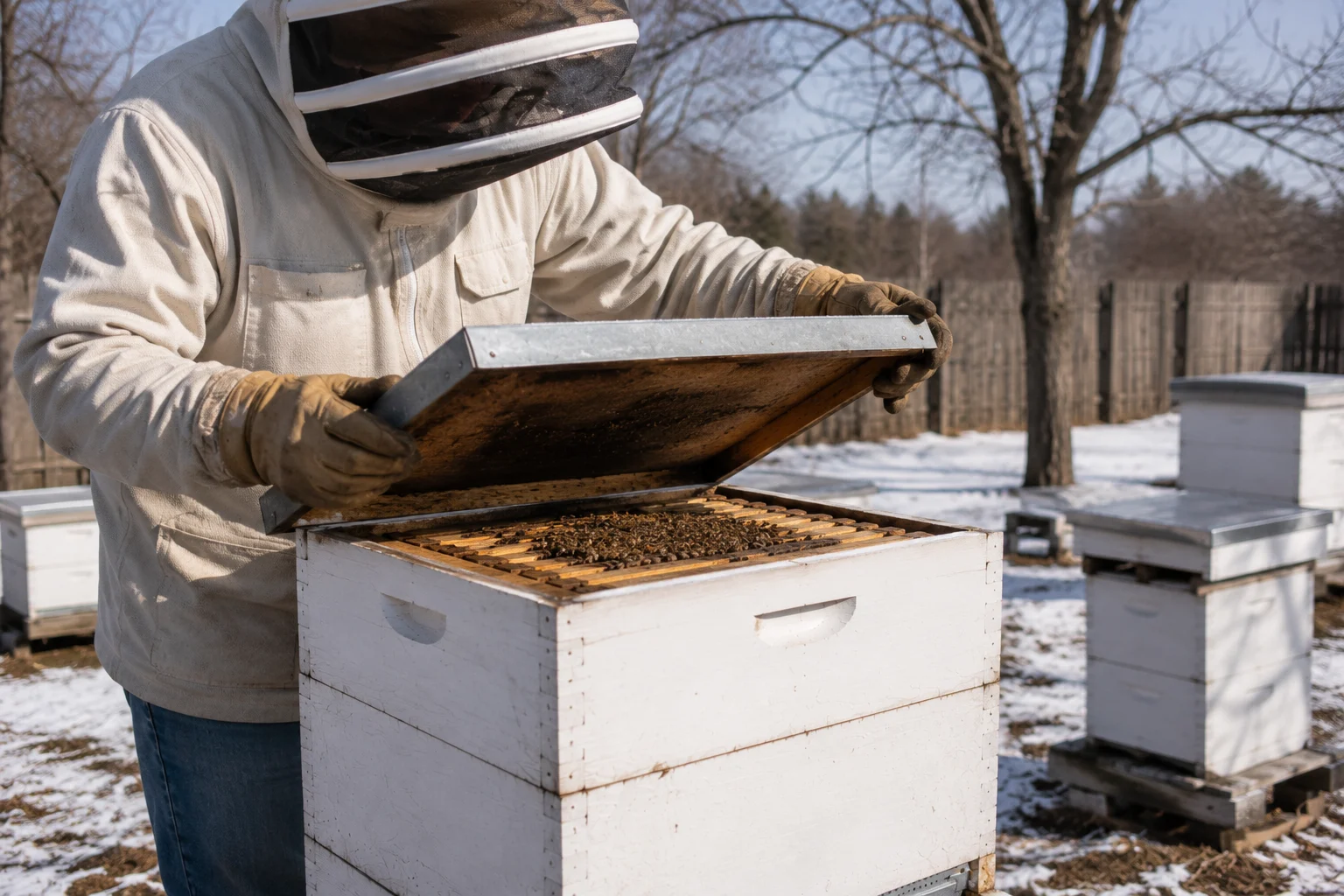
A mid-winter warm spell above 50°F (10°C) that lasts more than a day or two creates the conditions for a brief external inspection of the entrance and, if genuinely necessary, a quick lift of the inner cover to assess cluster position and add emergency feed. The cluster should not be disturbed unnecessarily even during warm spells, but a warm spell is the appropriate window for any intervention that requires lifting a cover.
The Hive Scale: The Gold Standard of Non-Invasive Winter Monitoring
For beekeepers managing multiple hives or interested in precise data rather than the approximate assessments of the heft test, a hive scale provides continuous, accurate weight data without any physical interaction with the colony.
A single hive scale under one representative hive in an apiary provides daily weight readings that show consumption rate precisely, identify abnormal consumption patterns that might indicate disease or absconding, and give advance warning of stores running critically low — often weeks before an emergency heft check would detect the problem.
Colony consumption in a healthy cluster in zones 4–6 typically runs at 15–30 lbs (7–14 kg) of honey per month through the coldest months, with lower consumption during the coldest periods (when the cluster is tight and metabolic rate is lower) and higher consumption in late winter as the colony begins spring buildup and brood rearing restarts. A hive losing weight faster than 30 lbs per month in mid-winter is either a very large colony, is experiencing abnormal conditions, or the scale data warrants investigation.
Bluetooth and WiFi-connected hive scales that send data to a smartphone app are available from several manufacturers and have become increasingly affordable. The data they provide is genuinely superior to any manual check method for tracking winter colony status without disturbing the bees.
What to Do if Something Looks Wrong
External checks identify problems; they rarely resolve them without further investigation. If a check raises genuine concern — the hive is silent across multiple knocks, the hive feels critically light, there is extensive entrance blockage, or unusual quantities of dead or distorted bees are present — the appropriate response depends on the temperature.
If temperatures are below 45°F (7°C): Add emergency carbohydrate feed — dry granulated sugar or fondant placed directly on the inner cover above the cluster — without opening the lower hive body. This addresses starvation risk without breaking cluster integrity. Do not attempt a full inspection in these conditions regardless of what the external check suggests.
If temperatures are above 50°F (10°C) for a sustained period: A brief examination of the top box is warranted. Lift the inner cover, look down into the top box, assess cluster position and size, check for obvious stores near the cluster, and replace the cover promptly. Keep this examination under two minutes. Smoke is generally not necessary or desirable for a brief winter check.
If the colony appears to have died: Confirm by looking through the entrance with a flashlight on a cold day. A dead cluster appears as a mass of dark, motionless bees, often with the typical pattern of heads in cells indicating starvation at the cluster edge. Do not remove or disturb the hive until you have properly assessed the cause of death — a disease diagnosis from the dead colony can inform your management of surviving hives. Contact your local state apiary inspector if you suspect American Foulbrood.
The spring inspection — when temperatures reliably reach 55–60°F (13–16°C) for several consecutive days and bees are actively flying — is the first opportunity for a complete assessment of colony condition. Signs of a failing or failed queen that emerged from winter should be assessed then using the diagnostic framework in How to Spot a Failing Queen in Your Beehive.
A Practical Winter Check Schedule
For a single-apiary beekeeper in zones 4–8, this schedule provides adequate monitoring without unnecessary disturbance.
Every 2 weeks throughout winter: Heft test, entrance check for blockage, listening test if no bees are visible. Note any changes from the previous check in writing — a log of heft observations is far more useful than individual data points.
After every significant snowfall: Entrance check only. Clear any snow blocking the entrance.
After any significant wind or wildlife disturbance: Visual check that the hive is upright, roof is secure, and entrance reducer is in place.
During any sustained warm spell above 50°F: Option for a brief inner cover lift if there is specific concern from previous checks. Add emergency feed if warranted by cluster position or heft observations.
Late February / early March (zones 6–8) or March / early April (zones 4–5): First proper inspection when bees are actively flying on warm days. Assess cluster size, brood presence, queen status, and remaining stores. This is the inspection that determines what intervention, if any, is needed to support the colony into spring.
The consistent discipline of the fortnightly check — even when nothing appears wrong — is what allows you to detect the gradual changes that indicate a developing problem before it becomes an unrecoverable one. Most winter colony losses are not sudden events. They are gradual processes that external monitoring, done consistently, can identify early enough to intervene. 🐝