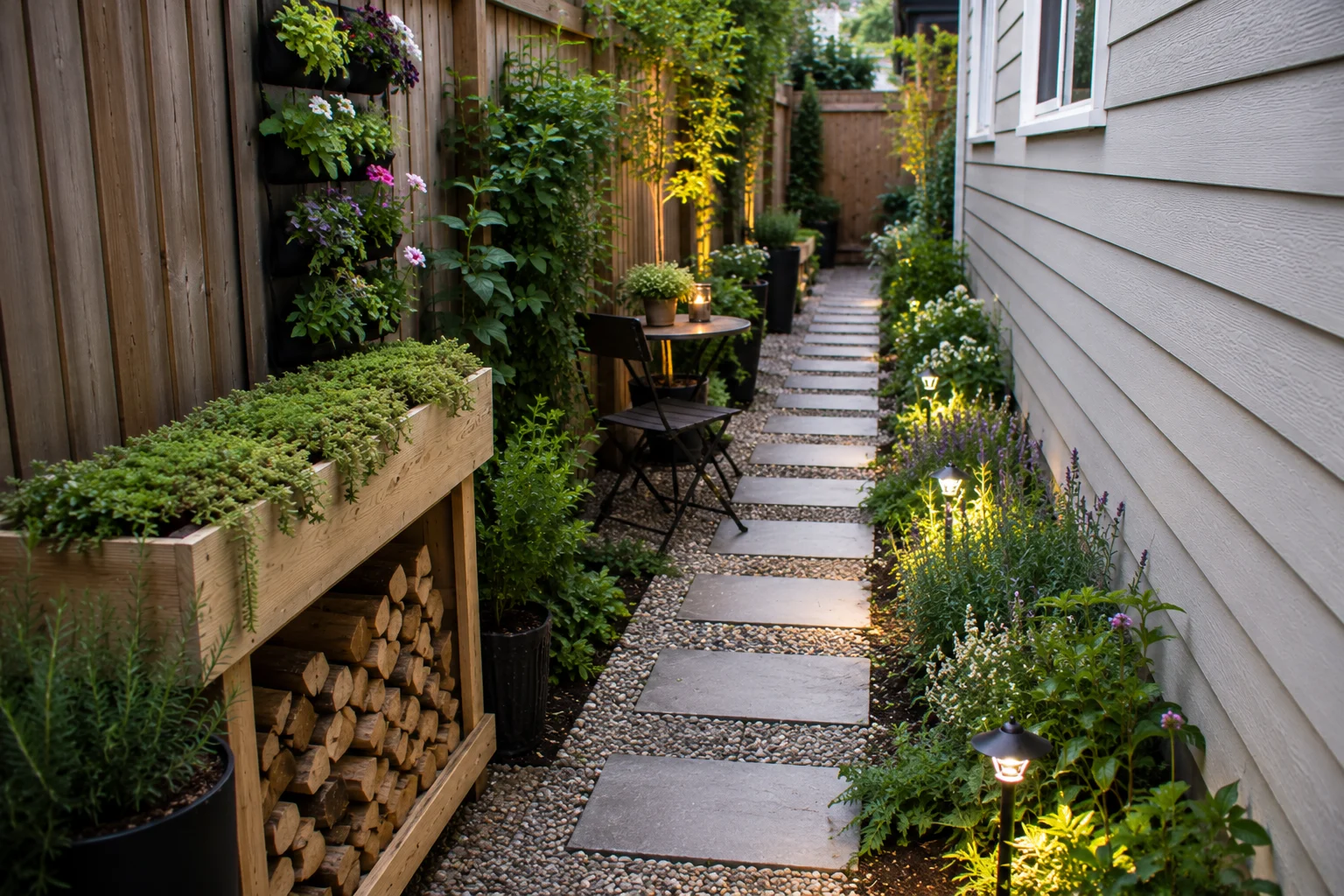

You do not need a lawn to grow flowers for bees.
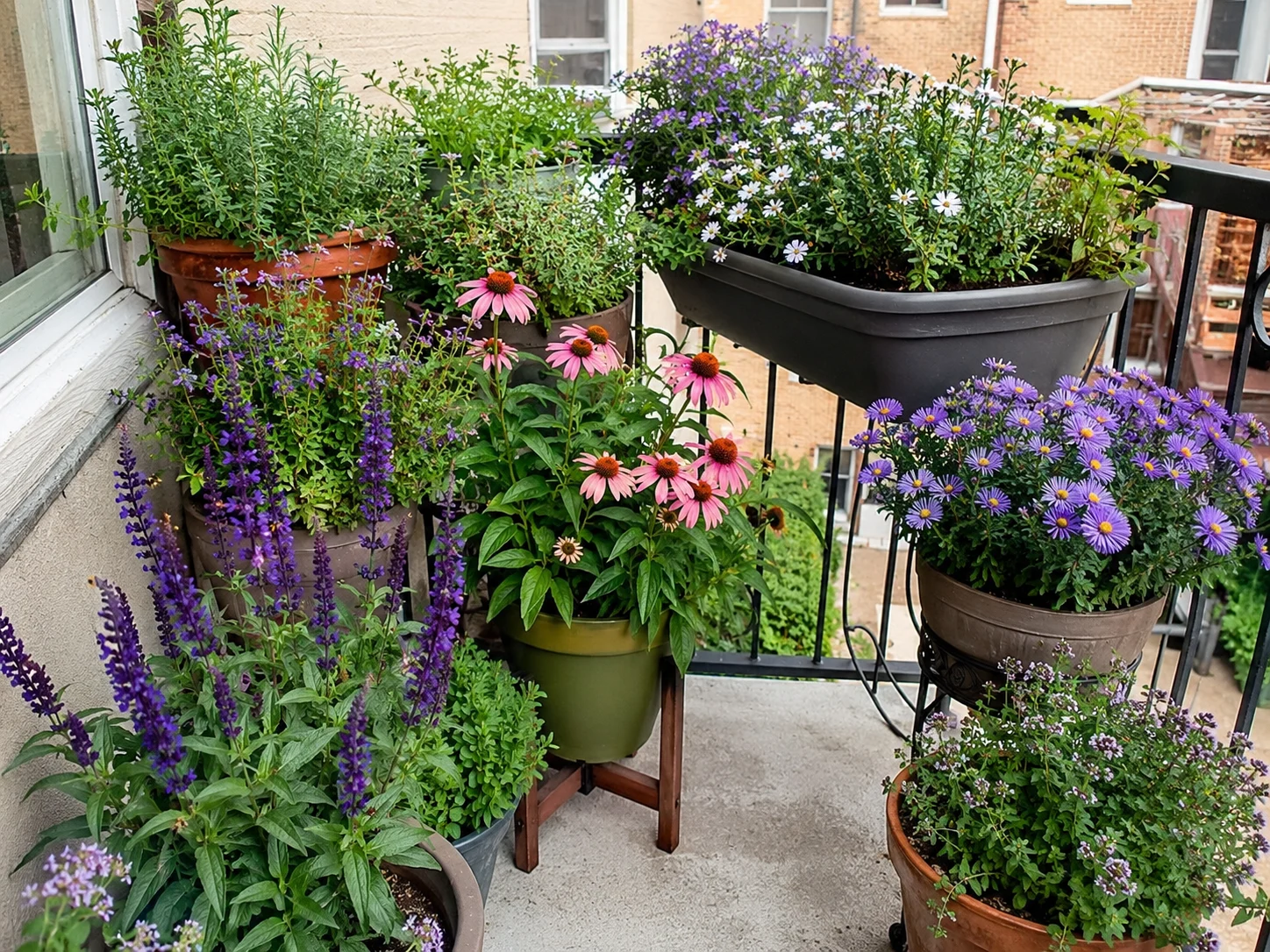
You do not need a large backyard, a meadow, or a permanent flower bed either. A sunny balcony, rooftop, porch, or patio can support a surprisingly active collection of bees, butterflies, hoverflies, and other insects when it contains the right plants.
But let’s kill the fantasy before it starts.
Three tiny pots of ornamental flowers will not “save the bees.” They will not feed an entire honeybee colony, replace lost habitat, or compensate for acres of flowerless landscaping.
They can still matter.
A well-designed container pollinator garden can provide concentrated nectar and pollen, fill seasonal bloom gaps, create a useful stopping point in an urban landscape, and introduce people with no soil access to real pollinator gardening. Even a few containers can attract pollinators to a porch or deck, while larger collections of pots can become substantial small-space habitat. (Penn State Extension)
The difference between a useful container garden and a decorative failure is simple:
You must design for pollinators first and pots second.
That means choosing accessible flowers, grouping them visibly, covering more than one season, avoiding pesticide-treated plants, providing enough root space, and keeping everything alive through summer.
What a Container Pollinator Garden Can Actually Do
Pollinators need more than random flowers.
They need nectar and pollen across the growing season, suitable shelter or nesting resources, and protection from pesticides. Xerces identifies those three elements—food, habitat, and pesticide protection—as the foundation of pollinator-friendly yards and gardens. (xerces.org)
Containers are strongest at providing food.
They can offer:
- Early flowers when surrounding landscapes are still sparse
- Summer nectar during hot, dry periods
- Late-season flowers when many gardens have stopped blooming
- Dense, visible groups that insects can find easily
- Herbs that feed both people and pollinators
- Host plants for selected butterfly caterpillars
- Small water sources on otherwise dry balconies
What they generally cannot provide well is large areas of undisturbed ground for soil-nesting bees. Many balconies also lack leaf litter, dead wood, hollow stems, and other natural nesting materials.
That does not make container gardening useless. It means the honest goal is to build a forage station, not pretend a balcony is an entire ecosystem.
Start by Reading the Balcony, Not the Plant Label
The fastest way to waste money is to buy plants before understanding the space.
Stand outside at several points during the day and record:
- How many hours of direct sun the area receives
- Whether that sun arrives in the morning or afternoon
- How strong the wind becomes
- Whether rain reaches the containers
- How quickly the surface heats up
- Where excess water can drain
- How much weight and floor space the balcony can safely support
- Whether building rules restrict planters, railing boxes, drainage, or hanging baskets
Many pollinator plants perform best with around six or more hours of direct sun, but a balcony receiving less light can still support a smaller range of shade-tolerant flowers. (Penn State Extension)
Full sun
Six or more hours of direct sunlight gives you the widest plant selection.
Good candidates may include:
- Salvia
- Mountain mint
- Coneflower
- Coreopsis
- Goldenrod
- Asters
- Lavender
- Thyme
- Oregano
- Zinnias
- Cosmos
- Borage
Part sun
Three to six hours of sun requires more careful selection.
Possible options include:
- Columbine
- Coral bells
- Woodland phlox
- Native violets
- Calico aster
- Certain native geraniums
- Mint
- Lemon balm
- Parsley allowed to flower
Deep shade
A balcony receiving almost no direct or bright indirect light is a weak site for a flower-heavy pollinator garden.
Do not buy sun-loving flowers and hope motivation will replace sunlight. It will not.
Either choose genuinely shade-adapted regional plants or accept that another gardening goal—foliage, mushrooms, houseplants, or herbs under supplemental lighting—may fit the space better.
Wind Is the Balcony Problem People Forget
A plant that behaves perfectly in a sheltered yard may get destroyed on a sixth-floor balcony.
Wind can:
- Topple narrow pots
- Snap tall stems
- Dry potting mix rapidly
- Tear large leaves
- Damage flowers
- Knock railing planters loose
- Push containers across smooth flooring
Illinois Extension recommends broad, stable containers for exposed balconies and warns that top-heavy pots and plants are especially vulnerable. It also advises checking with an architect or building authority before placing very heavy containers on balconies or rooftops. (Illinois Extension)
For windy spaces:
- Use wide pots rather than narrow decorative urns
- Keep taller plants near a protected wall
- Choose compact or sturdy-stemmed varieties
- Secure railing boxes properly
- Avoid loose hanging baskets over public areas
- Group pots so they shelter one another
- Use a permeable screen rather than a solid panel that creates violent turbulence
- Stake only when necessary
Do not balance a heavy planter on a railing because it looks good in a photograph. That is not garden design. It is a liability.
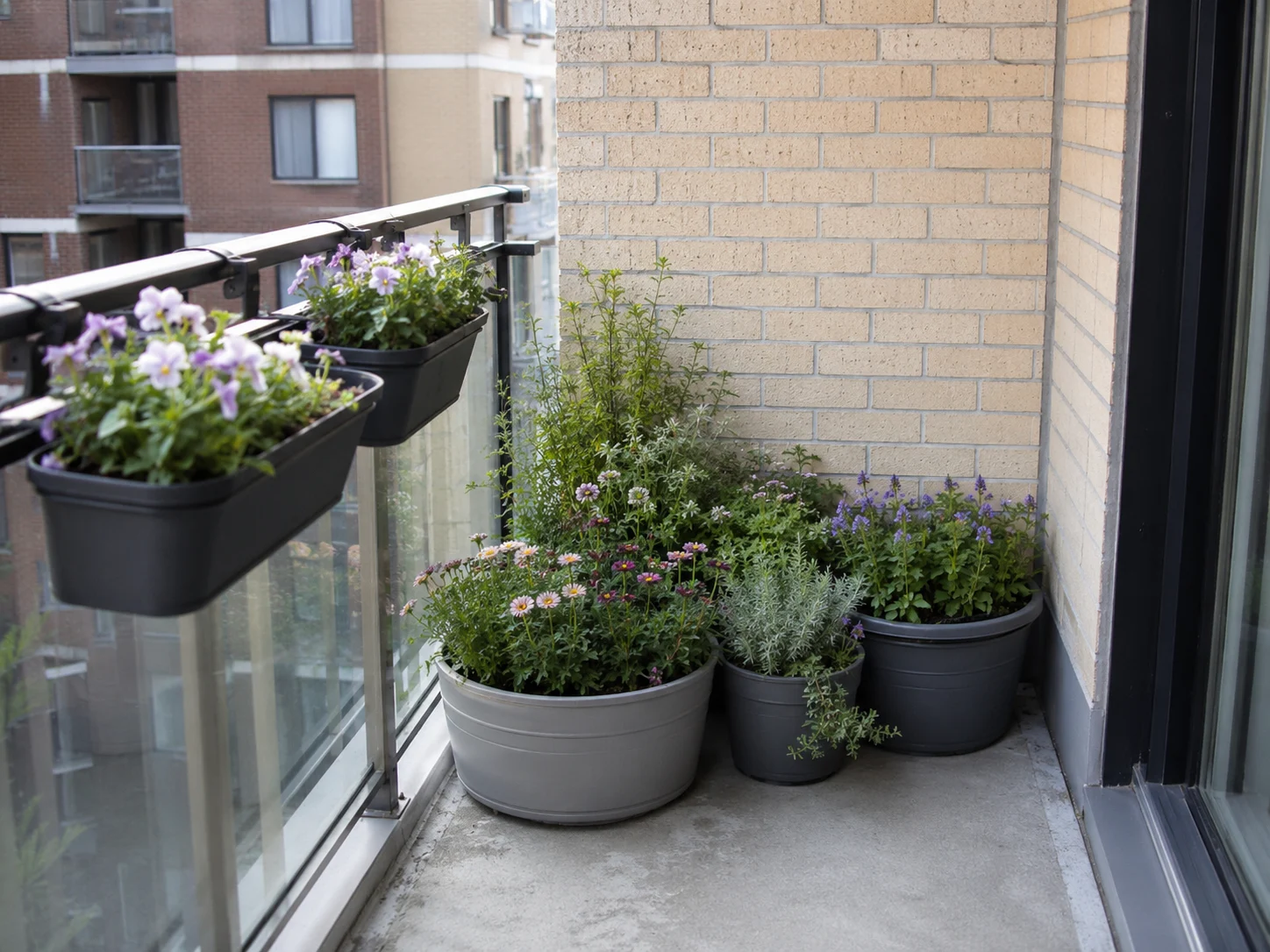
Choose Bigger Containers Than You Think You Need
Small pots are seductive because they are cheap, light, and easy to arrange.
They are also the source of endless summer failure.
The smaller the soil volume, the faster it heats up and dries out. Tiny pots can go from adequately moist to severely dry within hours during hot weather. Larger containers hold more water, provide more root space, and are usually more stable in wind. (Illinois Extension)
Use small pots for:
- Thyme
- Compact annuals
- Short seasonal displays
- Seedlings that will later be transplanted
Use medium or large pots for:
- Salvia
- Catmint
- Asters
- Goldenrod
- Coneflowers
- Mountain mint
- Lavender
- Mixed herb plantings
- Perennials intended to return next year
Deep-rooted or moisture-demanding plants need more soil than their nursery pots suggest.
A practical container collection usually performs better with five substantial pots than with 25 tiny ones that require constant rescue.
Drainage Is Non-Negotiable
Every permanent outdoor container needs working drainage holes.
Without drainage, water collects around the roots, reduces available oxygen, and can lead to root decline or rot. Illinois Extension recommends multiple drainage holes where practical and watering thoroughly until excess water exits the bottom. (Illinois Extension)
Do not add a thick gravel layer to “improve drainage.” That common trick does not fix a pot without adequate holes and can reduce the useful soil volume. (Penn State Extension)
Use:
- A quality container potting mix
- Containers with open drainage holes
- Saucers only where necessary to protect the surface
- Pot feet or small supports if water cannot escape beneath the container
Do not fill balcony pots with dense garden topsoil. It is often too heavy and poorly aerated for containers. Use a quality soilless or container mix instead. (University of Minnesota Extension)
Build a Bloom Relay, Not One Pretty Weekend
The biggest weakness in most container gardens is timing.
People visit a nursery in May, buy everything flowering that day, and create a balcony that looks excellent for three weeks. Then every flower fades together.
A useful container pollinator garden needs plants that take turns.
Divide the season into at least three periods:
- Spring
- Summer
- Late summer and fall
Xerces recommends regionally appropriate plants that match the growing conditions and provide useful forage without harmful pesticide exposure. (xerces.org)
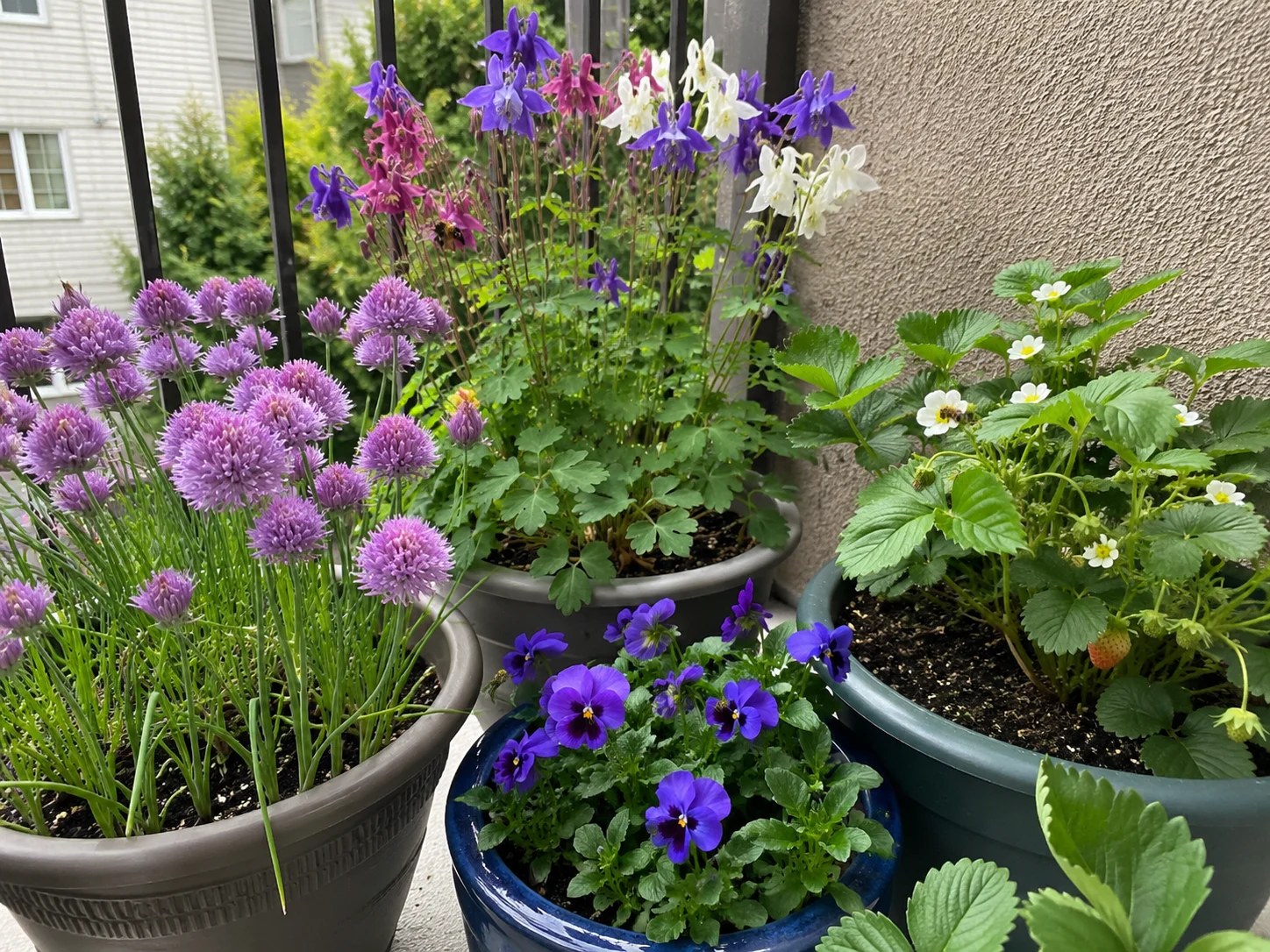
Spring Container Plants
Spring container plants help early-active bees before summer annuals reach full size.
Possible choices include:
Chives
Chives are compact, cold-hardy in many regions, and produce round purple flowers. The leaves are useful in the kitchen, but you must allow some flower stalks to remain if pollinators are supposed to benefit.
Columbine
Regional native columbines can perform well in medium containers and provide early flowers with an airy form that does not overwhelm a balcony.
Native violets
Violets fit low containers and shaded corners. Their early flowers can provide nectar and pollen when fewer other plants are available. (University of Minnesota Extension)
Strawberries
Strawberries provide flowers and fruit while fitting planters, hanging containers, and window boxes. Choose varieties suited to your region and container conditions.
Spring bulbs
Crocus, species tulips, grape hyacinth, and other bulbs can start the season, but choose carefully. Some ornamental hybrids provide little accessible forage.
Bulbs can be planted beneath later-emerging perennials so the container does not become empty after spring.
Summer Container Plants
Summer is when the balcony should become visibly active.
Salvia
Salvias produce upright flower spikes and are frequently visited by bees, butterflies, and hummingbirds. Compact annual and perennial types can work especially well in containers. (University of Minnesota Extension)
Mountain mint
A container is one of the smartest places to grow a spreading mountain mint.
It receives enough root space to create a useful patch but cannot travel across the entire garden. Choose a species whose mature height suits the balcony.
Catmint
Catmint flowers for a long period, tolerates containers, and can be cut back after its first flush to encourage fresh growth.
Do not confuse catmint with every aggressive culinary mint. Standard mint species are best kept in their own pots because they spread rapidly.
Coneflower
Compact coneflower varieties can work in larger containers. Avoid extreme double-flowered forms if accessible pollen and nectar are the priority.
Coreopsis
Compact coreopsis provides bright flowers and generally handles heat well once established.
Bee balm
Shorter bee balm selections can work in large containers with consistent moisture and good airflow. Tall forms may become unstable in wind.
Borage
Borage grows quickly from seed and produces blue flowers visited by bees. It can become bulky, so give it its own pot or enough room in a large mixed container.
Zinnias
Zinnias provide long summer bloom and are attractive to pollinators, particularly butterflies. Single and semi-double forms generally make the flower center easier to access than dense double forms. (University of Minnesota Extension)
Cosmos
Cosmos can provide prolonged bloom but may grow too tall and floppy for a windy balcony. Select compact forms or place them in sheltered positions.
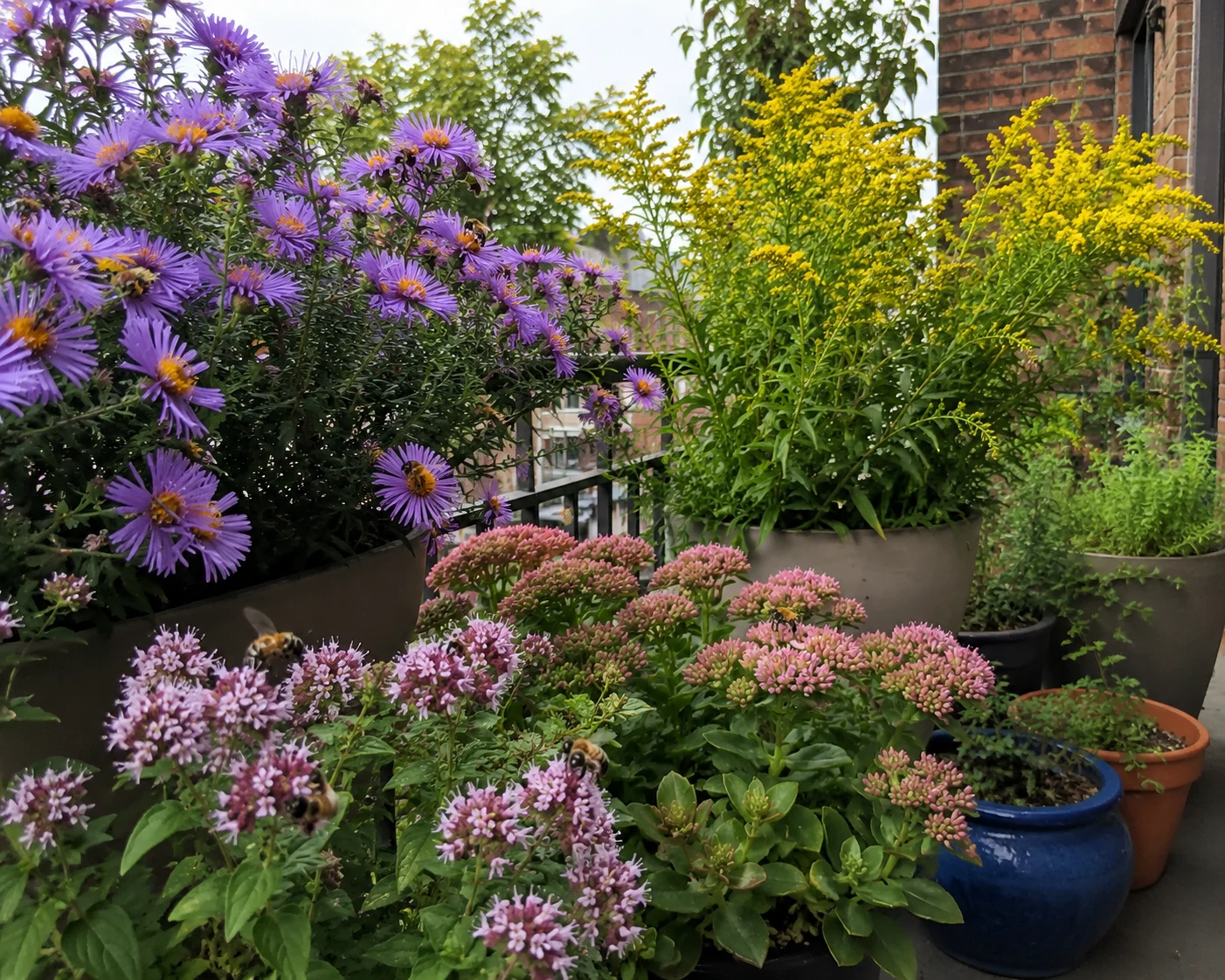
Late-Summer and Fall Container Plants
This is where your garden becomes useful rather than merely attractive.
Many balconies look colorful in June and dead by September. Late-flowering plants extend forage when fewer surrounding flowers remain.
Native asters
Compact native asters can flower heavily in containers and provide late-season nectar and pollen. Select species or cultivars appropriate for your region and pot size.
Goldenrod
Goldenrod is not only for large meadows. Compact, clump-forming species and cultivars can work in sizable containers.
Do not put an aggressive six-foot spreading goldenrod into a narrow balcony pot and then complain that goldenrod is difficult. You selected the wrong plant.
Sedum
Late-blooming sedums tolerate dry conditions and fit sunny containers. They are useful additions, although they should not be the only late-season forage.
Anise hyssop
Anise hyssop can flower for a long period and works in a large container, but taller types need wind protection.
Herbs left in flower
Oregano, thyme, basil, mint, sage, and other herbs can continue providing flowers after you stop harvesting every stem.
Many culinary herbs are useful to pollinators and other beneficial insects when allowed to bloom. (Penn State Extension)
The Best Herbs for a Balcony Pollinator Garden
Herbs are ideal for beginners because they provide a clear human benefit even before they flower.
Use:
- Chives
- Thyme
- Oregano
- Sage
- Basil
- Mint
- Lemon balm
- Lavender where climate and drainage allow
- Parsley
- Dill
- Fennel in a large, stable pot
There is one catch:
You must let some of them bloom.
A basil plant cut back every week gives you pesto, but almost no flowers. The solution is to divide the plantings:
- Harvest one pot regularly
- Let another portion flower
- Replace aging annual herbs gradually
- Deadhead selectively rather than stripping every bloom
Parsley, dill, and fennel may also function as caterpillar host plants for some swallowtail butterflies. The caterpillars may eat substantial foliage. That is not plant failure. That is the habitat doing its job.
Three Simple Container Garden Plans
Stop buying plants individually without knowing how they fit together.
Use one of these frameworks.
Plan 1: The Three-Pot Seasonal Relay
Best for a small sunny balcony.
Pot 1: Spring
- Chives
- Native violet or low columbine
- Spring bulbs beneath them
Pot 2: Summer
- Compact salvia
- Thyme around the edge
- Borage or short coreopsis
Pot 3: Fall
- Compact native aster
- Small clump-forming goldenrod
- Trailing oregano
This plan will not guarantee uninterrupted flowering, but it gives each major season a dedicated container.
Plan 2: The Hot Patio Herb Garden
Best for full sun and fast-draining conditions.
Use separate medium containers for:
- Lavender
- Thyme
- Oregano
- Sage
- Salvia
- Sedum
Do not combine plants with radically different water needs in the same pot. Lavender and thyme do not want to share constantly wet soil with moisture-demanding bee balm.
Plan 3: The Part-Shade Balcony
Best for morning sun or bright filtered light.
Use:
- Columbine
- Coral bells
- Native violet
- Woodland phlox
- Calico or shade-tolerant aster
- Mint in its own pot
- Flowering parsley
The result may attract fewer bees than a sunny garden, but it can still contribute useful flowers.
Plan 4: The Five-Container Pollinator Balcony
For a more substantial setup:
- Spring pot: chives, violets, bulbs
- Herb pot: thyme, oregano, sage
- Summer pot: salvia and compact coreopsis
- Midsummer pot: mountain mint or bee balm
- Fall pot: native aster and compact goldenrod
This is the container version of the seasonal approach used in Overwhelmed by Your Garden? Start With These 5 Plants—Then Add Everything Else.
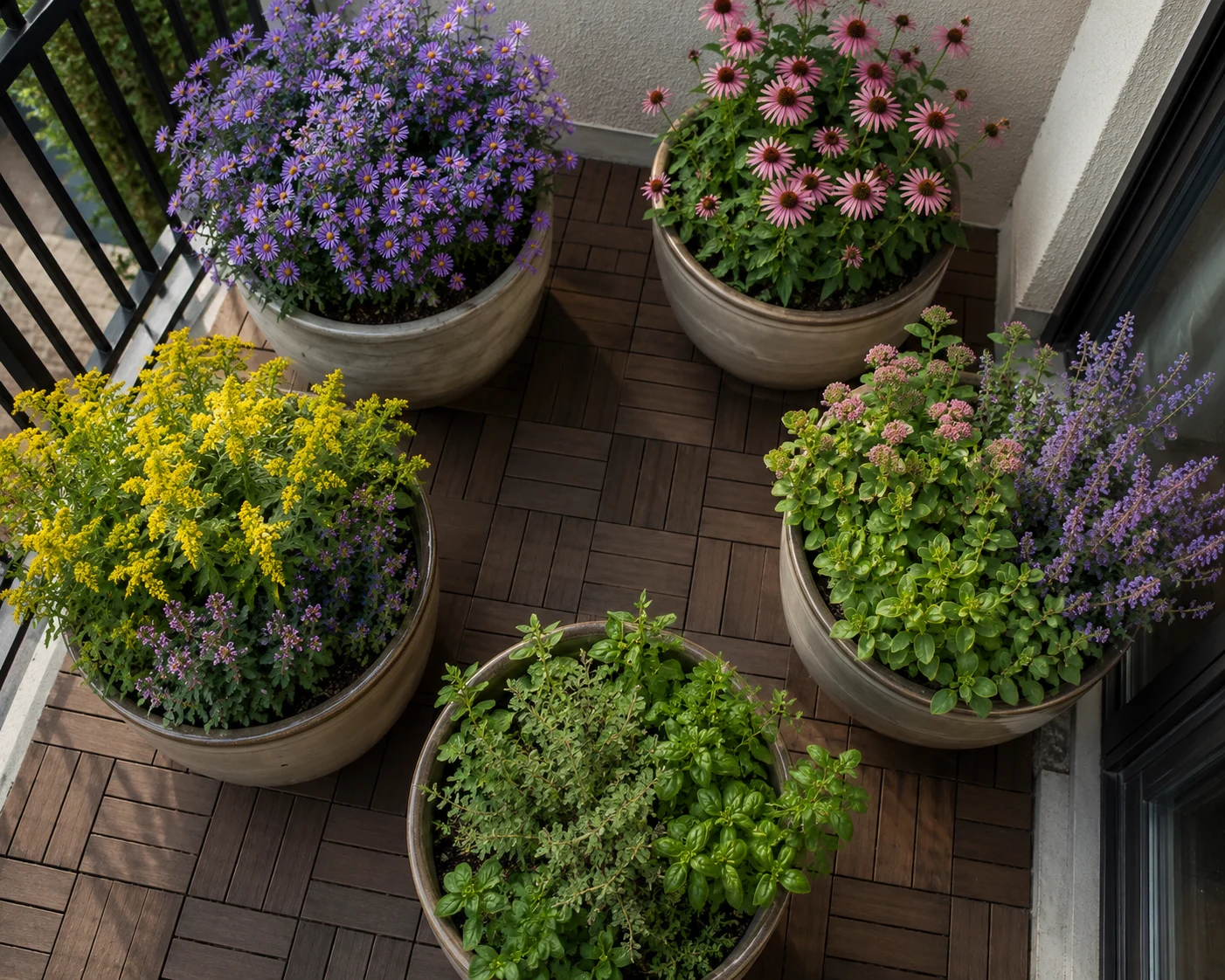
Plant in Groups Bees Can Actually Notice
One flower here and one flower there may look charming to you. It creates a weak visual and foraging signal for insects.
Instead of planting ten unrelated species, repeat a smaller number:
- One generous salvia container
- One broad patch of thyme
- One substantial mountain mint pot
- Two matching aster containers
- Several railing boxes repeating the same compact flower
Grouping flowers makes them easier to locate and gives pollinators more reward before they need to move elsewhere.
You do not need botanical chaos.
You need visible, repeated food sources.
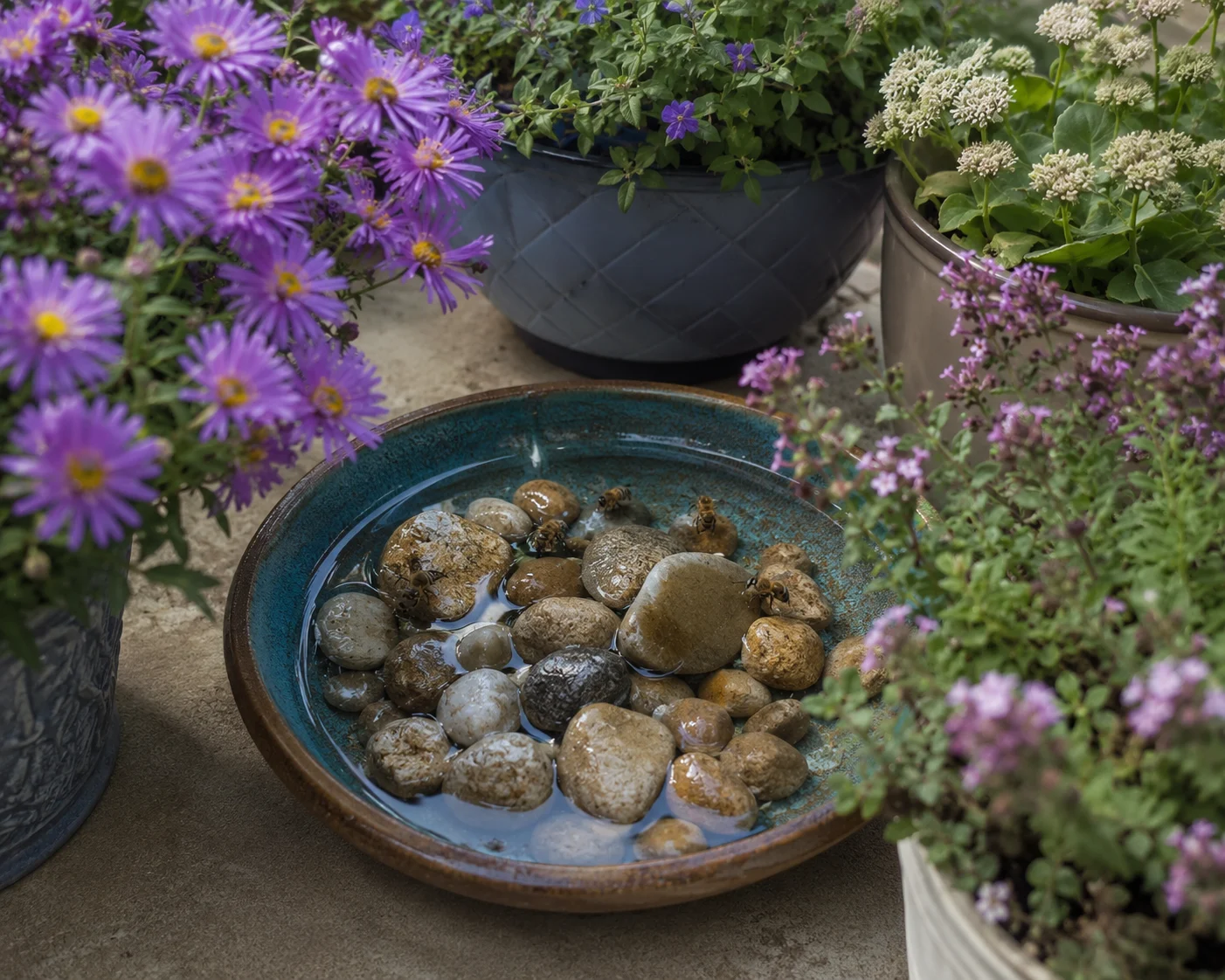
Add a Water Source Carefully
A balcony water source can help insects, but poorly managed standing water can become filthy, leak onto neighbors, or support mosquito development.
Use:
- A shallow dish
- Stones, pebbles, or cork pieces as landing surfaces
- A small amount of water
- Frequent cleaning and refilling
- A stable location away from the edge
- No deep exposed container in which insects can drown
Do not create a stagnant bucket and call it wildlife habitat.
Change or refresh the water frequently, scrub accumulated algae when necessary, and ensure overflow cannot damage the building or fall onto people below.
Watering Is the Real Maintenance Problem
Container plants cannot send roots deep into the ground during heat.
Their entire water supply is limited to what the pot holds. Hot surfaces, reflected heat, sun, and wind can dry containers rapidly.
Illinois Extension recommends checking containers frequently and watering thoroughly so the full root ball becomes moist and water exits the drainage holes. Porous containers such as unglazed clay and fabric generally dry faster than plastic or glazed pots. (Illinois Extension)
Do not water on a rigid calendar.
Check the soil.
During mild spring weather, a large pot may remain moist for several days. During a hot, windy week, the same container may need water daily.
Useful tactics include:
- Using larger pots
- Grouping containers
- Adding a thin organic mulch layer
- Watering early in the day
- Installing drip irrigation where allowed
- Using self-watering containers for thirsty plants
- Moving vulnerable pots out of extreme afternoon heat
- Choosing drought-tolerant plants for exposed sites
Do not interpret “pollinator plant” as “plant that survives neglect in a tiny pot.”
Feeding the Plants Without Producing Weak Growth
Container plants eventually use the nutrients available in the potting mix.
However, excessive fertilizer can produce tall, soft, leafy growth with fewer flowers and weak stems. It can also cause plants to outgrow their containers rapidly.
Use fertilizer according to the specific plant and product directions.
A slow-release container fertilizer or diluted liquid feed may be appropriate, particularly for annuals that flower continuously. Many native perennials need less feeding.
The goal is healthy flowering, not forcing every plant into oversized growth.
Avoid Pesticide-Contaminated Plants
A plant labeled “bee-friendly” may still have been treated with systemic insecticides during production.
Xerces recommends selecting plants suited to the region and site while asking nurseries about pesticide practices. Pollinator habitat should be protected from pesticide exposure rather than built from contaminated flowers. (xerces.org)
Before buying, ask:
- Were systemic insecticides used?
- Was the plant treated while flowering?
- Does the nursery identify pesticide-free or organic stock?
- Is the plant locally native or at least non-invasive?
- Are the flowers single and accessible?
- Will the mature plant actually fit the container?
Do not spray broad-spectrum insecticide over a flowering balcony because you saw three aphids.
Aphids can often be removed with water, hand wiping, pruning, or tolerated until predators arrive. Start with the least disruptive solution.
Avoid Double Flowers and Sterile Decoration
Many highly modified flowers prioritize petal count over accessible pollen and nectar.
Dense double blooms can hide or replace the flower structures insects need. That does not mean every ornamental cultivar is worthless, but you should inspect the flower rather than trusting marketing.
Prefer:
- Single blooms
- Open centers
- Visible pollen-bearing structures
- Several flower shapes
- Plants that insects are actively visiting at the nursery
One useful test is brutally simple:
Are pollinators using it?
A flower can look perfect and still provide almost nothing.
What to Do in Winter
Perennial plants in containers face colder root conditions than the same plants growing in the ground. Above-ground pots can approach winter air temperature, so Penn State recommends selecting container perennials rated roughly two hardiness zones colder than the local climate when they will remain outdoors. (Penn State Extension)
Possible winter strategies include:
- Grouping pots in a sheltered location
- Wrapping or insulating containers
- Moving dormant pots into an unheated garage or shed
- Sinking pots into the ground where possible
- Mulching around grouped containers
- Choosing large frost-resistant pots
- Continuing occasional winter moisture checks
- Treating some plants as annuals and replacing them
Illinois Extension notes that grouping pots, sheltering them from wind, mulching, or storing dormant perennials in cool protected spaces can improve survival. (Illinois Extension)
Do not move cold-hardy dormant perennials into a heated living room unless the plant is suited to indoor conditions. Many need winter dormancy, not tropical treatment.
Also check whether the pot itself can survive freezing. Water trapped in unsuitable ceramic containers can crack them.
Common Container Pollinator Garden Mistakes
Using pots that are too small
Tiny containers dry out fast and restrict root growth.
Buying only plants currently in bloom
This builds a one-season garden.
Ignoring wind
Tall plants and hanging baskets can become dangerous on exposed balconies.
Blocking drainage
A decorative pot without holes is a plant coffin.
Mixing incompatible plants
Do not place moisture-loving plants and drought-tolerant herbs in the same container.
Harvesting every herb before it flowers
No flowers means no pollinator forage.
Choosing only dense double blooms
Pretty does not automatically mean useful.
Using systemic pesticides
A contaminated flower is not habitat.
Overloading the balcony
Wet soil is heavy. Consult building rules or a qualified professional before installing large, heavy containers on an elevated structure. (Illinois Extension)
Expecting three pots to feed a colony
Your balcony is one patch in a much larger landscape. Build it honestly and make the patch as useful as possible.
A Practical Shopping List
For a sunny beginner balcony, start with:
- Three to five containers at least medium-sized
- Quality container potting mix
- Stable saucers or drainage protection
- One early-flowering plant
- Two long-blooming summer plants
- One flowering herb
- One late-season aster or compact goldenrod
- A shallow water dish
- Organic mulch
- A watering can or hose attachment
- Secure supports for any railing planters
A possible plant combination:
- Chives
- Compact salvia
- Mountain mint
- Thyme
- Native aster
Do not buy 18 plants on day one.
Build the first group, observe the sun and watering demand, then expand.
Conclusion: Small Space Is Not the Problem
The absence of a yard is not what ruins a pollinator garden.
Bad plant choices, tiny pots, poor drainage, one-season bloom, and dead plants in July ruin it.
A balcony or patio can become a useful flowering station when you:
- Choose plants suited to the actual light and wind
- Use containers large enough to support them
- Create a spring-to-fall bloom sequence
- Repeat flowers in visible groups
- Let herbs bloom
- Provide clean shallow water
- Avoid pesticides
- Protect perennial roots through winter
- Keep the garden manageable enough to maintain
Your container pollinator garden will not replace a meadow.
It does not need to.
It only needs to turn an empty hard surface into a reliable patch of flowers that was not there before.
That is real improvement—and it can start with five pots.
Keep Reading 🐝
- Overwhelmed by Your Garden? Start With These 5 Plants—Then Add Everything Else — use the same five-role method in a permanent garden bed.
- Best Plants to Grow Near a Backyard Beehive — expand your seasonal plant selection for larger spaces.
- The July Nectar Crash: Why Your Hive Can Struggle in Midsummer — understand why summer-flowering balcony plants matter.
- The No-Mow May Survival Guide: What to Let Grow and What to Pull — create pollinator habitat when you have both containers and lawn.