
A single flowering tree can feed more bees in one bloom cycle than an entire bed of perennials — but plant the wrong species too close to a house, a patio, or a sewer line, and you’ll spend years dealing with cracked pavement or invasive root repairs instead. Trees like silver maple, willow, and poplar are excellent forage plants, which is exactly why they get recommended so often — but their aggressive, shallow, water-seeking root systems make them a poor fit for most residential lots.
This list solves that problem directly: 18 trees that genuinely support bees, butterflies, and other pollinators, all chosen specifically for root systems that behave well near structures, patios, and underground utilities. They’re organized by size, so whether you have a tiny front yard or room for a real shade tree, there’s a workable option below.
What “Non-Invasive Roots” Actually Means
Two different things get lumped under “invasive” when people talk about tree roots, and it’s worth separating them:
- Invasive species — trees that spread aggressively into wild areas and displace native plants (Bradford pear and tree-of-heaven are common examples).
- Aggressive root structure — trees with shallow, fast-spreading roots that seek out water lines, septic systems, and foundations regardless of whether the species itself is invasive (willow, silver maple, and poplar are the classic offenders here).
This list avoids both categories. Every tree below has either a deep taproot system, a compact and well-contained root spread, or root behavior gentle enough to plant within normal distance of hardscaping — generally 8–10 feet from foundations and further from septic lines, though local guidance always takes precedence over general rules of thumb.
Small Ornamental Trees for Tight Spaces
These stay under 25 feet at maturity and work well in small yards, near patios, or as understory plants beneath larger trees.
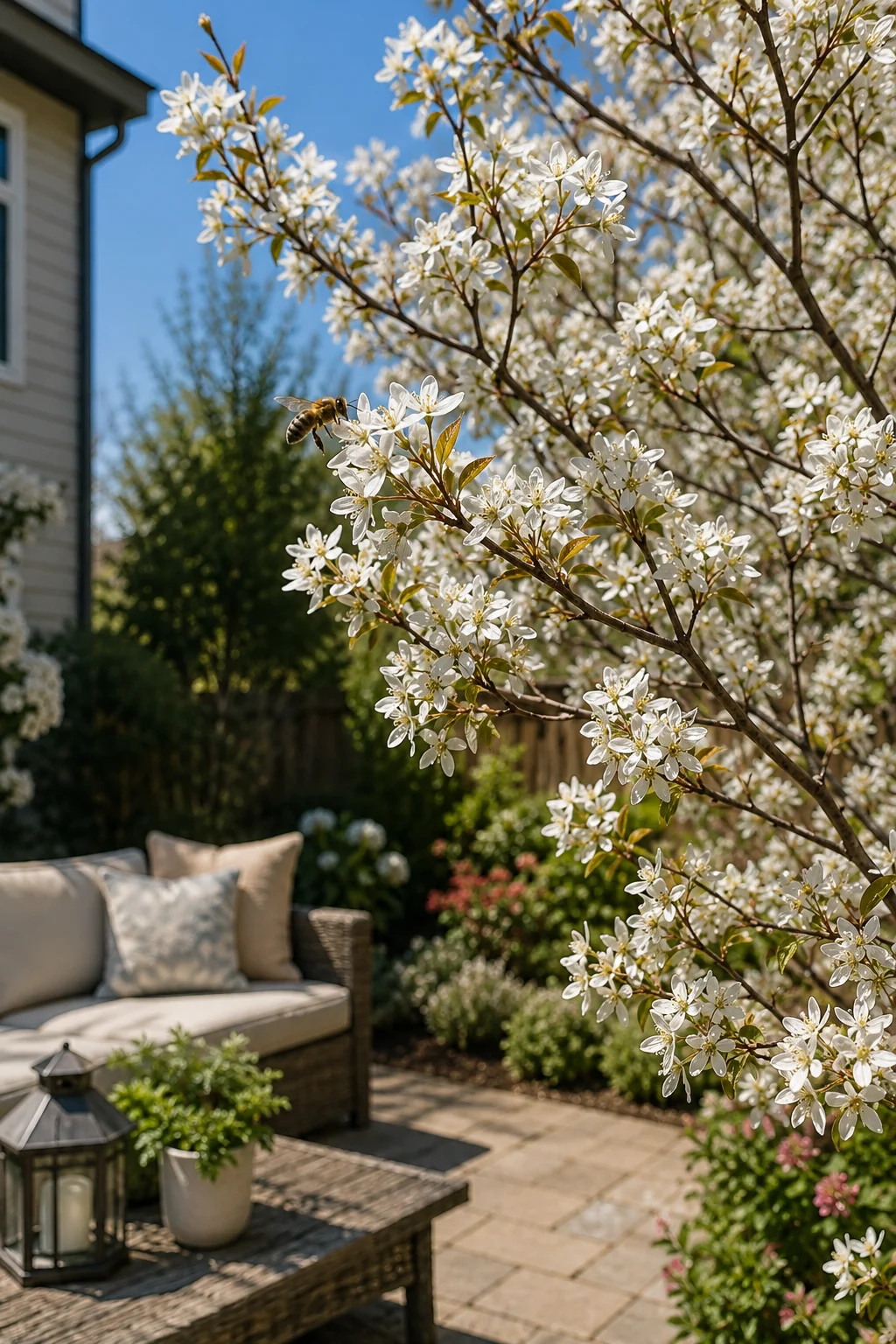
- Serviceberry (Amelanchier) — Early spring white blossoms feed bees before almost anything else is blooming, and a fibrous, well-contained root system makes it safe near foundations.
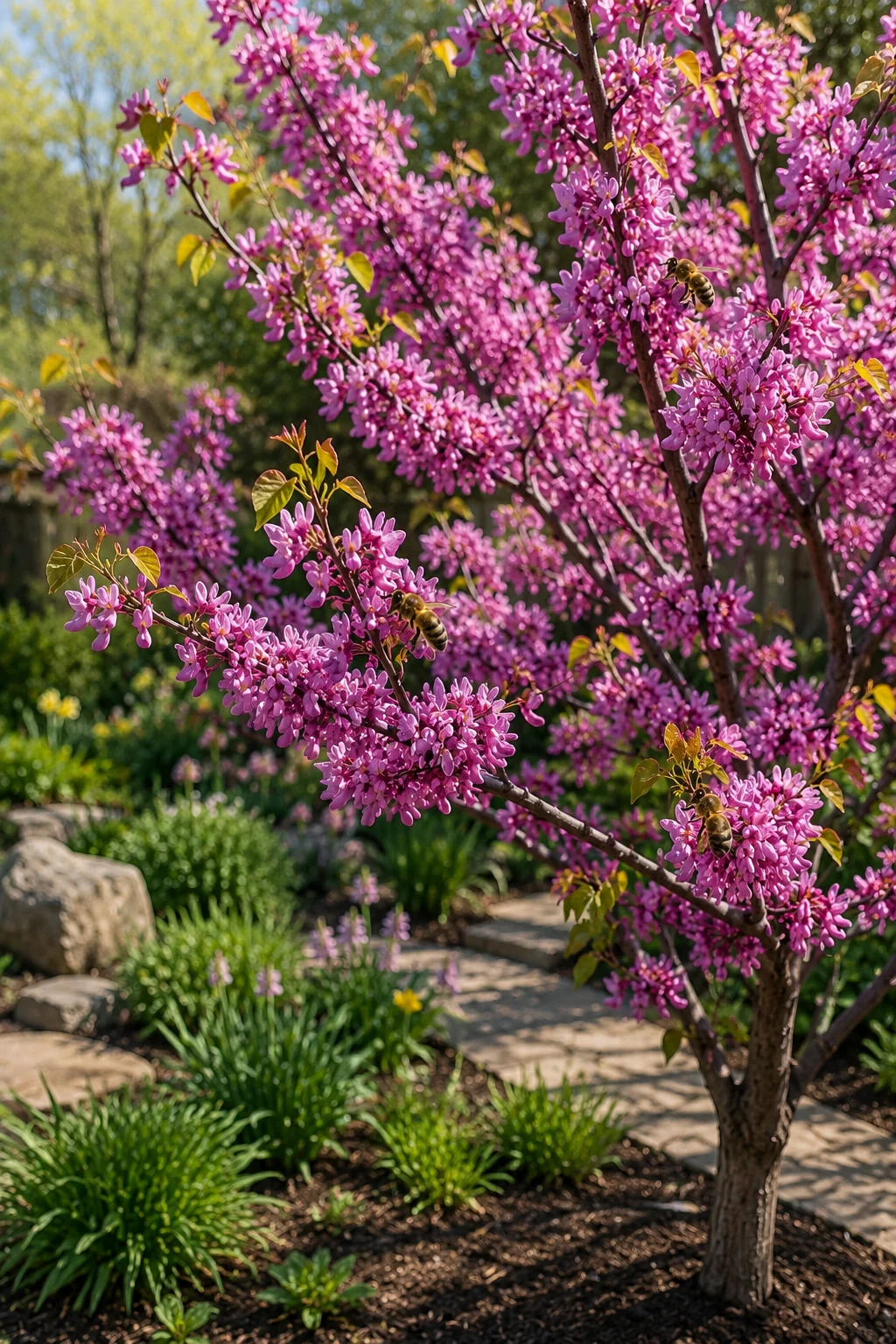
- Eastern redbud (Cercis canadensis) — Pink-purple flowers cover bare branches in early spring; roots stay compact and rarely cause hardscape problems.
- Star magnolia (Magnolia stellata) — An early, fragrant bloomer with a naturally shallow but non-aggressive root system, well suited to smaller front yards.
- Fringetree (Chionanthus virginicus) — Fragrant, feathery white flowers in late spring and a slow-growing, well-behaved root structure that tolerates close planting.
- Crape myrtle (Lagerstroemia) — A long summer bloom season and roots that stay contained enough for foundation planting in warmer climates.
- Japanese maple (Acer palmatum) — Modest, early-season bloom that bees use before the foliage fully unfurls, with one of the most compact, non-invasive root systems of any small ornamental tree.
Medium Flowering Trees
These reach 25–40 feet and can anchor a larger border or side yard without threatening nearby structures.
- Sourwood (Oxydendrum arboreum) — Produces long, drooping clusters of bell-shaped summer flowers that bees favor heavily, with a deep taproot rather than a spreading surface system.
- Sweetbay magnolia (Magnolia virginiana) — Fragrant summer blooms and a fibrous root system that behaves far better near hardscaping than its larger cousin, southern magnolia.
- Golden rain tree (Koelreuteria paniculata) — Bright yellow summer flower panicles draw heavy bee traffic, and it tolerates close urban planting without disrupting pavement.
- Seven-son flower (Heptacodium miconioides) — A late-summer to fall bloomer that fills a forage gap most trees miss, with a manageable, non-aggressive root spread.
- Crabapple (Malus species) — Reliable spring bloom, a wide range of compact cultivars bred for small yards, and roots that stay well-contained compared to full-size apple trees.
- Katsura tree (Cercidiphyllum japonicum) — Subtle spring flowers followed by outstanding fall color, paired with a root system considered one of the more polite among medium ornamental trees.
Larger Canopy Trees With Deep, Non-Invasive Roots
If you have the space for a genuine shade tree, these options provide real canopy without the foundation risk associated with maples, willows, or poplars.
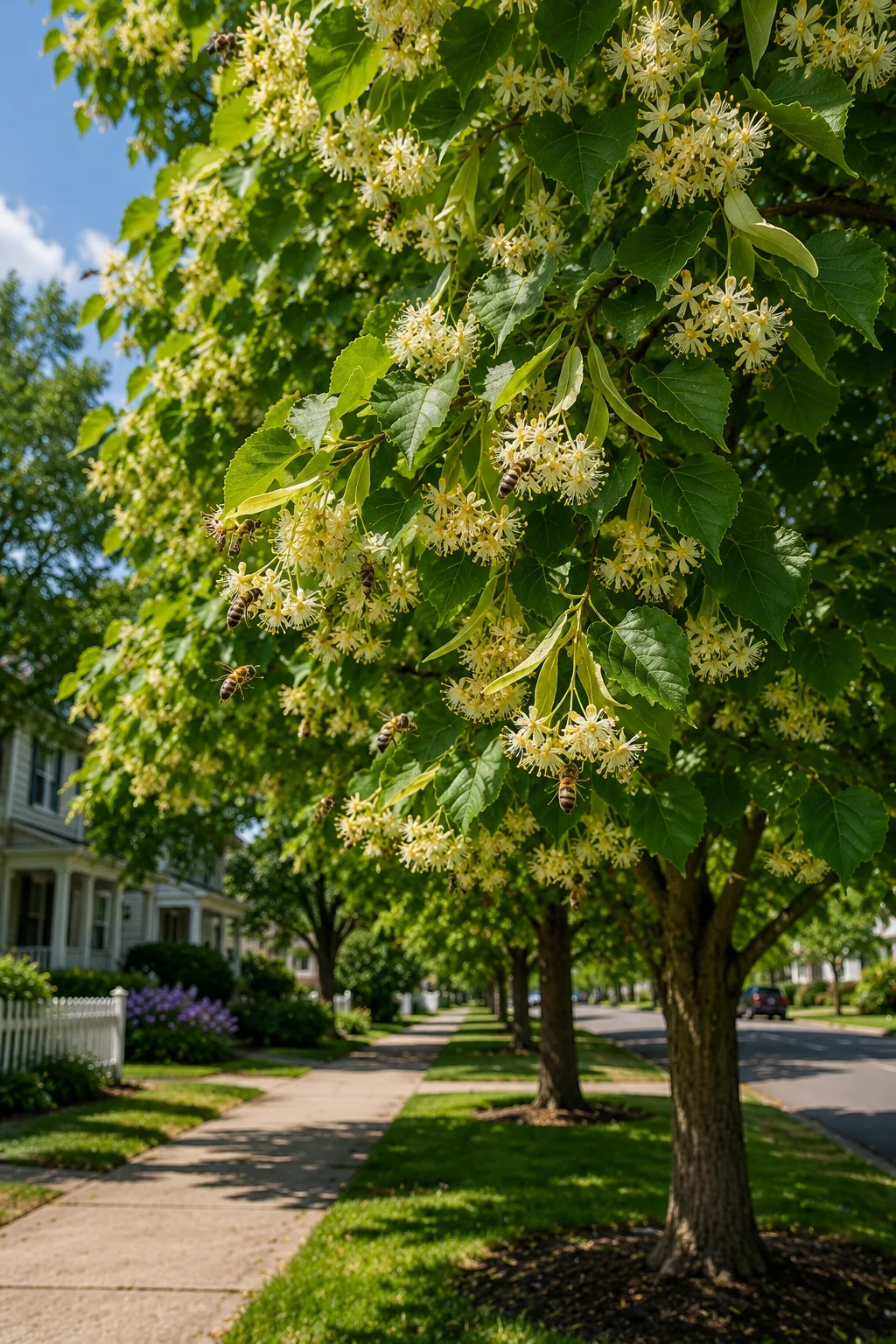
- Littleleaf linden (Tilia cordata) — Among the best bee trees available; its small, intensely fragrant summer flowers can produce a noticeable honey flow, and its root system is deep and non-aggressive.
- American hornbeam (Carpinus caroliniana) — Early spring catkins provide pollen for emerging bees, and its slow growth pairs with a naturally restrained root structure.
- Tulip tree (Liriodendron tulipifera) — A tall native with large, nectar-rich yellow-green flowers prized by bees; it relies on a deep taproot rather than the shallow spread seen in similarly sized shade trees.
- Black gum (Nyssa sylvatica) — Small, easily overlooked spring flowers are a strong early nectar source, and this native’s deep taproot makes it one of the safer large shade trees for planting near a yard’s usable space.
- Persian ironwood (Parrotia persica) — Small but pollen-rich late-winter blooms, exceptional fall color, and a root system that stays well-behaved even in confined urban planting strips.
- Japanese stewartia (Stewartia pseudocamellia) — Camellia-like summer flowers, striking peeling bark for winter interest, and a compact, non-invasive root system suited to smaller lots than most large-flowering trees.
Trees Worth Avoiding Near Structures
A few well-known “bee trees” are worth flagging specifically because they’re so often recommended without a root-behavior warning attached:
- Silver maple and willow — Both are excellent early forage sources but are notorious for shallow, water-seeking roots that damage pipes, foundations, and pavement.
- Poplar and cottonwood — Fast-growing and useful for windbreaks at a distance, but their aggressive surface roots make them unsuitable close to any structure.
- Black locust — A strong bee forage tree, but it suckers aggressively and can send new shoots up through nearby lawns and beds.
None of these need to be ruled out entirely — they can work well planted well away from hardscaping, particularly as part of a windbreak. For guidance on integrating larger trees into a boundary planting at a safe distance, our multi-layered hedgerow guide covers how tree placement fits into a wider layered design.
Where to Plant These Trees for Maximum Pollinator Value
Getting the species right solves the root problem, but placement still affects how useful the tree is to pollinators:
- Plant in full sun where possible — most of these trees flower more heavily with at least six hours of direct sun.
- Underplant with low groundcover rather than turf, extending the forage value of the space beneath the canopy; our guide to ground cover plants for pollinators pairs well with several of the smaller trees on this list.
- Position larger canopy trees to provide afternoon shade for a hive, if you keep bees — a well-placed tulip tree or linden can double as both forage and the shade structure discussed in our hive heatwave protection guide.
- Use small ornamental trees as a design anchor, the same focal-point role covered in our backyard garden design guide.
According to tree-selection guidance published by university extension arboriculture programs, matching root habit to planting distance is one of the most overlooked factors in residential tree selection, often causing more long-term cost than species hardiness or pest resistance combined (Missouri Botanical Garden Plant Finder).
Final Thoughts
A pollinator-friendly tree doesn’t have to come with a foundation-repair bill attached. Serviceberry and redbud handle small spaces beautifully; linden and tulip tree offer serious shade-tree presence without the shallow, aggressive roots of maple or willow; and mid-size options like sourwood and golden rain tree fill in everything between. Choose based on your available space and root clearance first, bloom season second, and you’ll end up with a tree that feeds pollinators for decades without ever threatening your patio, pipes, or foundation.