
Every yard in America has a boundary. Most of them are made of wood, vinyl, chain-link, or concrete block — materials chosen for privacy and durability, installed and then largely ignored for decades. They do one thing reasonably well. They block the view. Everything else they do is neutral at best and ecologically negative at worst: they heat up in summer, they exclude wildlife, they contribute nothing to soil health, and they require periodic replacement at significant cost.
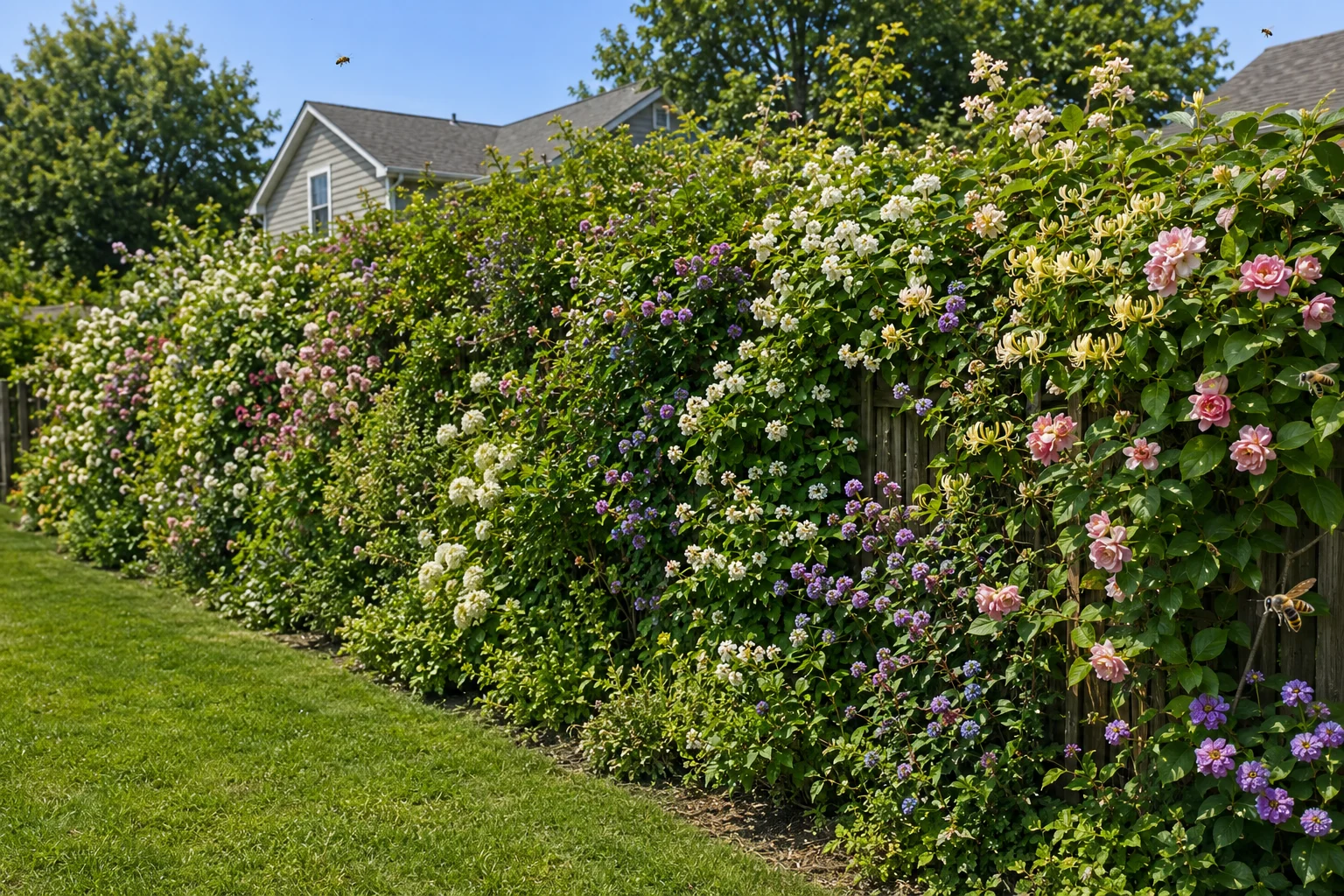
There is a better boundary. One that screens your yard as effectively as any wooden fence, establishes within two to four years to full height, requires less long-term maintenance than a painted fence, increases in value rather than deteriorating over time, provides habitat for birds and beneficial insects, actively improves your soil through root activity and leaf fall, and — for beekeepers specifically — delivers a continuous season-long forage resource that a wooden fence categorically cannot.
The living fence — a planted boundary of flowering shrubs, native hedgerow species, climbing plants, and mixed woody perennials — is one of the most underutilized design tools in the American garden. In Europe, the tradition of planted boundary hedgerows dates back centuries and continues to define the visual and ecological character of the agricultural landscape. In America, the wooden privacy fence became culturally dominant in the postwar suburban expansion and has been the default choice ever since — despite the availability of planted alternatives that outperform it on almost every measure except installation simplicity.
This post is your complete guide to designing, planting, and managing a living fence for a US yard. We’ll cover the design principles that make a living fence effective as a privacy screen, the specific plant species that deliver the highest combined value for both privacy and bee forage, how to sequence the planting for rapid establishment, how a living fence functions as an apiary windbreak and fly-up barrier, the bloom calendar across the whole structure from March to November, and a practical implementation plan that takes you from bare boundary to established living fence in three seasons.
Why a Living Fence Outperforms a Wooden Fence on Almost Every Metric
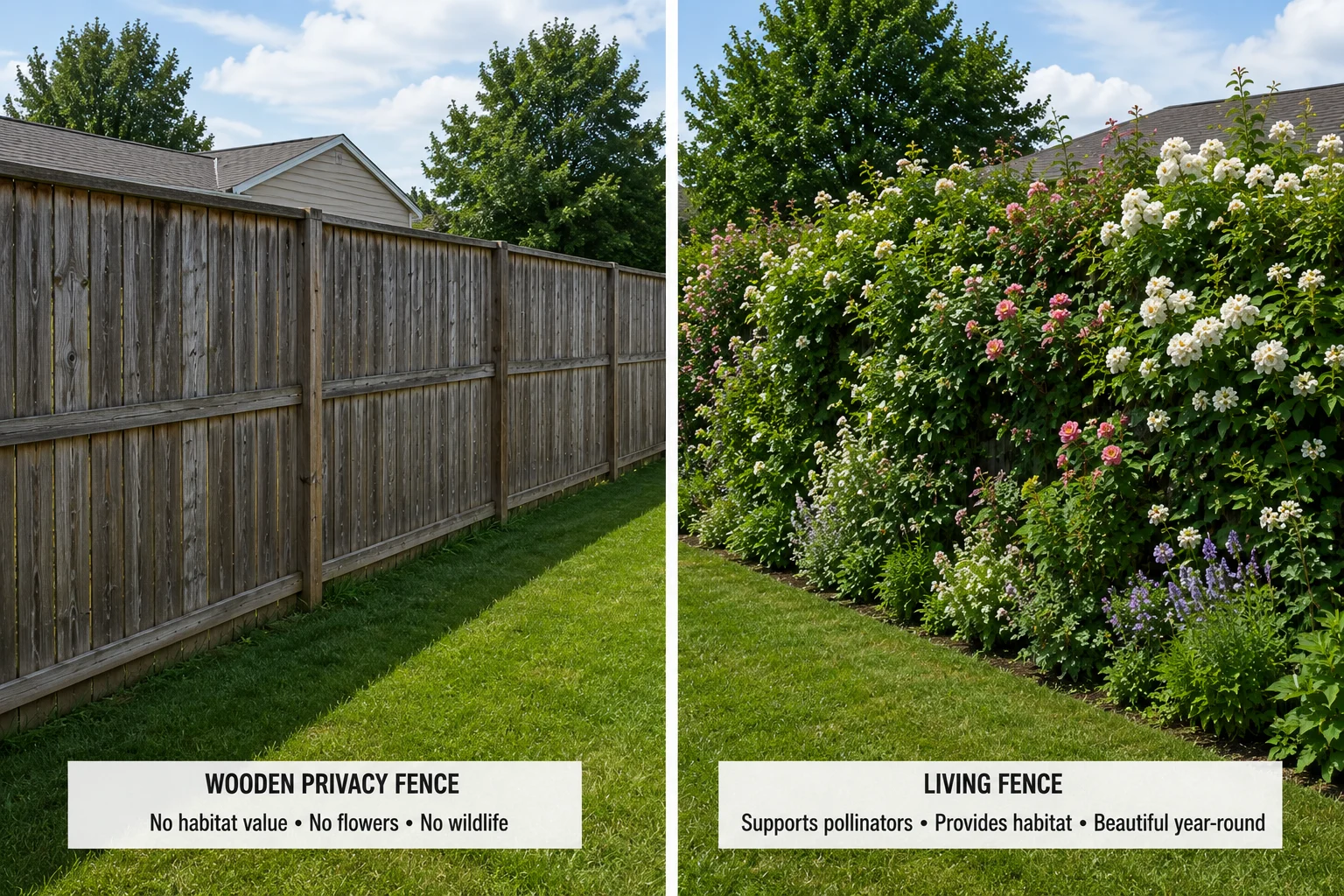
The comparison between a planted living fence and a conventional wooden privacy fence is worth making explicitly, because the advantages of the living fence are genuinely substantial and most homeowners have never been presented with the full picture.
Privacy screening: A mature mixed hedgerow of the species covered in this post reaches 6–8 feet in height and develops a density that is opaque to view year-round when the evergreen component is correctly proportioned. The visual screening of a well-established living fence is comparable to a 6-foot wooden privacy fence — and unlike a wooden fence, a living fence continues to improve in screening effectiveness as it matures, rather than deteriorating.
Cost: The initial installation cost of a planted living fence is typically lower than a quality wooden privacy fence of equivalent length. A 50-foot wooden privacy fence costs $1,500–$3,000 installed. The same length in planted hedgerow shrubs costs $300–$800 in plant material plus labor or your own time. The 10-year maintenance cost comparison is even more favorable to the living fence — no staining, no replacing rotted boards, no structural repairs.
Lifespan: A quality wooden fence has a functional lifespan of 15–25 years before structural replacement becomes necessary. A living fence, properly established, is essentially permanent and increases in ecological value with every passing decade. A 50-year-old hedgerow supports dramatically more biodiversity than a 5-year-old one. A 50-year-old wooden fence is landfill.
Ecological value: A wooden fence supports essentially no native species. A living fence of the species covered in this post supports honeybees, bumblebees, native solitary bees, butterflies, moths, beetles, spiders, small mammals, and dozens of songbird species simultaneously. It improves soil biology through root exudates and leaf litter. It sequesters carbon. It manages stormwater through root absorption. It moderates the local microclimate through transpiration cooling. These are not trivial benefits.
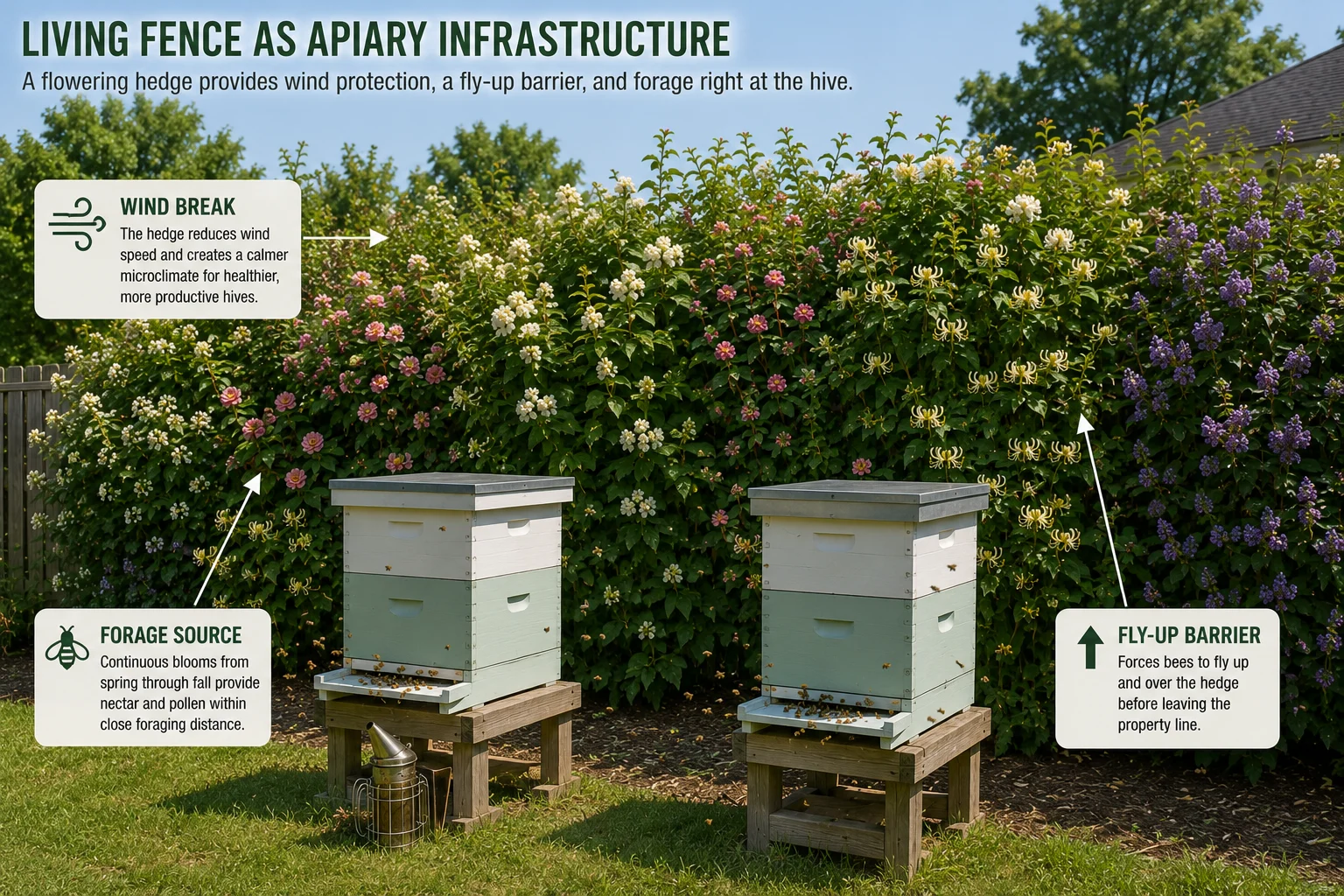
Beekeeping-specific value: For beekeepers, a living fence along the property boundary serves three functions simultaneously: it provides a windbreak that shelters hives from prevailing winds (covered in detail in the complete guide to apiary layout mistakes including the critical importance of windbreak positioning; it acts as a fly-up barrier that encourages foragers to gain altitude before crossing the property line; and it provides a rich, varied forage resource within the closest possible foraging distance to the hive.
The Architecture of a Living Fence: Three Layers That Work Together
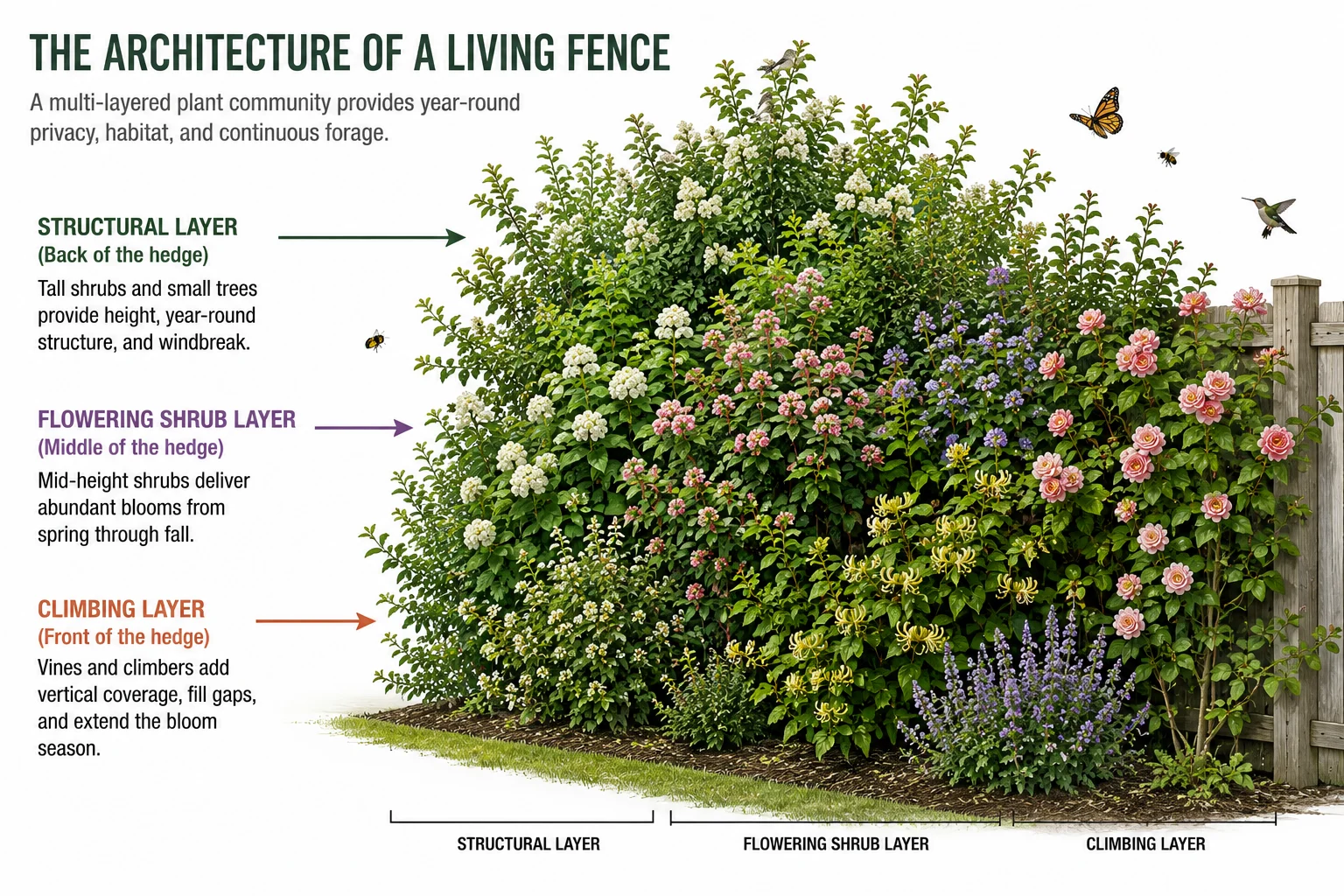
The most effective living fences — the ones that achieve full privacy screening, maximum wildlife value, and the greatest forage diversity — are built in three distinct structural layers that work together as a system rather than as a collection of individual plants.
Understanding this layered architecture before you choose a single species is the most important design decision you’ll make. A living fence that is all one height or all one species will be less dense, less ecologically rich, and less interesting than one that uses the three-layer system to create a structure with genuine depth and complexity.
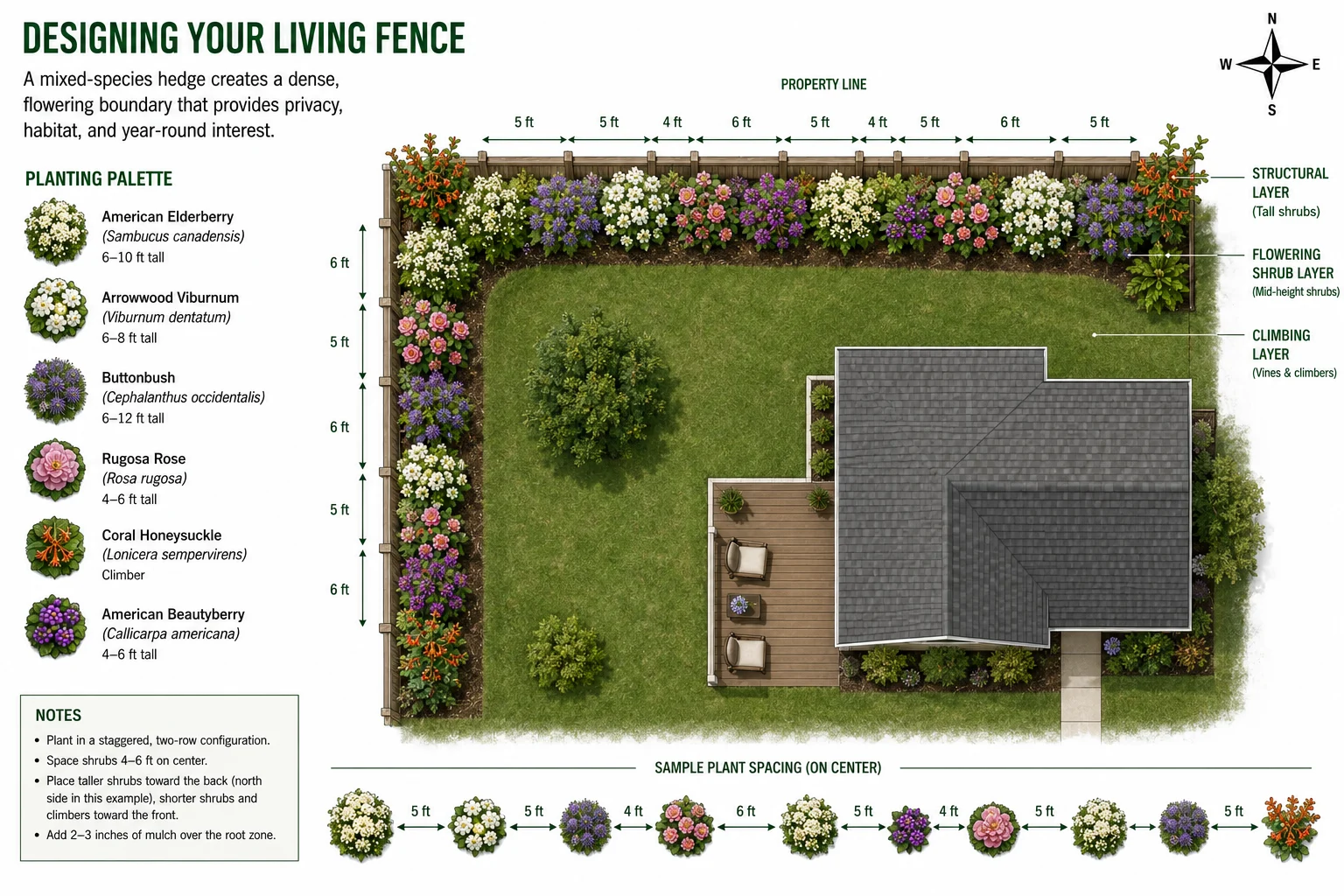
The structural layer forms the backbone of the fence — the tallest, densest plants that provide the primary privacy screening and the windbreak function. These are typically large flowering shrubs or small trees that reach 8–12 feet at maturity and develop a dense woody structure that screens year-round. In a US context, the best structural layer species include native viburnums, elderberry, American hazelnut, native hollies, and — in warmer regions — native wax myrtle. The structural layer is planted at the back of the boundary and forms the primary visual screen.
The flowering shrub layer sits in front of the structural layer and provides the majority of the bee forage value — these are medium-height species (4–7 feet) that produce generous quantities of nectar and pollen across a long bloom season. Native clethra, native buttonbush, rugosa roses, native spicebush, flowering quince, and native viburnums in their smaller forms all belong in this layer. This is the layer that makes the living fence visually spectacular in bloom and ecologically productive for pollinators.
The climbing and weaving layer uses the structure created by the first two layers as a support system. Climbing plants — native honeysuckle, native clematis, Virginia creeper in its less aggressive forms, climbing prairie roses — are woven through the shrub layer to fill visual gaps, add additional bloom periods, and create the final density of screening that makes the living fence opaque to view. This layer also adds significant wildlife value through berry production and nesting cover.
The total depth of a three-layer living fence is typically 3–5 feet from front to back — wider than a wooden fence but narrower than most people imagine when they hear the word “hedgerow.” In a yard where boundary space is at a premium, a simplified two-layer version (structural plus flowering shrub) achieves 80% of the privacy and forage value in a depth of 2–3 feet.
The Best Species for a US Living Fence: A Region-by-Region Guide
The single most important principle in living fence plant selection for a US context is native species first. The Xerces Society for Invertebrate Conservation maintains regional native plant lists for every US state — an invaluable free resource for confirming which species are native to your specific area before you spend a dollar on plants. Native plants have co-evolved with native bee species over millions of years, providing pollen and nectar in forms that native bees are anatomically and physiologically optimized to utilize. Many native bee species are specialist foragers — they can only raise their larvae on pollen from specific plant genera — and a living fence built primarily from native species supports this specialist diversity in ways that a fence of introduced ornamentals cannot.
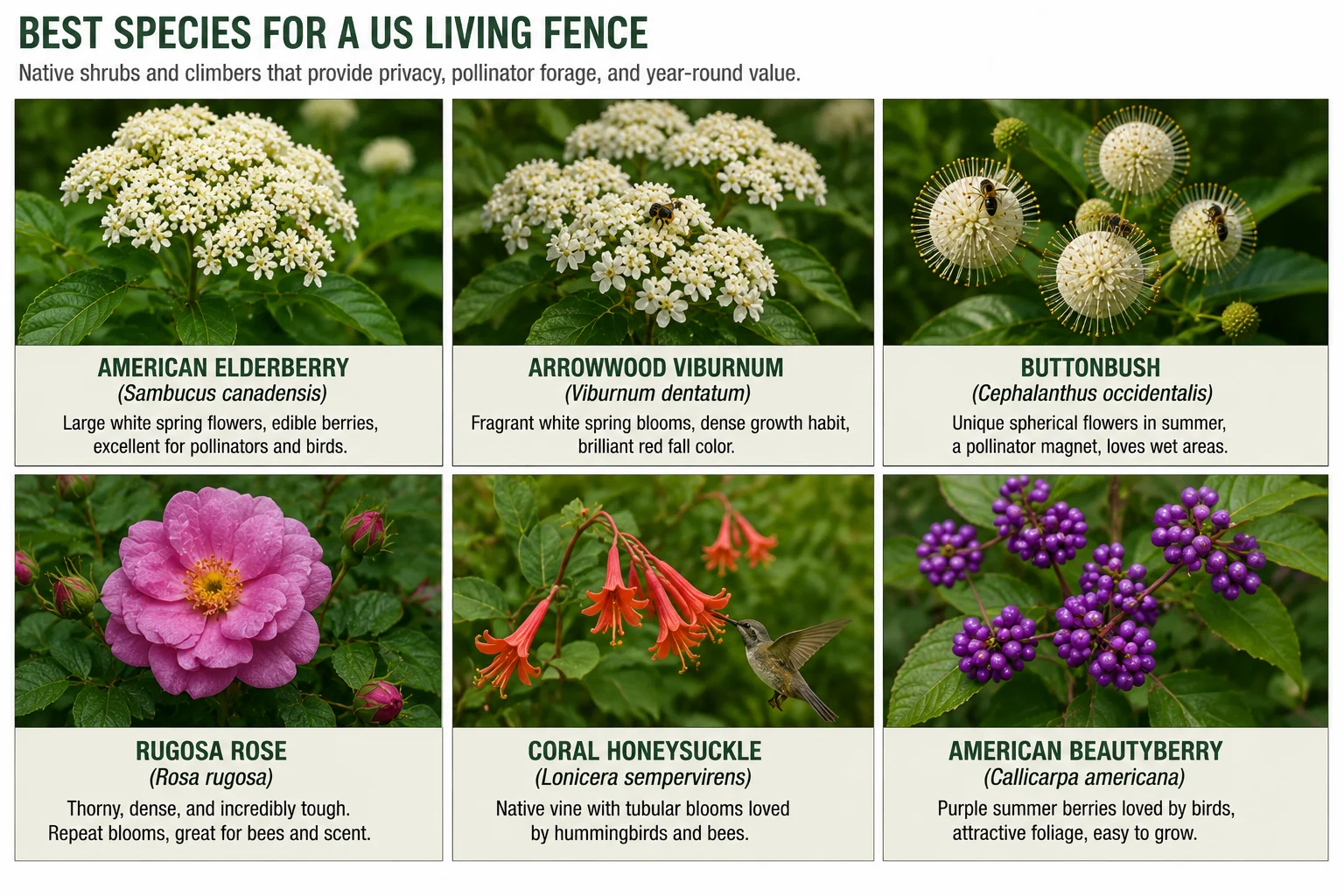
The following species list covers the most widely adaptable and highest-performing options, with regional notes where climate or availability differs significantly across the US.
American Black Elderberry (Sambucus canadensis) is the single most valuable structural layer species for a US living fence in most regions. It grows rapidly to 8–12 feet, produces enormous flat-topped flower clusters in June and July that honeybees and native bees work intensively, and follows the bloom with heavy crops of dark berries that feed dozens of songbird species through late summer and fall. It tolerates wet soil, part shade, and a range of soil types. Native across the eastern two-thirds of the US and adaptable in the west when given reliable moisture. Spreads by root suckers to fill gaps in the hedge line — a feature in a living fence context. Cut hard to the ground every 3–5 years to rejuvenate and maintain density.
Native Viburnum species — particularly Arrowwood Viburnum (Viburnum dentatum), Blackhaw (Viburnum prunifolium), and Nannyberry (Viburnum lentago) — form the most versatile and ecologically rich component of the structural layer. All three reach 8–12 feet, produce flat-topped white flower clusters in May–June that are heavily visited by bees, develop berries that persist through winter for birds, and provide excellent screening density. Arrowwood is the most widely adaptable across US regions and the most readily available at native plant nurseries.
Native Buttonbush (Cephalanthus occidentalis) is the most extraordinary mid-summer bee plant in the entire living fence plant palette. It blooms in July and August — precisely during the summer dearth when most other shrubs have finished — producing spherical white flower heads that are covered in bees from morning to dusk during the bloom period. Native across the eastern US, tolerates seasonal flooding, reaches 6–10 feet. For any beekeeper managing the July nectar gap — covered in detail in why the July dearth is the most dangerous period of the beekeeping calendar and which plants close the gap — buttonbush in the living fence is one of the most effective single interventions available.
Carolina Allspice (Calycanthus floridus) provides unusual burgundy-red flowers in May–June with a spicy fragrance, grows to 6–9 feet, tolerates part shade, and is visited by specialist native bees including carrion beetles and some Andrena species. Native to the southeastern US but adaptable across most of the country in sheltered positions. Excellent middle layer species.
Rugosa Rose (Rosa rugosa) is the most productive flowering shrub layer species for honeybees in a US living fence. It blooms from May to October — one of the longest single-shrub bloom periods available — produces simple open single flowers with full pollen and nectar accessibility (unlike hybrid tea roses), develops large ornamental hips that persist through winter, and grows densely enough to provide excellent screening at 4–6 feet. It is technically introduced rather than native to North America, originating in eastern Asia, but is fully naturalized in many regions and widely considered non-invasive in most US states. Check your specific state’s invasive species list before planting in coastal areas of the Pacific Northwest and Northeast where naturalized populations exist.
Native Spicebush (Lindera benzoin) is one of the earliest-blooming shrubs in the American landscape — tiny yellow flowers appear in March and April before the leaves emerge, providing critical early-season forage at exactly the point when queen bumblebees need it most. Native across the eastern US, tolerant of shade and moist soil, grows to 6–12 feet, produces red berries loved by migratory songbirds in fall. An invaluable early-season component of any living fence designed for bee support.
Native Honeysuckle (Lonicera sempervirens, coral honeysuckle) is the climbing layer species that solves the most common gap in a US living fence — the need for a native climber that blooms over a long season without becoming the ecological disaster that the invasive Japanese honeysuckle (Lonicera japonica) has been across the eastern US. Coral honeysuckle blooms from March to November in warmer regions, May to September further north, produces tubular red-orange flowers that hummingbirds work intensively and that provide nectar for long-tongued bumblebees, and reaches 10–15 feet in a supported climbing situation. Non-invasive. Native across the eastern US.
American Beautyberry (Callicarpa americana) contributes to the flowering shrub layer with small lavender flowers in summer followed by the most spectacular berry display of any shrub in the American native palette — dense clusters of iridescent purple berries covering every stem through late summer and fall. Grows to 4–6 feet, spreads to fill gaps, extremely attractive to native bees during bloom and to birds through the berry period. Native to the southeastern US and adaptable across warmer regions.
The Bloom Calendar: What Your Living Fence Flowers Month by Month
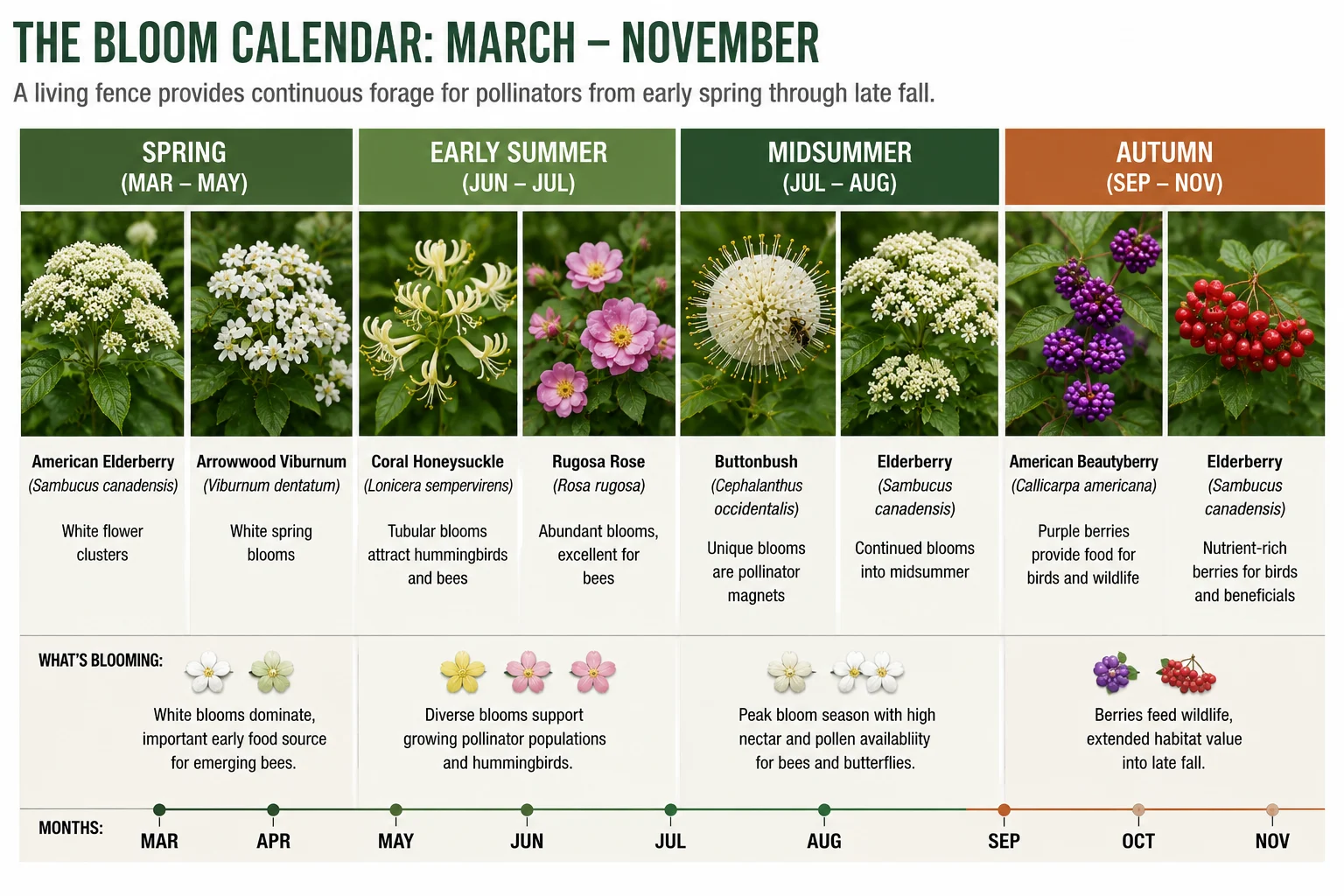
One of the greatest advantages of a species-diverse living fence over a monoculture hedge is the ability to engineer continuous bloom across the entire growing season. A single-species hedge — all forsythia, all privet, all boxwood — blooms once and then disappears as a forage resource for the remaining six or seven months of the year. A well-designed mixed living fence blooms from March to November in most US regions, providing a forage corridor directly along your property boundary through the entire active season.
Here is the bloom sequence for a living fence incorporating the species above, across a temperate US growing season:
March and April belong to spicebush — tiny yellow flowers before any leaves appear, feeding queen bumblebees that have just emerged from winter dormancy with almost nothing else available in the landscape. Coral honeysuckle begins its first flush in April in most regions, adding nectar for long-tongued bees and hummingbirds.
May and June are the peak structural bloom period. Native viburnums flower in May, covering themselves in flat white clusters that smell faintly of vanilla and are worked by honeybees, bumblebees, and dozens of native bee species simultaneously. Elderberry follows in June with its flat-topped cream flower heads — one of the largest inflorescences in the American shrub palette and one of the most productive for bees. Rugosa roses begin their long bloom in May and will continue intermittently until frost.
July and August are where most shrub hedges go quiet — and where the living fence most dramatically outperforms a conventional hedge. Buttonbush blooms in July and August, filling the critical dearth period with spherical flower heads that attract an extraordinary range of bee species. Coral honeysuckle continues. Carolina allspice may produce a second flush of flowers in warm summers.
September and October bring the berry period — beautyberry’s spectacular purple clusters, viburnum berries ripening from red to blue-black, elderberry’s dark fruit — while the late-blooming goldenrod and aster species that can be woven into the living fence base provide the last significant nectar flow before frost.
November extends the season with rosehips from the rugosa roses — ornamentally stunning and nutritionally valuable to overwintering birds.
This eleven-month sequence, concentrated along your property boundary and therefore within the minimum possible foraging distance from any hive positioned near that boundary, is a forage resource of extraordinary value to any colony. Combined with the windbreak and fly-up barrier functions already discussed, a properly planted living fence is arguably the highest single-investment improvement a beekeeper with a property boundary to plant can make to their apiary.
Designing Your Living Fence: The Planning Process
The planning process for a living fence follows a specific sequence that prevents the most common mistakes — buying plants before understanding the site, underestimating mature sizes, or planting a monoculture that looks like a hedge rather than a living system.
Step 1 — Measure and assess your boundary. Walk the boundary you intend to plant and measure its total length. Note which sections receive full sun (6+ hours), part sun (3–6 hours), or shade (under 3 hours). Note the soil type — whether it drains freely after rain or holds water for more than an hour. Note any existing structures, utilities, or root systems that will compete with new planting. In most US states, call 811 before you dig to have underground utilities marked — this is a legal requirement and a genuine safety necessity.
Step 2 — Decide your primary function priority. A living fence designed primarily for bee forage will prioritize flowering diversity and bloom season continuity. A living fence designed primarily for privacy screening will prioritize fast-establishing dense species and year-round opacity. A fence designed for windbreak function around an apiary will prioritize height and density on the north and west sides. Most living fences serve all three functions, but knowing your priority influences which species you put in the structural layer and how densely you plant.
Step 3 — Select your species for each layer. Using the species list above as your starting point, select a minimum of three structural layer species, two to three flowering shrub layer species, and one climbing species. Aim for bloom coverage across every month from April to October as you select. Confirm that every species you choose is appropriate for your USDA hardiness zone and your specific soil conditions.
Step 4 — Calculate quantities and spacing. Structural layer species are typically planted at 4–6 foot centers — slightly closer than their mature spread to create the overlapping density that makes the fence opaque. Flowering shrub layer species at 3–4 foot centers. Climbing species at 8–10 foot centers along the fence line, with a temporary wire or trellis support to help them establish before the shrubs provide their own structure. For a 50-foot fence line, you will typically need 8–12 structural layer plants, 10–15 flowering shrub layer plants, and 5–6 climbing plants.
Step 5 — Sequence the planting by growth rate. The fastest-establishing species — elderberry, spicebush, buttonbush — should go in first and will provide rudimentary screening within one to two seasons. Slower-establishing species — viburnums, native hollies — follow in the gaps. Climbing species go in last, once the shrubs they will climb have at least one season of establishment behind them.
The complete planting philosophy that underlies this sequencing — using massed plantings of complementary species to create connected habitat rather than isolated specimens — is the same principle behind the drift method for garden bed design which maximizes both visual impact and ecological connectivity. A living fence is, in essence, a drift planting oriented vertically rather than horizontally.
The Living Fence as Apiary Infrastructure: What Beekeepers Need to Know
For beekeepers specifically, the living fence offers a set of functions that go beyond aesthetics and general pollinator support — it is genuinely useful apiary infrastructure that performs several management tasks simultaneously.
As a windbreak, the living fence along the north and west boundary of an apiary reduces wind speed in the hive zone by 50–70% compared to an open boundary — a reduction that translates directly into reduced hive energy expenditure for thermoregulation in spring and autumn, earlier foraging starts on cold mornings, and meaningfully better colony performance through the shoulder seasons. The ideal windbreak is positioned 3–5 times its height behind the hives — so a 6-foot living fence provides optimal protection when hives are positioned 18–30 feet in front of it. This is precisely the positioning that works for most residential yards.
As a fly-up barrier, the density and height of the living fence encourages foragers departing the hive to gain altitude before crossing the property line — the same function performed by a solid fly-up screen, but in a form that is visually attractive from both sides of the boundary and contributes positively to the ecological value of the neighborhood rather than just managing flight paths.
As a forage resource, the proximity of the living fence to the hive means that foragers can begin working the closest forage within seconds of departure — the lowest possible energy cost for any foraging trip, returning maximum caloric yield per unit of energy expended. The complete garden bed design guide for creating detectable massed plantings adjacent to the apiary applies at the boundary scale: a living fence that is diverse, dense, and in continuous bloom is a foraging destination your bees will communicate to each other through the waggle dance and return to repeatedly throughout the season.
As a swarm containment feature, a dense living fence along the boundary provides a likely landing point for any swarm that emerges from hives positioned near it — keeping the swarm cluster on your property where you can collect it rather than allowing it to drift to a neighbor’s garden or a public space. This is not a guaranteed outcome, but an established dense shrub boundary is more attractive to a swarming cluster than open air or a wooden fence, and the probability of containment is meaningfully higher with a living fence than without one.
Implementation: A Three-Season Establishment Plan
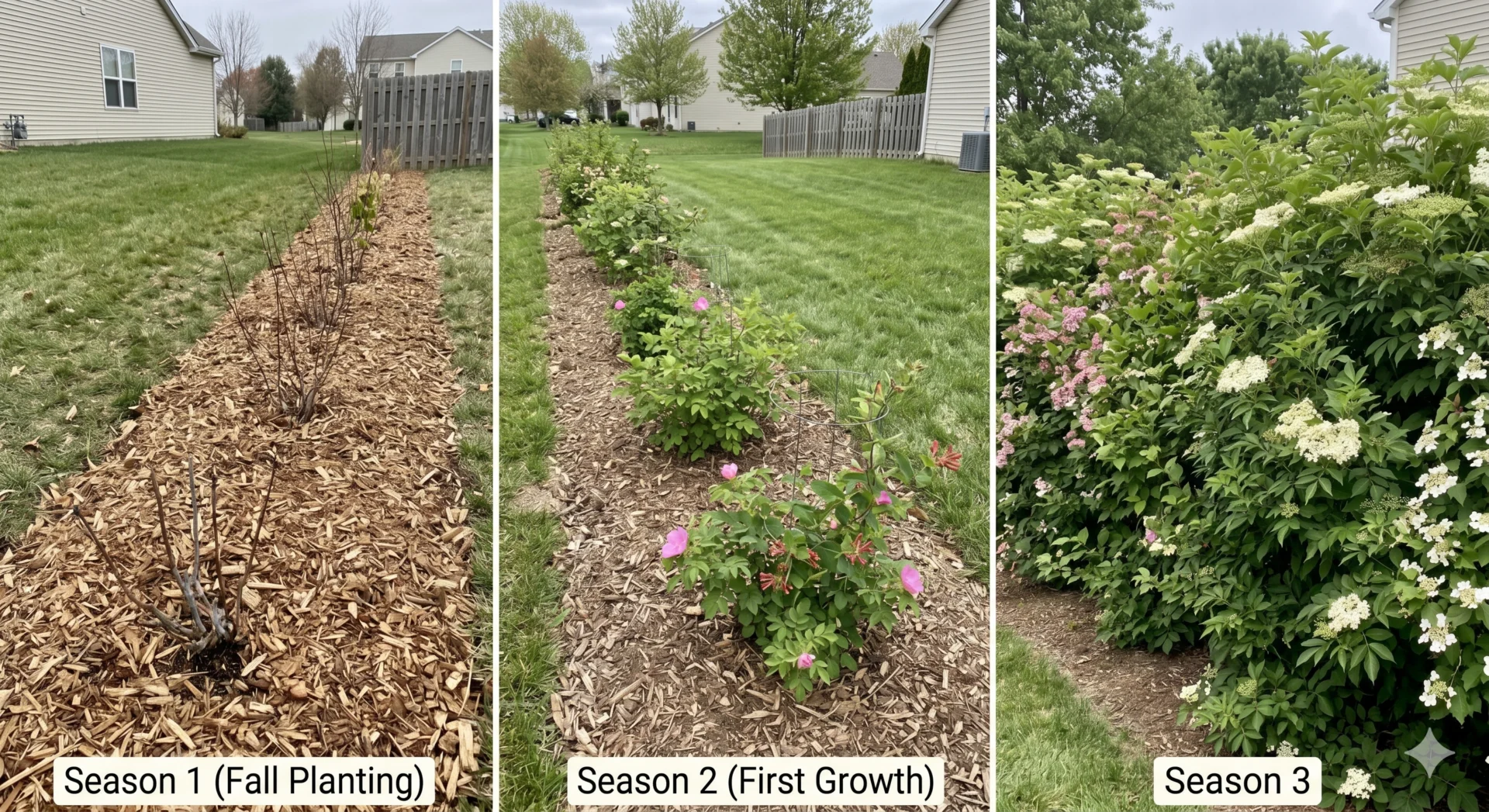
Establishing a living fence from bare boundary to functional screen takes three growing seasons in most US regions. Here is what each season looks like and what you should do in each.
Season 1 — Fall planting: Fall is the optimal planting season for all woody shrubs and trees in the US — the soil is still warm enough for root establishment, rainfall is typically more reliable than spring, and the plants have the entire winter to develop root systems before they face their first summer heat. Plant structural layer species at final spacing, all flowering shrub layer species, and prepare climbing plant support structures. Water deeply at planting and apply a 3-inch layer of wood chip mulch from the trunk out to the drip line — this single step reduces establishment mortality dramatically by retaining soil moisture and moderating soil temperature through the first summer.
In this first season, expect very little visible above-ground growth. The plants are investing their energy below ground. Resist the urge to fertilize heavily — excessive nitrogen pushes soft vegetative growth that is vulnerable to disease and winter damage. Water during dry spells through the first summer and keep the mulch ring intact.
Season 2 — First visible growth: In the second growing season, most structural species will put on 12–24 inches of new growth and begin to look like plants rather than sticks. Elderberry will be the star performer — it can grow 4–6 feet in a single season under good conditions and may reach screening height by the end of season two. Plant climbing species now, using the established shrubs as anchor points for their support structures. Begin to see the first bloom from the fastest-maturing species — spicebush, rugosa roses, and coral honeysuckle typically bloom in their first or second season.
Season 3 — Functional establishment: By the end of the third growing season, the structural layer will typically be at or approaching screening height, the flowering shrub layer will be producing meaningful bloom and forage, and the climbing layer will have begun weaving through the shrubs to fill visual gaps. The living fence is not yet at its ecological maximum — that comes over years and decades as the structure complexifies — but it is functionally effective as a privacy screen, windbreak, and pollinator forage corridor.
Before finalizing your plant selection, check which commonly planted garden and hedge species are actually harmful to pollinators and should be avoided — a few popular hedge species make this list and are worth substituting before you plant.
Conclusion: The Fence That Grows Better Every Year
The wooden fence you replace with a living hedge will deteriorate from the moment it’s installed. The living fence you plant this fall will improve from the moment it establishes — growing denser, taller, more florally diverse, more ecologically complex, and more valuable as forage with every passing season.
For homeowners, it delivers privacy screening of comparable effectiveness to a wooden fence at lower long-term cost, with extraordinary additional value as a garden feature, wildlife habitat, and neighborhood amenity. For beekeepers, it delivers windbreak protection, fly-up barrier function, and a continuous season-long forage corridor along the closest possible boundary to the hive — functions that a wooden fence, regardless of its quality or placement, cannot provide.
The key decisions: use three structural layers for maximum density and diversity. Prioritize native species — at least 70% of your planting by species count. Engineer for continuous bloom from March to November by selecting species with complementary bloom seasons. Plant in fall for best establishment. Mulch deeply and water through the first summer. Then step back and let it grow.
A living fence is the only garden structure that gets more valuable every year you own it. Start this fall. In three years, you’ll wonder why you ever considered the alternative. 🌿🐝
Keep Reading 🐝
These posts connect directly to the living fence strategy and help you build the complete picture:
- 🌿 The complete drift planting guide — the same massed planting principles that make a living fence ecologically effective applied to garden beds — The horizontal complement to the vertical living fence.
- 📅 Why July and August are the most critical months for bee forage — and why buttonbush in your living fence directly addresses the gap — The seasonal context that makes buttonbush a non-negotiable living fence species.
- 🏡 The complete apiary layout guide including windbreak positioning, hive orientation, and how a living fence serves multiple apiary functions simultaneously — The beekeeping infrastructure context for your living fence planting.
Your boundary can do more than divide. Let it grow. 🌿