
You’ve planted the flowers. You’ve read the lists. You’ve put in lavender, stuck in a few sunflowers, maybe even bought a wildflower mix and scattered it optimistically across a patch of soil. And yet — your garden feels quiet. Where are all the bees?
Here’s the thing most gardening guides won’t tell you: bees don’t experience your garden the way you do. They navigate by ultraviolet patterns invisible to the human eye, make foraging decisions based on caloric return, and abandon even beautiful gardens if the nectar dries up at the wrong time of year. Designing a garden that bees actually find — and keep coming back to — requires understanding a little bee biology alongside your planting plan.
This post breaks it all down. You’ll learn how bees locate food, which design principles turn a garden into a reliable foraging destination, which plants to prioritize by season, and the common layout mistakes that quietly drive pollinators away.
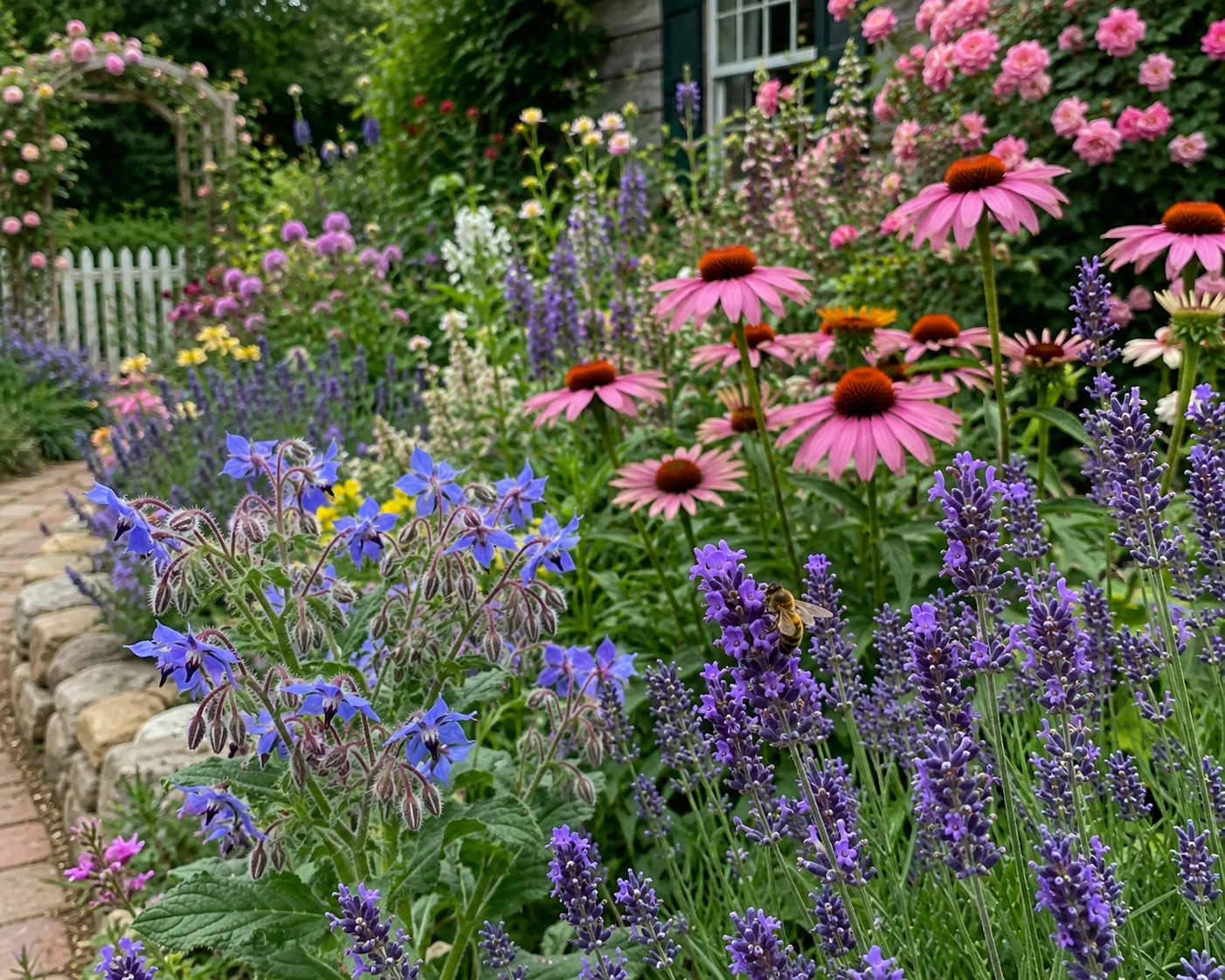
![bee-friendly garden bed design with lavender borage and echinacea attracting honeybees]](https://honeyroadblog.com/wp-content/uploads/2026/06/AC4B0A4E-F01A-4B5B-86A5-E794DA40AA3B.webp)
How Bees Actually Navigate to Your Garden
Before you move a single trowel, it helps to understand the forager’s perspective.
A honeybee scouting for food isn’t wandering randomly. She’s executing a calculated search mission guided by:
- Ultraviolet vision — Bees see UV light that humans can’t. Many flowers have UV “nectar guides” — patterns that look plain to us but appear as vivid landing-strip markings to a bee.
- Scent plumes — Bees can detect floral volatiles (aromatic compounds) from significant distances, especially in still morning air. A mass of one fragrant plant generates a much stronger scent signal than a single specimen.
- Color preference — Research from the University of Sussex Bee Lab confirms bees show strong preference for blue, violet, and yellow flowers over red ones (which appear black to bee eyes).
- Caloric reward — Foragers are efficient. They communicate the location of high-reward flowers back at the hive via the waggle dance and revisit reliably — but only as long as the nectar and pollen keep flowing.
The practical takeaway: your garden needs to be detectable, rewarding, and consistent.
The 5 Design Principles of a Bee-Attractive Garden Bed
1. Mass Planting Over Scattering
A single lavender plant gives a bee one stop. Twenty lavender plants in a cluster give her a destination worth communicating to the entire colony.
Bees are social foragers. When a scout finds a reliable patch, she dances the coordinates home and sends a team. That team needs enough flowers to justify the trip. A good rule of thumb: plant in drifts of at least 5–7 of the same species, positioned together rather than spread across the bed.
This also concentrates scent, making the patch more detectable from a distance.
2. Plan for the Full Season — Not Just Summer
Most gardeners plant for the summer peak and call it done. But bees forage from early spring (sometimes February in mild climates) through late autumn, and food gaps are genuinely dangerous for colonies — especially in what’s known as the “June gap” or summer dearth.
Structure your bed across three bloom windows:
| Season | Key Plants |
|---|---|
| Early Spring | Crocus, hellebore, pulmonaria, willow (if you have room) |
| Summer | Lavender, borage, phacelia, echinacea, catmint, agastache |
| Late Summer–Autumn | Sedum, helenium, aster, ivy (flowering), verbena bonariensis |
We’ve covered the dangerous summer food gap in detail — how the July nectar crash affects your bees and how to plug it with strategic planting If you keep hives, that post is essential reading alongside this one.
3. Prioritize Open, Single Flowers Over Double Blooms
This one catches a lot of gardeners off guard. Those lush, pom-pom dahlias and frilly double roses look spectacular — but they’re largely useless to bees.
Double-flowered cultivars have been bred for extra petals, often at the expense of accessible stamens and nectar. The nectar is either absent, buried too deep, or completely structurally inaccessible.
Stick to single-flowered varieties wherever possible:
- Single dahlia varieties over ball or pompom types
- Simple-flowered roses (Rosa rugosa is excellent) over hybrid teas
- Open-faced sunflowers over decorative double varieties
- Native wildflower species over heavily hybridized ornamentals
When in doubt, if you can see the center of the flower clearly — the stamens and pollen — a bee probably can too.
4. Layer Your Heights
Bees forage at different heights depending on species. Honeybees are generalists, but solitary bees (bumblebees, mason bees, leafcutters) often specialize. A flat, single-height bed misses the full spectrum of pollinators.
Design your bed in three layers:
- Ground level (0–30cm): Thyme, creeping oregano, clover, ajuga. Low-growing but high-value.
- Mid level (30–90cm): Lavender, salvia, catmint, borage, echinacea, phacelia.
- Upper level (90cm+): Agastache, verbena bonariensis, tall sunflowers, teasel, angelica.
This also makes for a far more visually interesting bed — structure and movement at every height, not just one flat plane of color.
5. Leave Some Bare Soil and Sun Pockets
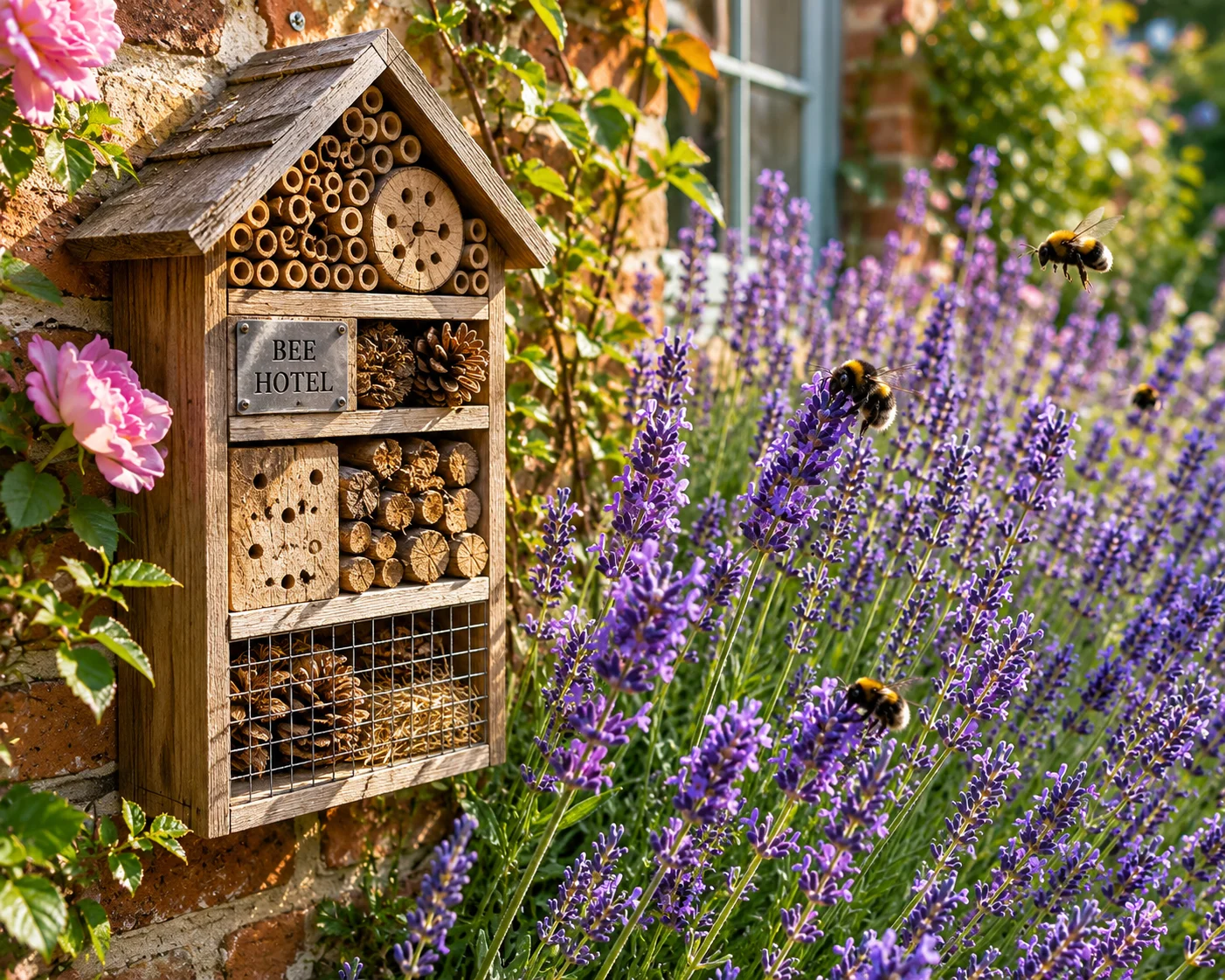
This is the most overlooked design element of all. Over 70% of the UK’s bee species are solitary ground-nesters, according to the Bumblebee Conservation Trust. They need patches of bare, loose, south-facing soil to nest in.
A bed that’s mulched wall-to-wall with weed-suppressing membrane and bark chips may look tidy, but it’s a dead zone for nesting bees.
Leave intentional gaps of bare earth — particularly at the sunniest end of the bed. A south-facing slope of loose soil is prime nesting real estate. Some gardeners add a dedicated “bee bank” — a raised mound of dry sandy soil adjacent to the planting bed — specifically for this purpose.
The Best Plants for a Bee-Focused Garden Bed
Here’s a curated shortlist of genuinely high-performing, well-tested plants by category:
Non-Negotiable Workhorses
- Phacelia tanacetifolia — Often cited as one of the single best bee plants in temperate gardens. Covered in bees from first bloom.
- Borage — Self-seeds freely, flowers for months, and produces nectar constantly throughout the day. Bees never stop visiting.
- Catmint (Nepeta) — Long-blooming, drought-tolerant, beloved by bumblebees and honeybees alike. Cut back mid-summer for a second flush.
- Lavender — The classic for a reason. Mass plant it in a sunny, well-drained spot and it becomes a bee magnet.
Underrated Additions
- Agastache (Hyssop) — Underused but outstanding. Long bloom period, strong scent, incredibly high bee visits per hour.
- Verbena bonariensis — Tall, airy, self-seeds politely. The purple flowers are visible from a distance and heavily visited.
- Teasel — Architectural, wild-looking, and absolutely covered in bees and butterflies when in flower.
- Lemon balm — Unremarkable-looking but produces huge quantities of nectar. Traditional beekeepers have rubbed new hive boxes with it for centuries.
Spring Gap Fillers
- Pulmonaria (Lungwort) — Flowers in March/April when almost nothing else does. Invaluable for early queens.
- Alliums — Ornamental onions bloom in late spring and are absolutely crawling with bees. And they look spectacular.
- Comfrey — Bumblebee royalty. Deep tubular flowers are designed for long-tongued bees. Also a fantastic compost activator.
Layout and Position: Getting the Basics Right
Even the right plants in the wrong location underperform. A few practical notes:
- Sun is non-negotiable for most bee plants. Lavender, phacelia, borage, and catmint all need full sun to produce nectar at meaningful rates. A shaded bed of the right species will still attract fewer bees than a sunny bed of average ones.
- Avoid heavy pesticide use in adjacent beds. Systemic insecticides, particularly neonicotinoids, persist in pollen and nectar and have well-documented harmful effects on bee cognition and colony health.
- Water access matters. Bees need water, especially in summer. A shallow dish of water with stones for landing platforms, placed near the bed, gives foragers another reason to stay in your garden.
- Proximity to shelter helps. Beds near hedges, walls, or shrubs give bees wind protection and often support nesting sites in the adjacent structure.
Before you finalize your plant list, it’s also worth checking which common garden plants are actually toxic to bees and should be avoided — a few popular ornamentals make the list.
Mistakes That Drive Bees Away (Even in Beautiful Gardens)
A quick checklist of what to avoid:
- ❌ Planting single specimens of many different species rather than massed drifts
- ❌ Double-flowered cultivars — beautiful for humans, inaccessible for bees
- ❌ Planting only for summer — leaving early spring and late autumn as food deserts
- ❌ Full mulch coverage — eliminates ground-nesting habitat
- ❌ Tidying up too early — hollow stems and seed heads are winter habitat for solitary bees; leave them until late March
- ❌ Planting in full shade — nectar production drops dramatically without sun
- ❌ Monoculture lawns — even a patch of clover in your grass is a significant food source
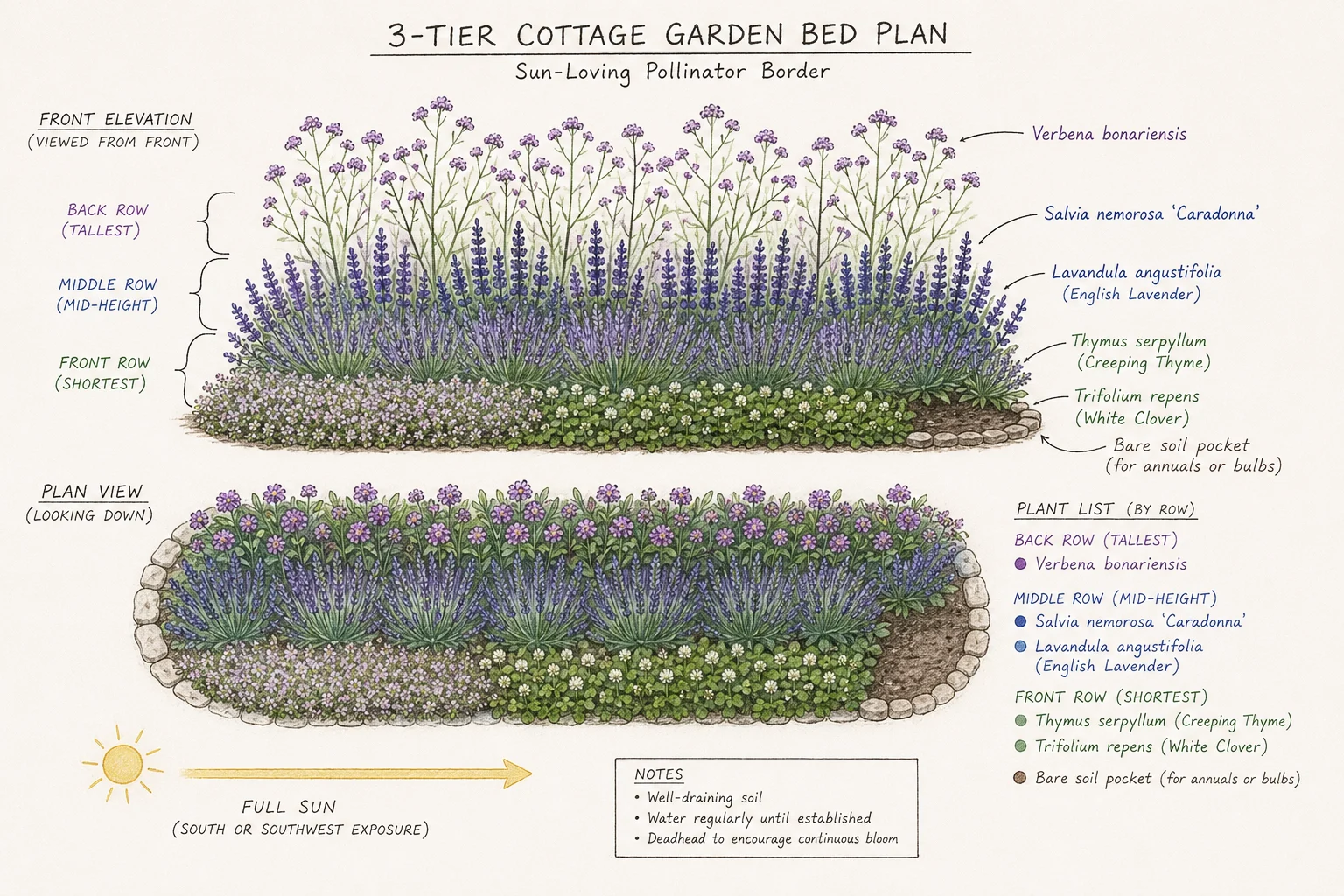
Putting It All Together: A Sample Bee Garden Bed Plan
Here’s a practical layout for a 3m × 1.5m sunny border, designed for maximum bee activity from March to October:
Back row (tall): Verbena bonariensis × 3, Teasel × 2, Agastache ‘Blue Fortune’ × 3
Middle row: Lavender ‘Hidcote’ × 5, Echinacea purpurea × 4, Catmint ‘Walker’s Low’ × 4
Front row (low): Borage × 5, Phacelia × 5, Creeping thyme (edging the full length)
Bare soil pocket: One 30cm patch of loose sandy soil at the sunny end, left intentionally unplanted.
This combination gives you bloom from April through to first frost, multi-height structure, strong scent signals, and nesting opportunity — everything a bee needs to make your garden a regular stop on her daily route.
Conclusion: Design With the Bee in Mind, Not Just the Eye
The gardens that buzz loudest aren’t always the most manicured. They’re the ones that offer the right flowers at the right time, in the right quantities, with space to nest and rest. That’s a design brief as much as a planting list.
Key takeaways:
- Mass plant in drifts of 5–7+ of the same species to create detectable food signals
- Cover the full season — spring, summer, and autumn — not just the summer peak
- Choose single, open flowers over double-bred cultivars
- Layer heights for different bee species and structural interest
- Leave bare soil patches for ground-nesting solitary bees
- Put sun first — nearly all the best bee plants are sun-lovers
Keep Building Your Bee-Friendly Garden 🐝
This post is just the beginning. Here are a few related reads from the blog that pair perfectly with what you’ve just learned:
- 🌿 The best medicinal herbs for your apiary layout — and why bees seek them out — Many of the most bee-attractive plants also have powerful health benefits for the colony itself.
- 📅 What happens to your bees during the July nectar crash, and how to design around it — The essential companion post to this one for anyone who keeps bees or wants to support a local colony.
- ☠️ 7 common garden plants that are actually toxic — to bees and to you — Before you finalize your planting list, this one could save you a costly mistake.
A well-designed garden doesn’t just support bees — it makes the whole ecosystem around your home richer, louder, and more alive. Plant with intention, and they will come. 🌻