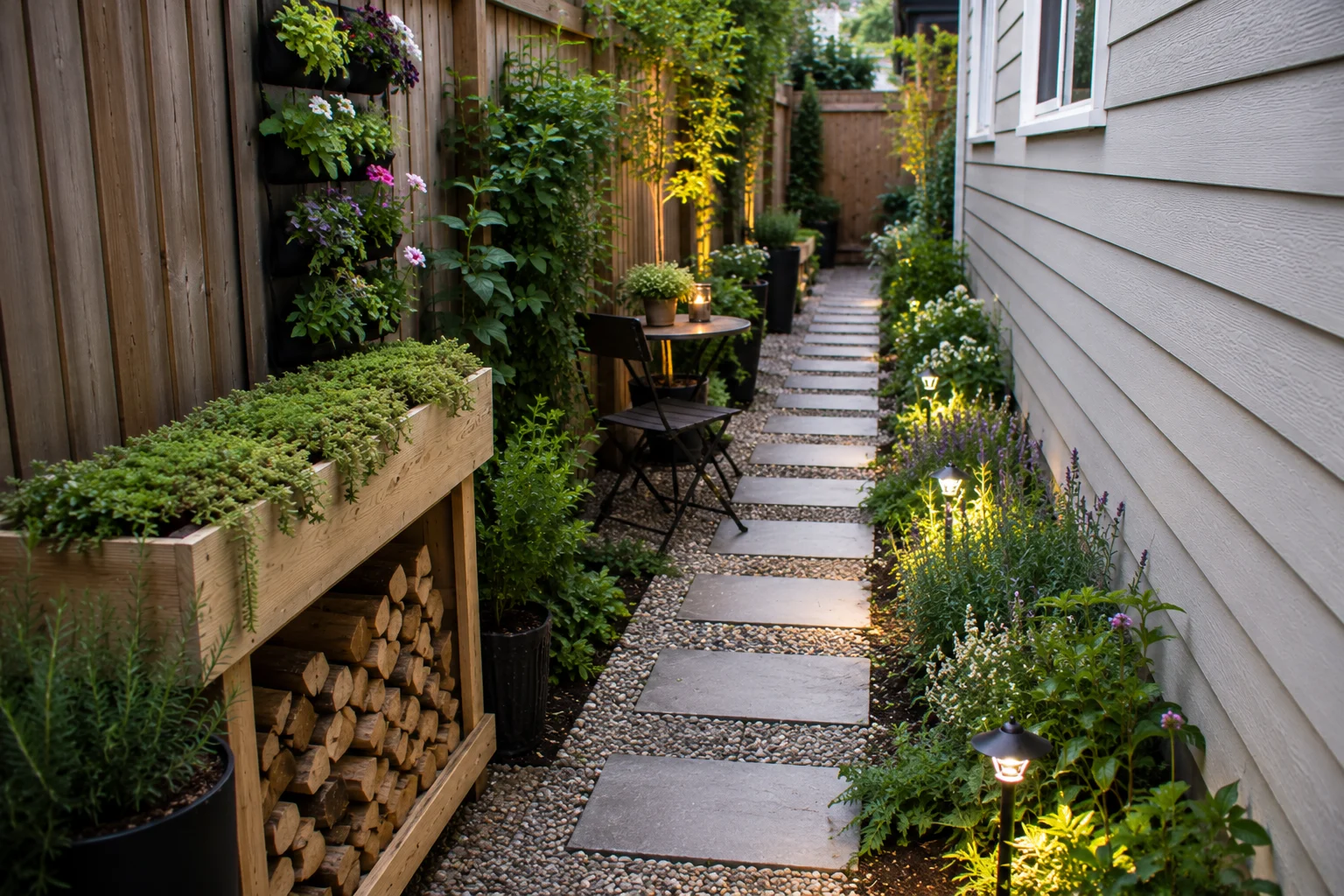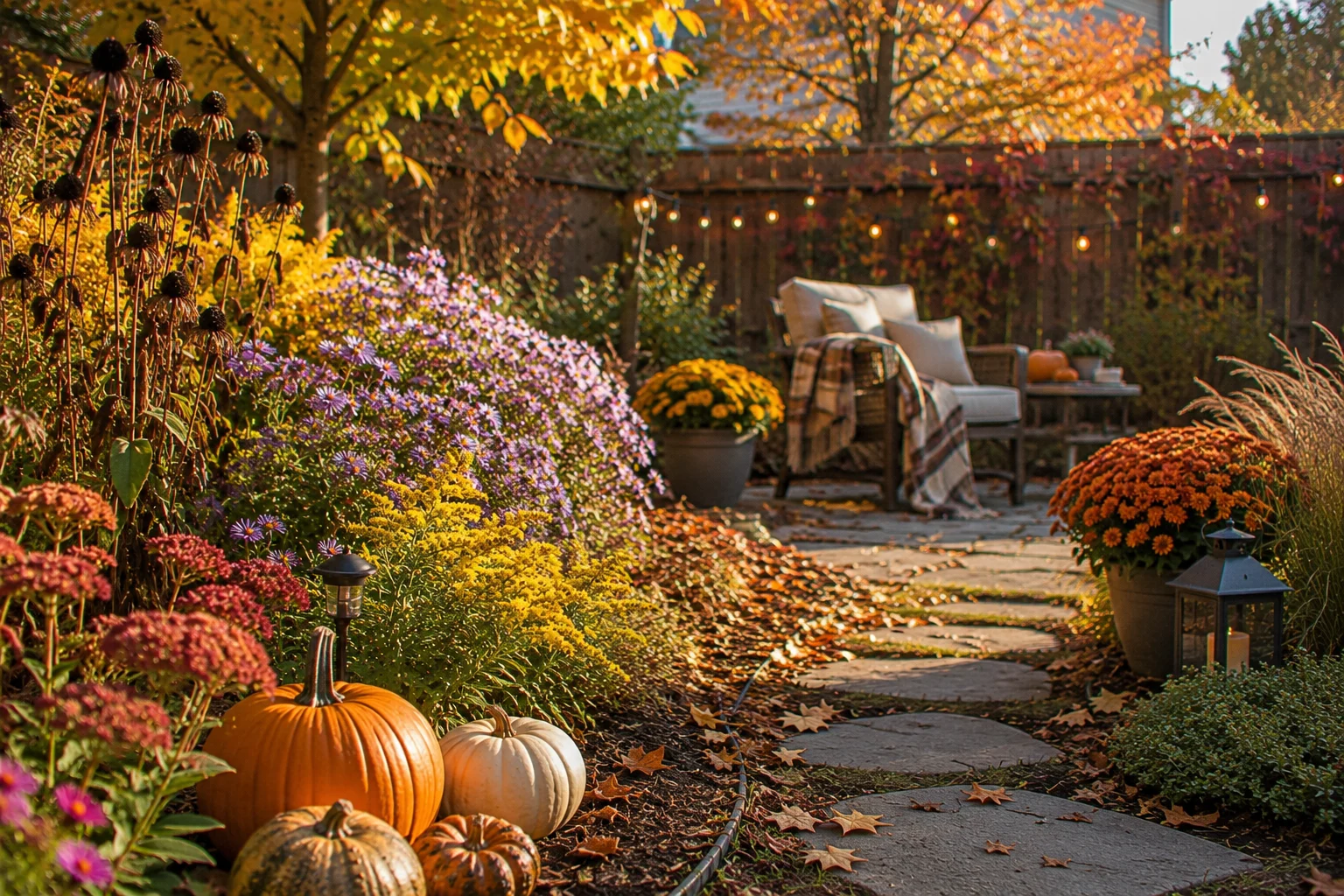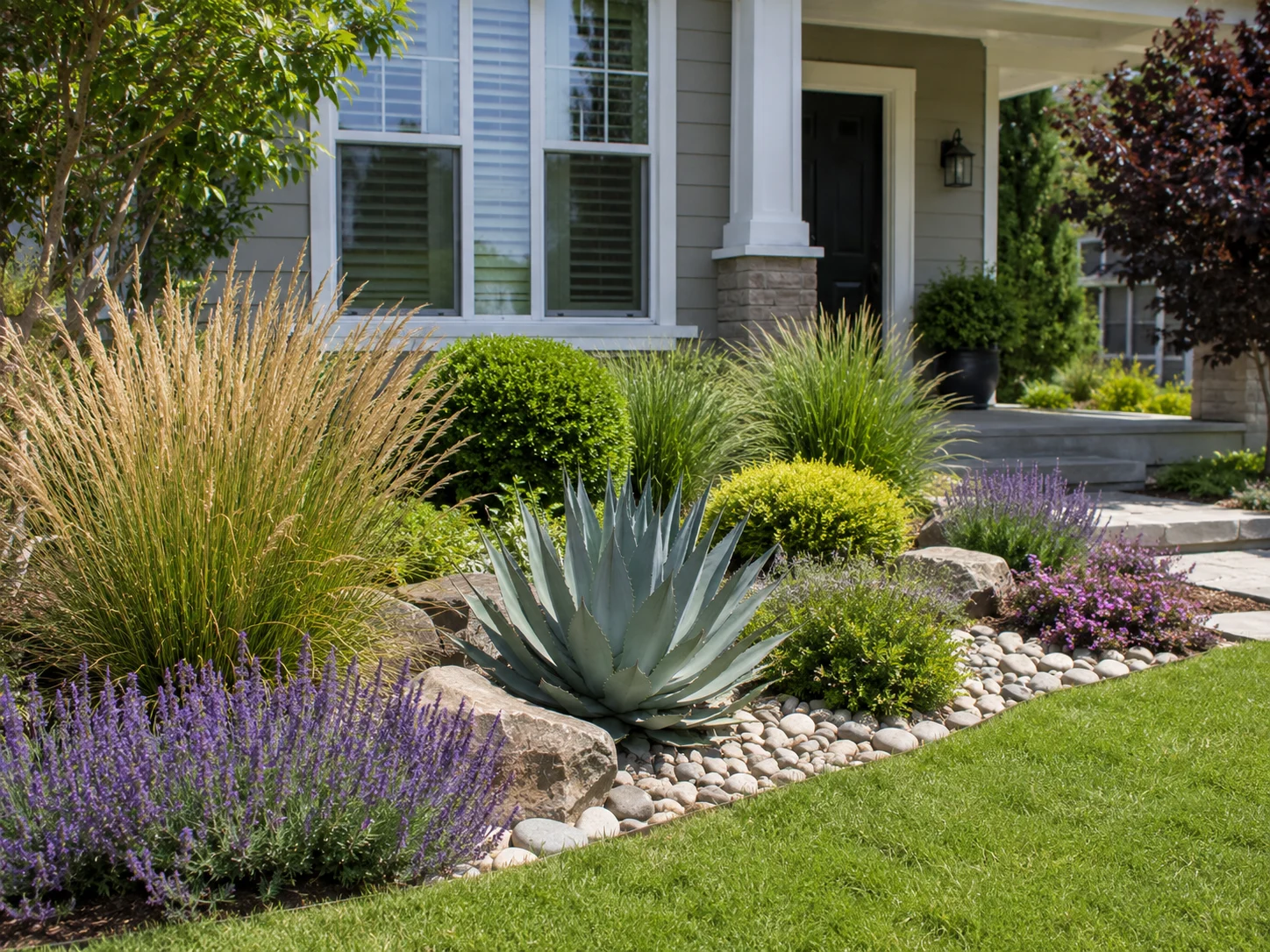

A terrace without plants is just a hard surface. It might be well-paved, well-proportioned, and perfectly positioned — but without planting, greenery, and some kind of living layer, it remains a functional space rather than a place you genuinely want to spend time in.
The challenge with terrace gardening is that the usual rules of garden design — dig here, plant there, add a border along this edge — often do not apply. Terraces are typically paved, elevated, weight-limited, or otherwise constrained in ways that make conventional garden thinking unhelpful. You need approaches that work within those constraints rather than fighting them.
These 30 ideas cover every terrace type and every budget. Some cost almost nothing and can be set up in a weekend. Some are longer-term investments that transform the terrace into a proper outdoor room. All of them work within the fundamental constraints of terrace gardening — limited soil, limited weight, usually limited space — and produce results that genuinely justify the effort.
Browse through and save the ideas that fit your specific situation.
1: The Grouped Container Display
The single most impactful change you can make to a plain terrace is replacing scattered individual pots with a deliberately grouped container display. Three, five, or seven containers of complementary sizes — planted with a consistent colour palette or plant family — create visual weight and intention that a collection of unrelated pots never achieves.
Group containers by height: one tall structural plant at the back, two medium plants in the middle, two to three low trailing plants at the front. Choose containers that share at least one material or colour. The grouping reads as a designed display rather than a collection of afterthoughts, and the plants benefit from the shared microclimate the group creates.
2: The Vertical Wall Planter System
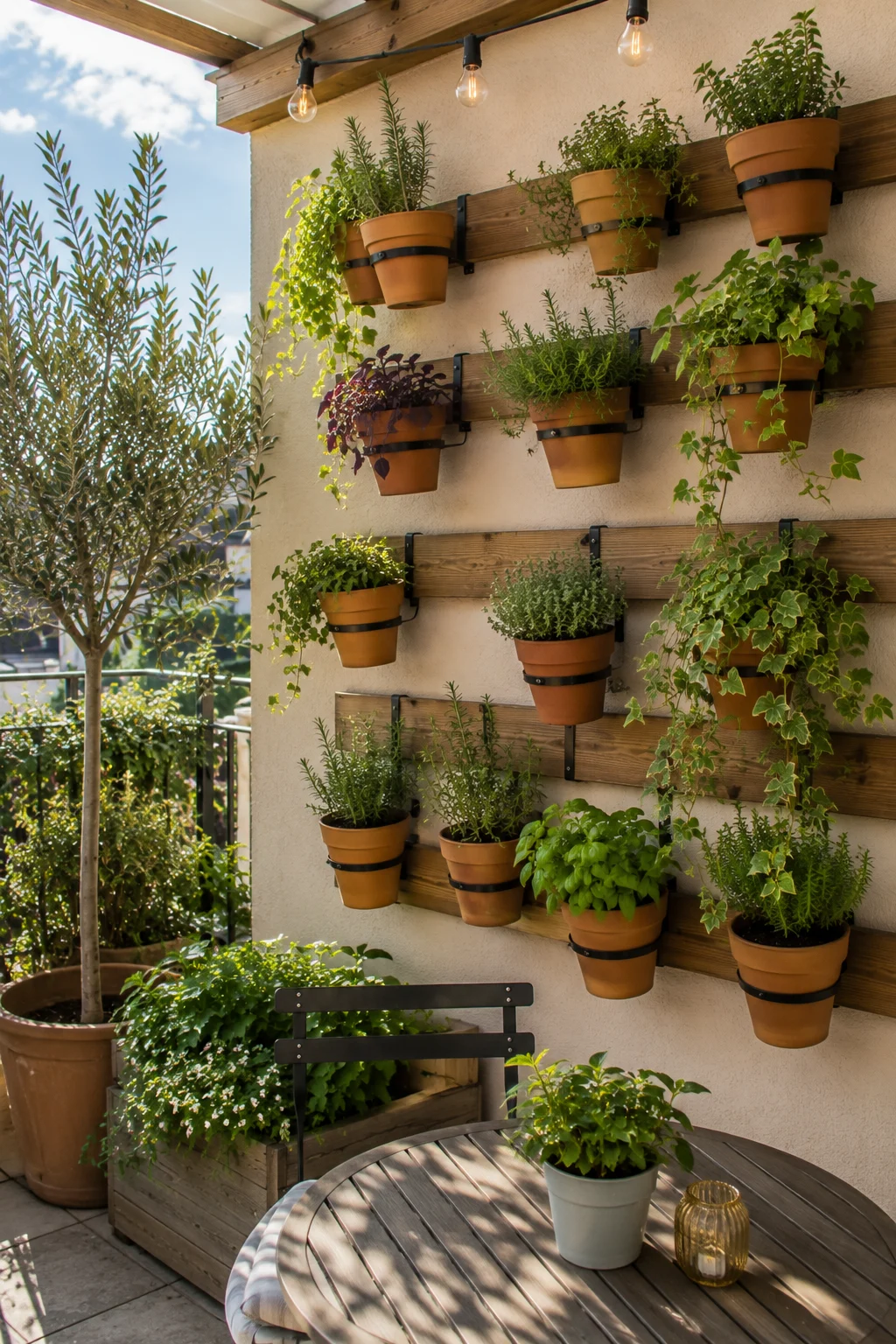
When floor space is limited, the walls and fences surrounding a terrace become the most valuable planting real estate available. A modular wall planter system — timber pocket planters, stacked terracotta, metal rail-mounted pots, or a felt pocket wall garden — covers a bare wall with living green without using a single square foot of terrace floor.
The most effective systems have individual removable pots or pockets so plants can be replaced seasonally — spring bulbs giving way to summer herbs and trailing plants, then autumn bedding taking over. Fix the system to the wall rather than hanging it from hooks, which fail under the weight of wet compost.
3: The Raised Timber Planting Bed
A single low raised timber bed — 30–45cm tall, built from decking boards, railway sleepers, or scaffolding planks — transforms a section of terrace from hard paving into a proper growing area. Even a bed 60cm × 120cm contains enough compost volume to support a genuine perennial planting or a productive kitchen garden.
Build directly on the paving using a weed-suppressing base layer. Fill with a lightweight growing medium — 50% peat-free compost, 30% perlite, 20% horticultural grit — to minimise weight. A raised bed at the edge of a terrace also doubles as informal seating if the wall is at the right height and built solidly enough.
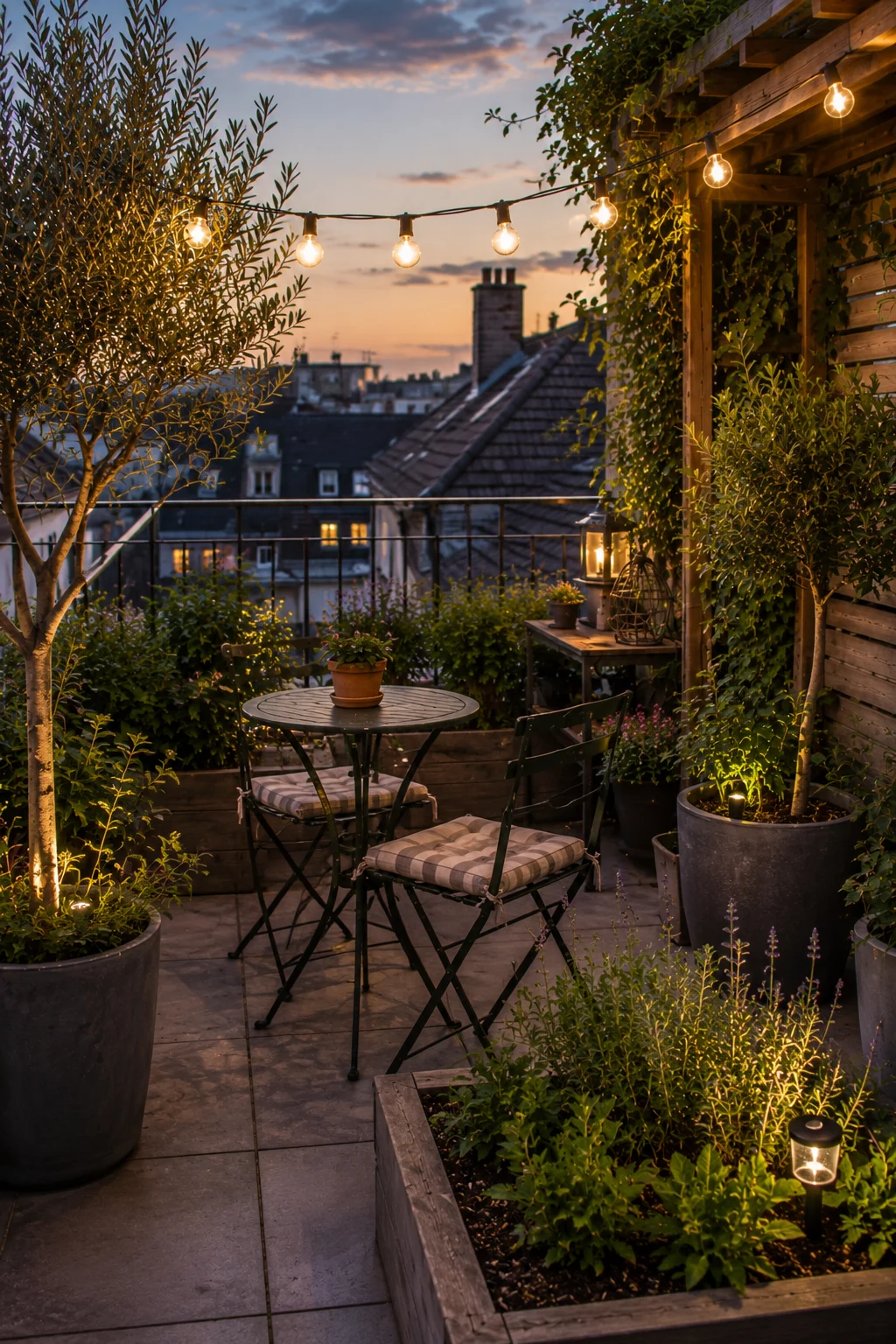
4: The Bistro Corner
A small round table, two matching chairs, one potted plant on each side, and a string of lights overhead — that is a complete and beautifully proportioned terrace dining area that takes up approximately 2 square metres and looks excellent in any terrace style. The bistro format works because it scales correctly to a small space without the visual compression of a full-sized garden dining set.
Choose a marble, zinc, or tiled table top for weather resistance. Rattan, powder-coated steel, or solid teak chairs last longest outdoors without requiring winter storage.
5: The Herb Terrace
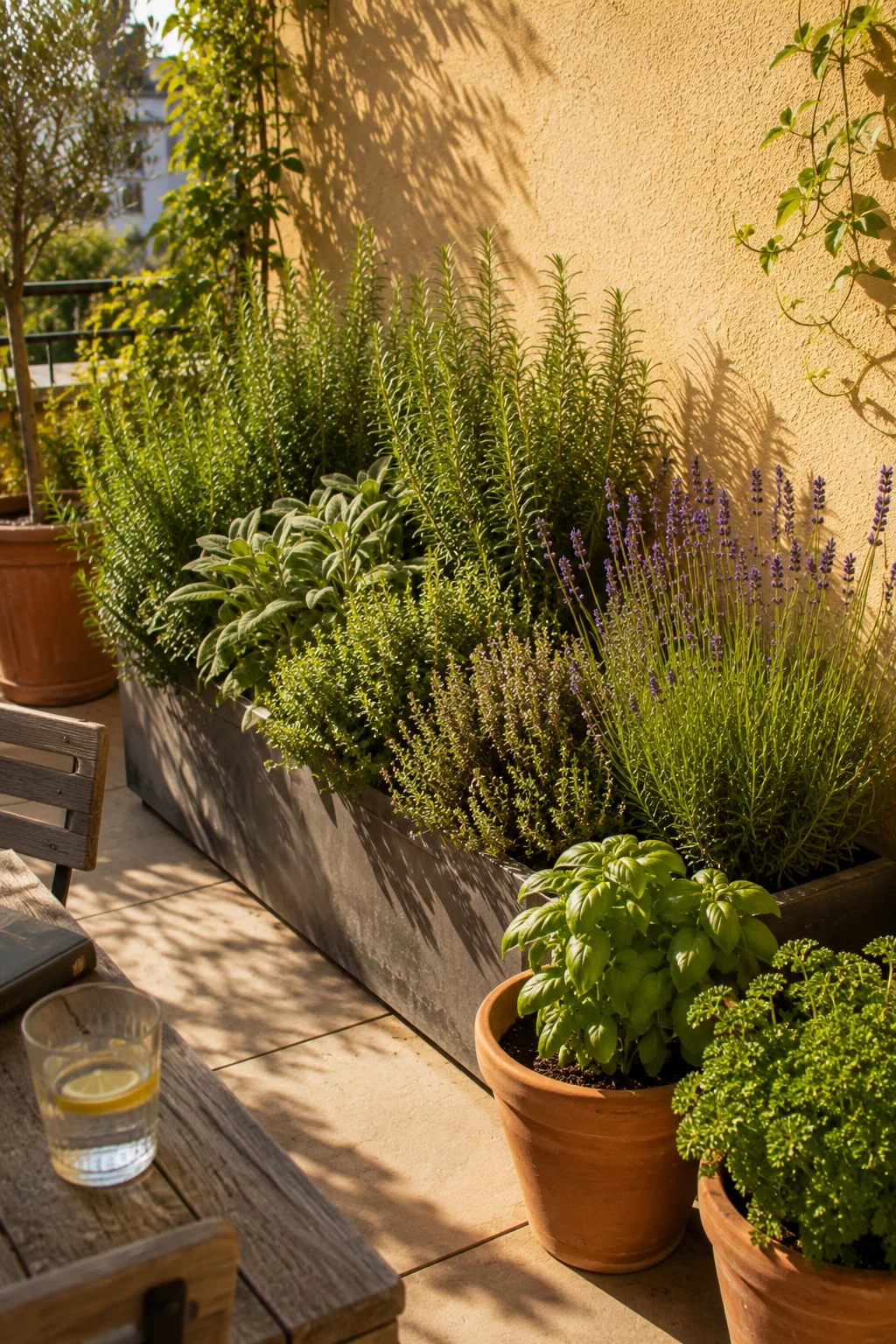
Dedicate one section of the terrace — or one long windowbox-style planter along a sunny wall — entirely to culinary herbs. Rosemary, thyme, sage, chives, flat-leaf parsley, and basil planted in generous groupings create a productive, fragrant, and visually interesting terrace feature that earns its position from multiple angles simultaneously.
A terrace herb garden positioned beside a kitchen door is genuinely useful in a way that purely decorative planting is not. The daily act of picking fresh herbs connects you to the space and makes maintaining it feel worthwhile rather than effortful.
6: The Statement Pot Pair
One very large pot — genuinely oversized, 60cm diameter or more — planted with a single spectacular plant at each end of a terrace anchors the space and creates the impression of a designed outdoor room without any other intervention. Scale is the whole point: a pair of genuinely large pots communicates confidence and intention in a way that a collection of small ones never does.
Effective statement plants for large terrace pots: a clipped standard olive, a cloud-pruned bay, a tree fern in sheltered positions, a phormium for year-round architectural interest, or a trained standard rose for seasonal drama.
7: The Trellis Privacy Screen
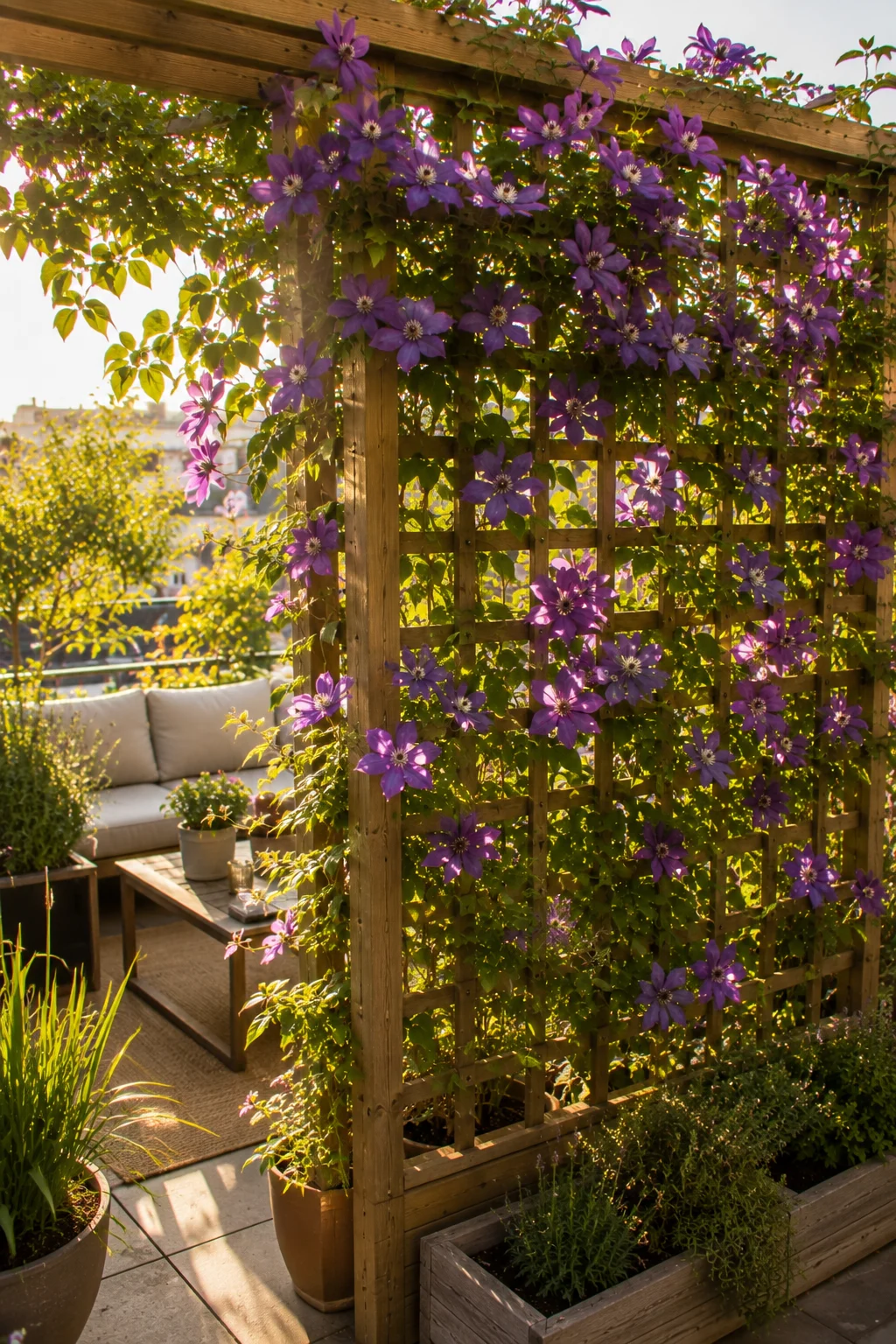
A simple timber trellis panel — fixed to a fence post or freestanding in a heavy ballast planter — provides immediate structure and a support framework for climbing plants. Within one growing season, a clematis, jasmine, or climbing rose trained onto the trellis creates privacy, fragrance, and a clearly defined edge to the terrace without permanent construction.
Fix the trellis panel to the fence with proper brackets rather than resting it against the fence surface, which is unstable in wind. For freestanding screens, use a minimum 60-litre ballast planter base or fix to ground anchors.
8: The Colour-Themed Planting
Choose one colour family for the entire terrace planting — all whites and silvers for a clean Scandi aesthetic, all warm oranges and yellows for a Mediterranean feel, all purples and blues for a traditional cottage effect — and repeat it across every pot, planter, and windowbox on the terrace. The visual coherence of a single colour theme makes a collection of containers look curated rather than random.
Change the theme seasonally: spring whites and yellows, summer purples and pinks, autumn oranges and reds. Keeping the colour discipline through each season produces a terrace that always looks intentional regardless of which plants are currently in flower.
9: The Pergola Frame
A simple timber or powder-coated steel pergola over part of the terrace transforms an open paved area into a defined outdoor room with overhead structure. Even without plants, the pergola creates the feeling of enclosure and purpose. Train a wisteria, grapevine, jasmine, or climbing rose over it and the terrace gains a living ceiling that changes through the season and provides dappled shade through summer.
For smaller terraces, a lean-to pergola fixed to the house wall takes up less ground space while providing the same overhead framing effect.
10: The Kitchen Garden Terrace
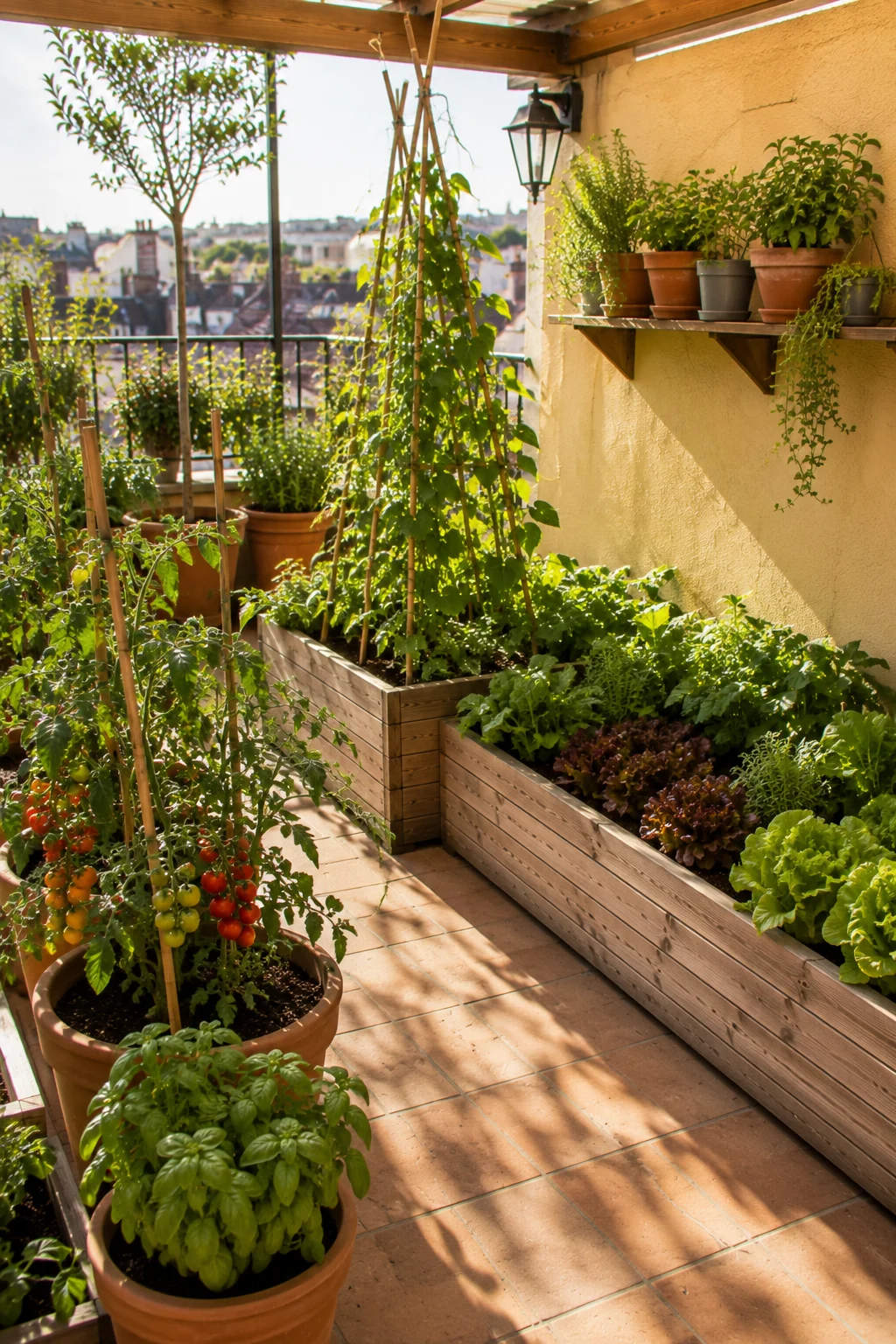
Grow food. A terrace is an excellent kitchen garden location — typically sunny, sheltered, easily accessed from the kitchen, and wasted on purely ornamental planting when raised beds and deep containers can produce tomatoes, salad, courgettes, climbing beans, strawberries, and cut flowers throughout summer.
Tomatoes in 30-litre containers. Climbing beans up a bamboo wigwam in a raised bed. Salad in long shallow windowboxes. Strawberries in a hanging basket or tiered planter. A kitchen garden terrace earns its position every day from June to September.
11: The Gravel and Pot Combination
Replace any remaining bare soil areas at the terrace edge with decorative gravel and position statement pots on top. The gravel suppresses weeds, manages drainage, provides a clean visual base for the pots, and costs a fraction of paving or decking. Pale limestone gravel with terracotta pots looks Mediterranean. Dark slate chippings with black powder-coated metal pots look contemporary.
Keep the gravel area simple — the pots are the feature, the gravel is the neutral ground they sit on.
12: The Outdoor Rug Anchor
An outdoor rug — in natural jute, synthetic woven fibre, or recycled plastic that handles weather — defines a seating zone within a larger terrace and immediately makes it feel more like a room. The rug anchors the furniture arrangement, softens the hard paving visually, and creates a clear psychological separation between the seating area and the surrounding space.
Choose a rug at least 30cm larger in all directions than the furniture footprint so chairs sit fully on the rug rather than half off the edge.
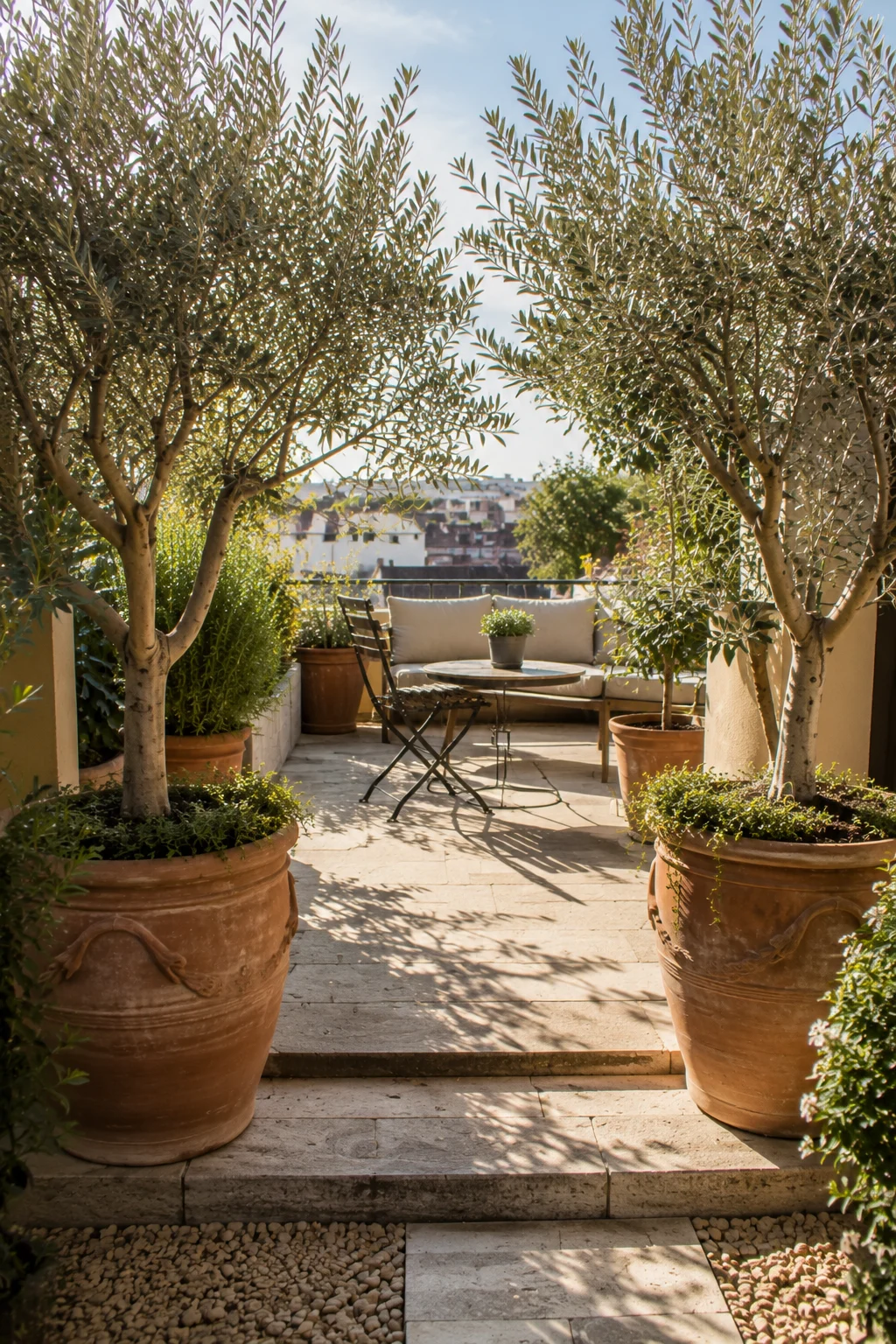
13: The Olive Tree Pair
Two mature olive trees in large terracotta pots either side of the terrace entrance or framing the main seating area create instant Mediterranean atmosphere, year-round silver-green structure, and — in warm climates — edible olives. Olive trees are extremely long-lived in containers when given adequate drainage, drought-tolerant once established, and improve visually with age as their trunk character develops.
Feed twice yearly with a slow-release balanced fertiliser and repot every three to four years when root-bound.
14: The Windowbox Collection
Every wall, balustrade, and fence rail along the terrace perimeter is a potential windowbox location. A consistent set of matching windowboxes — all terracotta, all powder-coated steel, all natural woven rattan — planted with trailing, mounding, and upright plants creates a perimeter of colour and greenery that frames the terrace from every angle.
For best visual effect: one trailing plant at each corner and front edge (bacopa, lobelia, trailing calibrachoa), one mounding plant in the centre (geranium, verbena, diascia), and one upright accent at the back (spike dracaena, dwarf agapanthus, ornamental grass).
15: The Night Garden Terrace
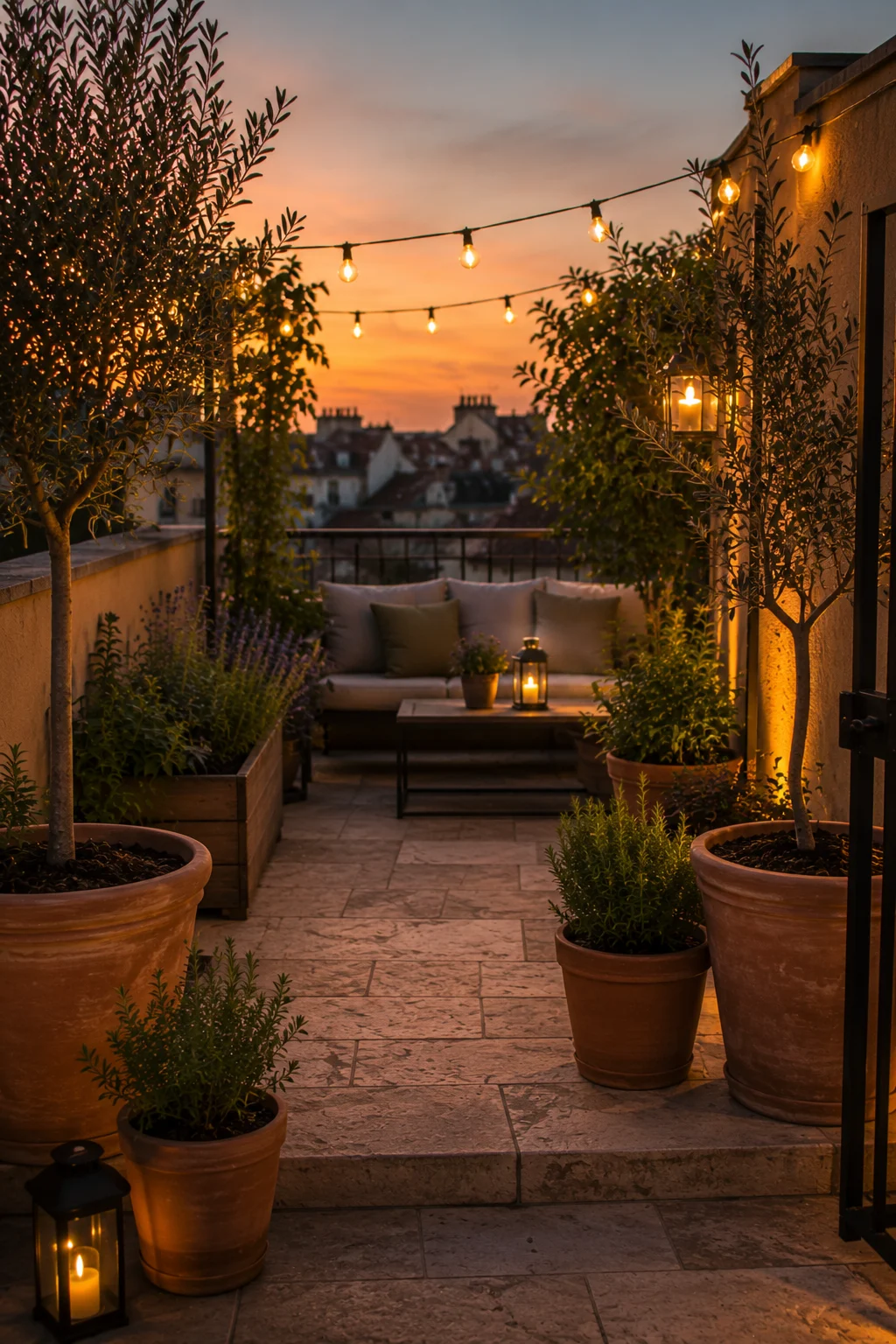
Design the terrace specifically to look beautiful after dark — which is when most people actually use it in summer. White and pale yellow flowers glow in low light and candlelight. Solar lanterns positioned among the pots create pools of warm ground-level light. LED strip lights under raised bed edges illuminate the terrace floor without requiring a hard-wired installation. A single outdoor uplighter on a statement pot or specimen plant creates instant drama.
A terrace that is beautiful after dark is used far more than one that only performs in daylight.
16: The Water Feature Corner
A small self-contained water feature — a drilled stone ball with a pump, a tiered fountain in a bowl, or a wall-mounted spout running into a stone trough — transforms a quiet terrace corner into a sensory focal point. The sound of moving water masks neighbouring noise, cools the surrounding air fractionally on warm days, and creates a backdrop of constant quiet movement that makes the terrace feel more alive even when nothing else is happening in it.
Self-contained solar or low-voltage pump systems require no mains connection and can be installed in an afternoon.
17: The Shade Structure
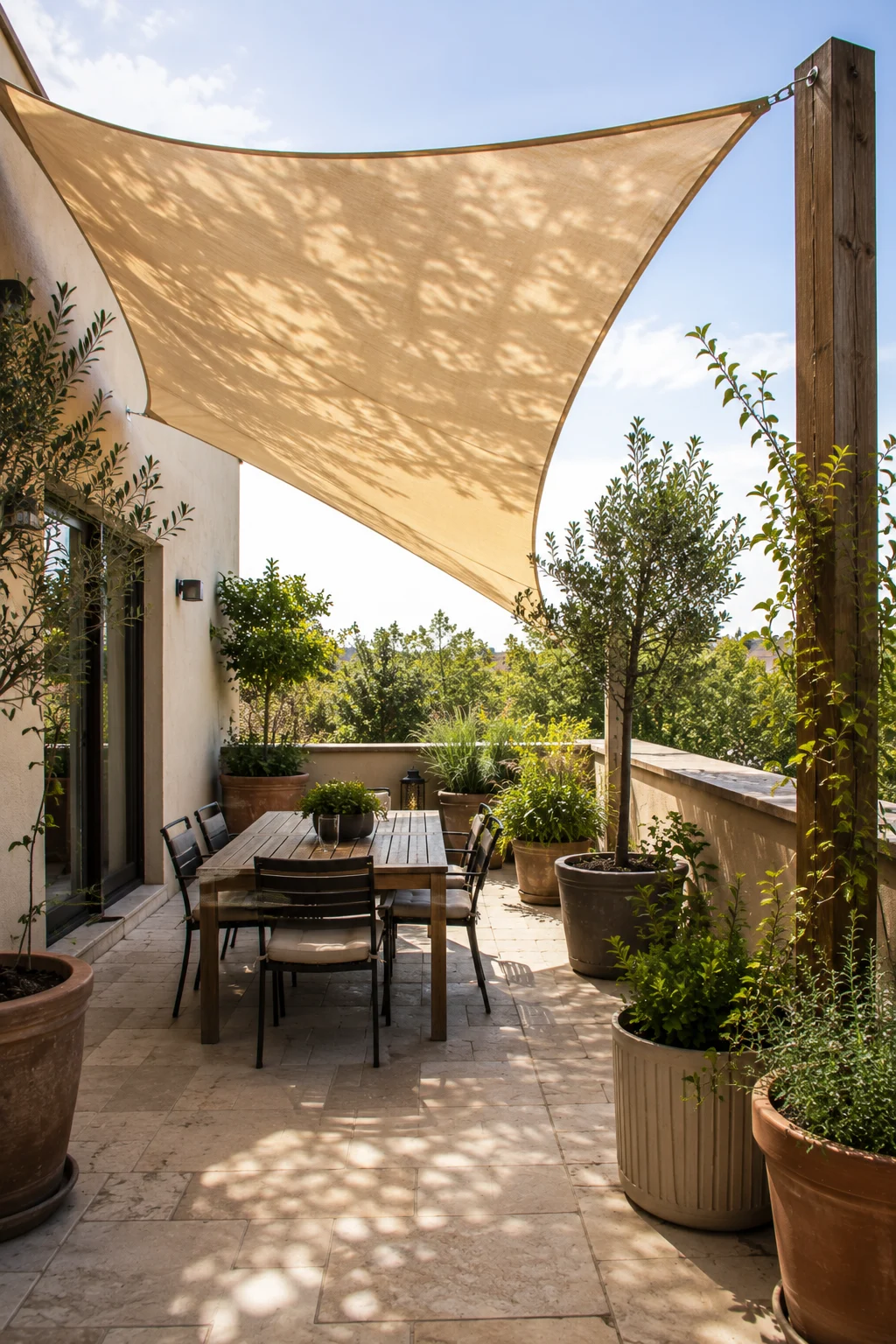
A sail shade, parasol, or fixed timber shade structure gives the terrace a reason to be used during the hottest part of summer days rather than abandoned because it is too exposed. Shade sails tensioned between wall hooks and a post are the lowest-cost permanent option. A large quality parasol on a weighted base is the most flexible. A fixed timber louvre or pergola roof is the most architectural.
Position shade so it covers the main seating area during the peak afternoon hours when direct sun makes the terrace uncomfortable, not over the whole terrace, which then loses the benefit of morning sun.
18: The Tiered Plant Stand
A tiered plant stand — timber, wrought iron, or bamboo, with three to five shelves at different heights — holds multiple pots in a single compact footprint and creates the layered height variation that makes a container display visually interesting. A well-stocked tiered stand in one corner of the terrace can provide more planting interest than twice the number of pots scattered across the floor.
Position the tallest, most structural plants on the upper shelves, trailing plants hanging over the lower shelf edges.
19: The Scented Terrace
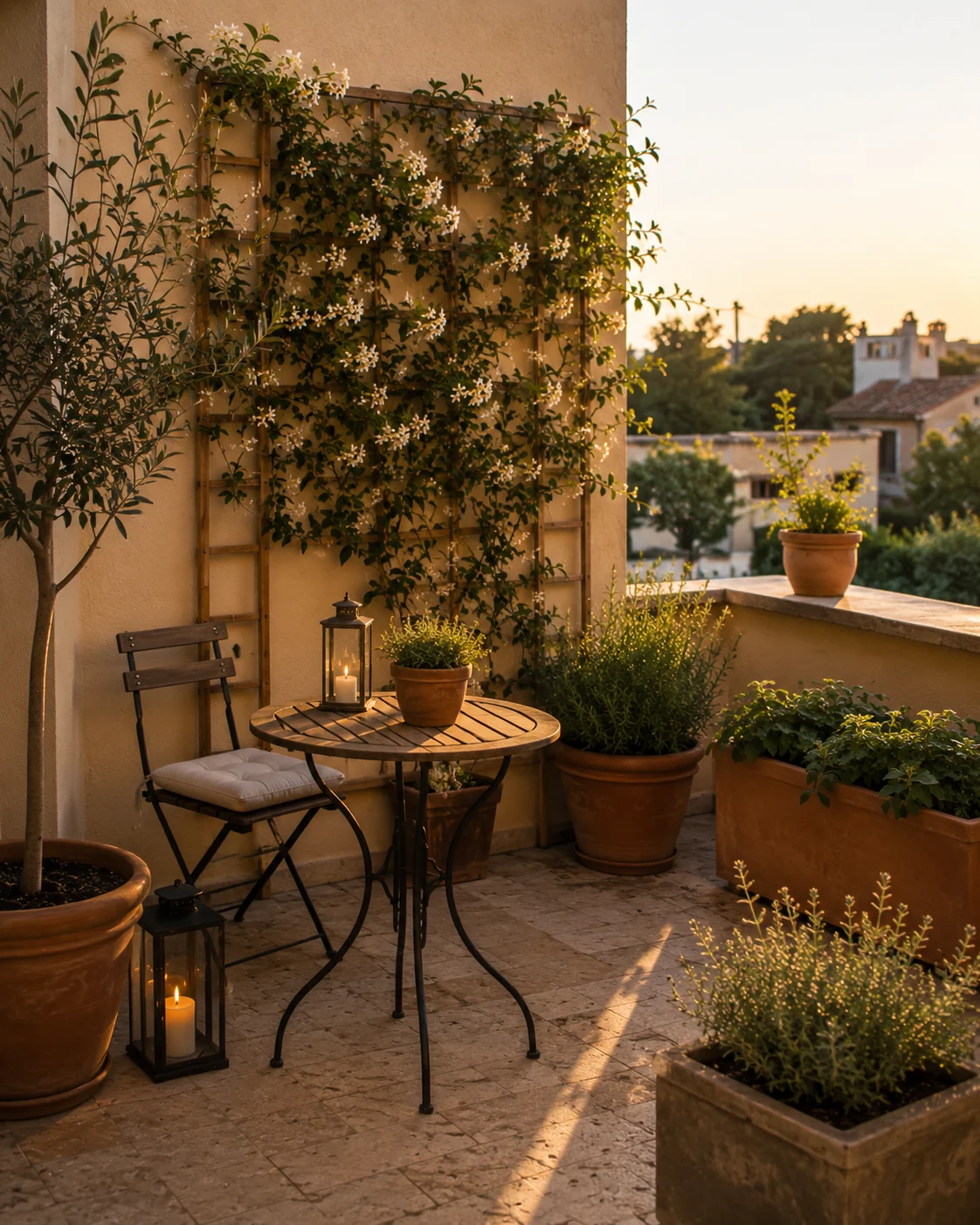
Plant entirely for fragrance. Jasmine on the trellis, lavender in windowboxes, night-scented stock in pots near the seating area, rosemary and thyme in raised beds, sweet peas up a wigwam. A terrace designed around scent provides a sensory experience that photographs cannot capture and that makes outdoor sitting on a warm evening genuinely extraordinary.
Position the most strongly scented plants upwind of the main seating area so the fragrance drifts toward you naturally rather than away from you.
20: The Potted Fruit Garden
Dwarf apple, pear, fig, lemon, and cherry trees all produce genuine fruit in containers. A fig in a large pot actually fruits better with restricted roots. A dwarf apple or pear on a dwarfing rootstock produces full-sized fruit in a 50-litre container. A lemon tree in a 30-litre pot fruits reliably in a sheltered terrace position in mild climates, or in a conservatory through winter in colder ones.
Combine with strawberry planters, a blueberry bush in ericaceous compost, and a tub of raspberries for a productive terrace that delivers fresh fruit from June to October.
A Note on Terrace Gardens and Bees
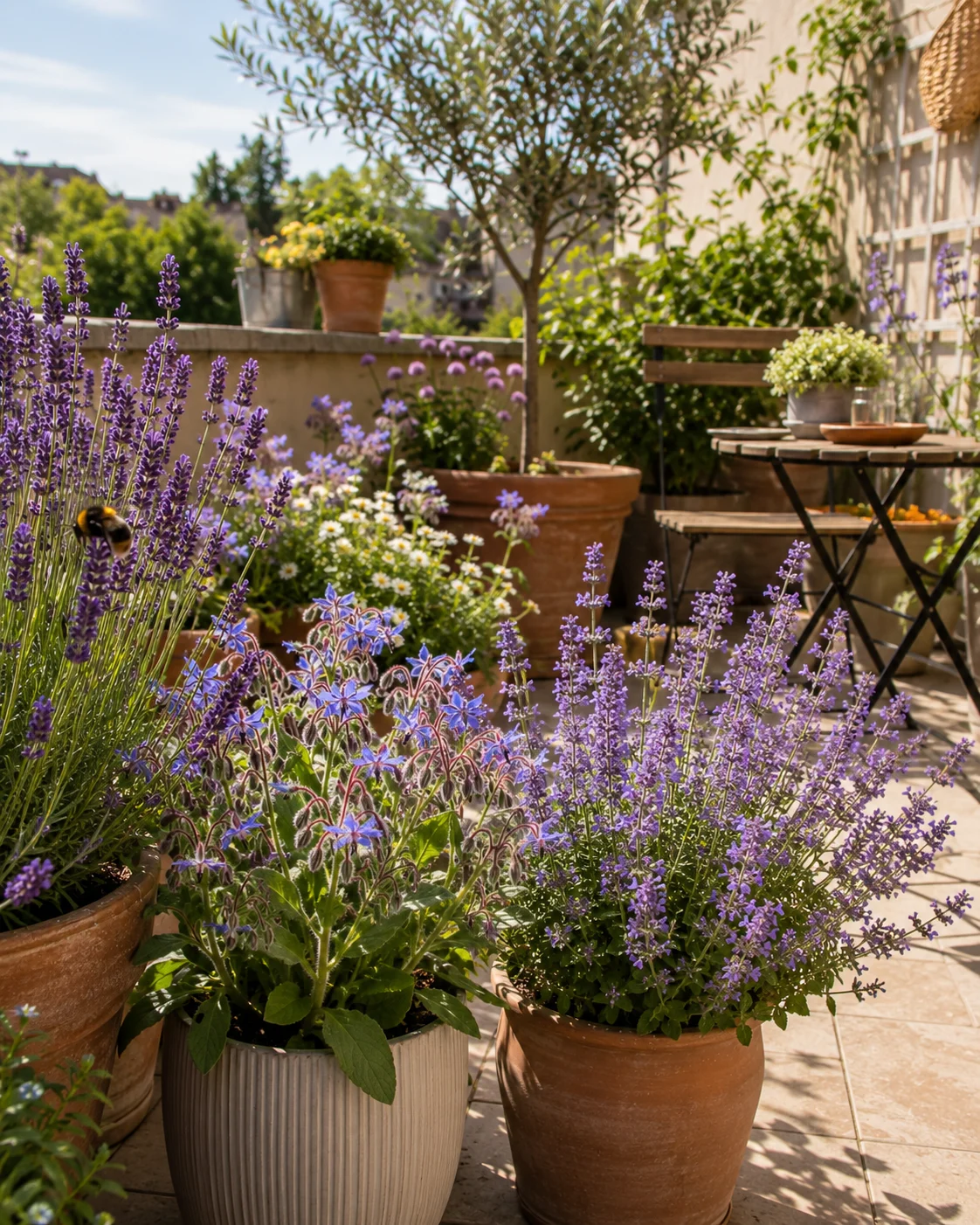
A terrace garden is often a person’s first serious encounter with container planting — and one of the best opportunities to make urban and suburban outdoor spaces meaningfully more useful to pollinators, without any additional effort beyond choosing the right plants.
Bees and other pollinators use terrace gardens in exactly the same way they use ground-level gardens. A container of lavender on a terrace produces nectar that foraging bees detect, visit, and return to just as reliably as the same plant in a border. A grouped display of borage, catmint, and agastache on a sunny terrace can be visibly working with bees on a warm morning within weeks of planting.
The specific plant choices that make the biggest difference for pollinators in a container setting — and how to sequence them for bloom from early spring through autumn so the terrace never leaves foraging bees with nothing — are covered in full in The Container Pollinator Garden: How to Feed Bees From a Balcony or Patio. If you want your terrace to be genuinely useful to bees rather than just incidentally visited by them, that guide gives you the complete framework.
21: The Colour Block Planting
Divide the terrace planting into distinct blocks of single colours rather than blending everything together — one cluster of all-white plants, one cluster of all-purple plants, one cluster of all-orange plants. Seen from inside the house, the blocks of colour read clearly and look confidently designed. The same plants mixed together would read as visual noise from the same distance.
22: The Decked Corner Platform
If any section of the terrace is lower than the rest, or if there is a previously unused corner, add a small raised decking platform — even 20cm above the surrounding paving — to create a distinct zone within the terrace. A simple square of hardwood or composite decking boards, built directly on adjustable joist feet, creates a warm, tactile surface in a corner that previously had no purpose.
Position the main seating on the decked platform and treat the surrounding paving as the circulation zone.
23: The Espalier Against the House Wall
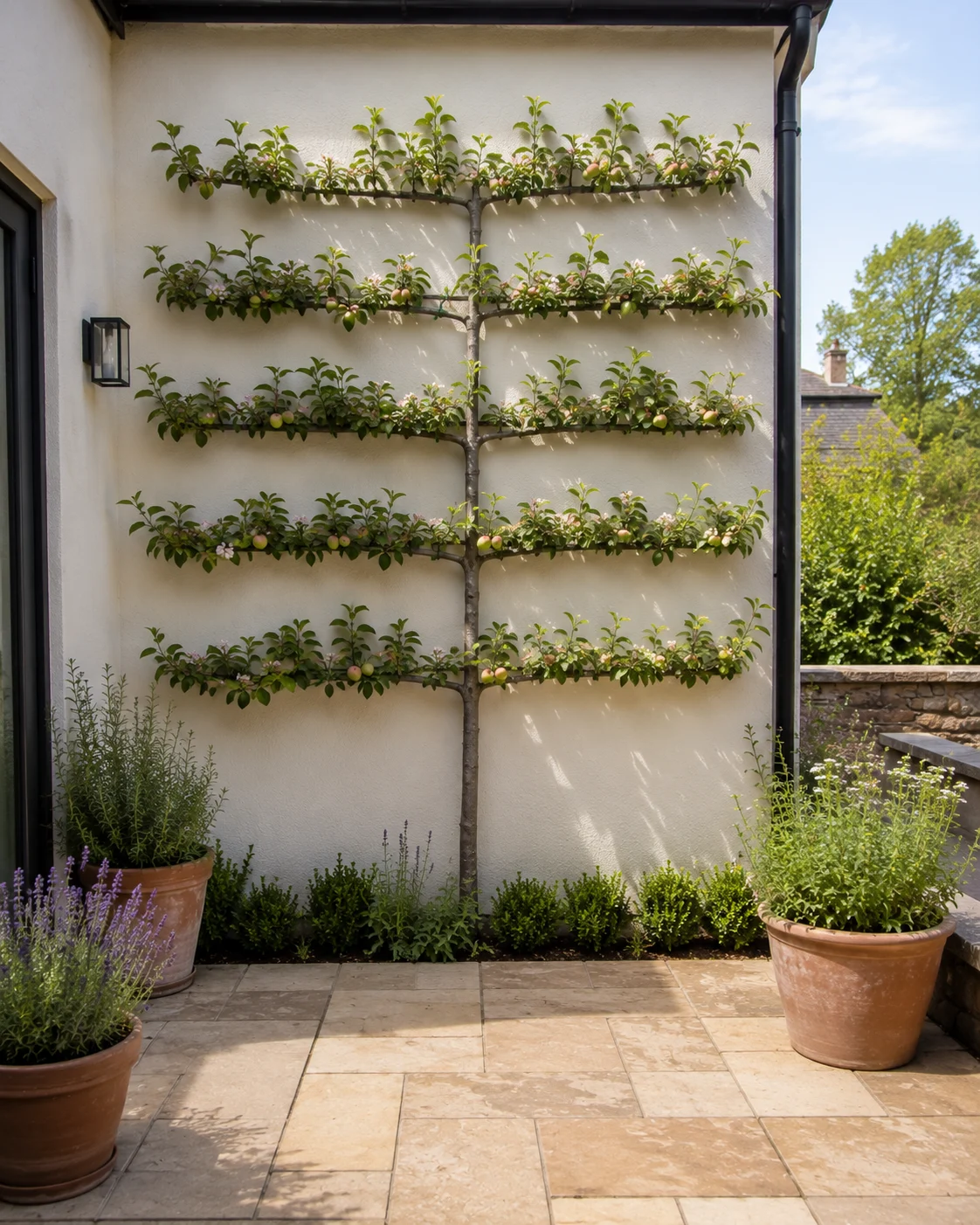
Train an espalier fruit tree — apple, pear, or quince — flat against the house wall behind the terrace. The geometric trained form covers a potentially blank wall surface with living green, produces blossom in spring and fruit in late summer, and takes up almost no terrace floor space since the tree grows against the wall rather than outward from it.
Fix a wire training system to the wall before planting. Space horizontal wires 40cm apart. The espalier will take 3–4 years to reach full coverage but provides interest from the first spring.
24: The Container Water Garden
A large watertight container — a half-barrel, a galvanised trough, or a purpose-made pot — filled with water and planted with dwarf water lily, water iris, and floating oxygenating plants creates a miniature pond on the terrace that adds movement, reflection, and wildlife interest in approximately two square feet of floor space.
A container water garden requires no electricity, no pump, and no permanent installation. Keep it in a position that receives 4–6 hours of sun daily for the water lily to flower. Submerge a small piece of barley straw in a mesh bag to control algae naturally.
25: The Cut Flower Terrace
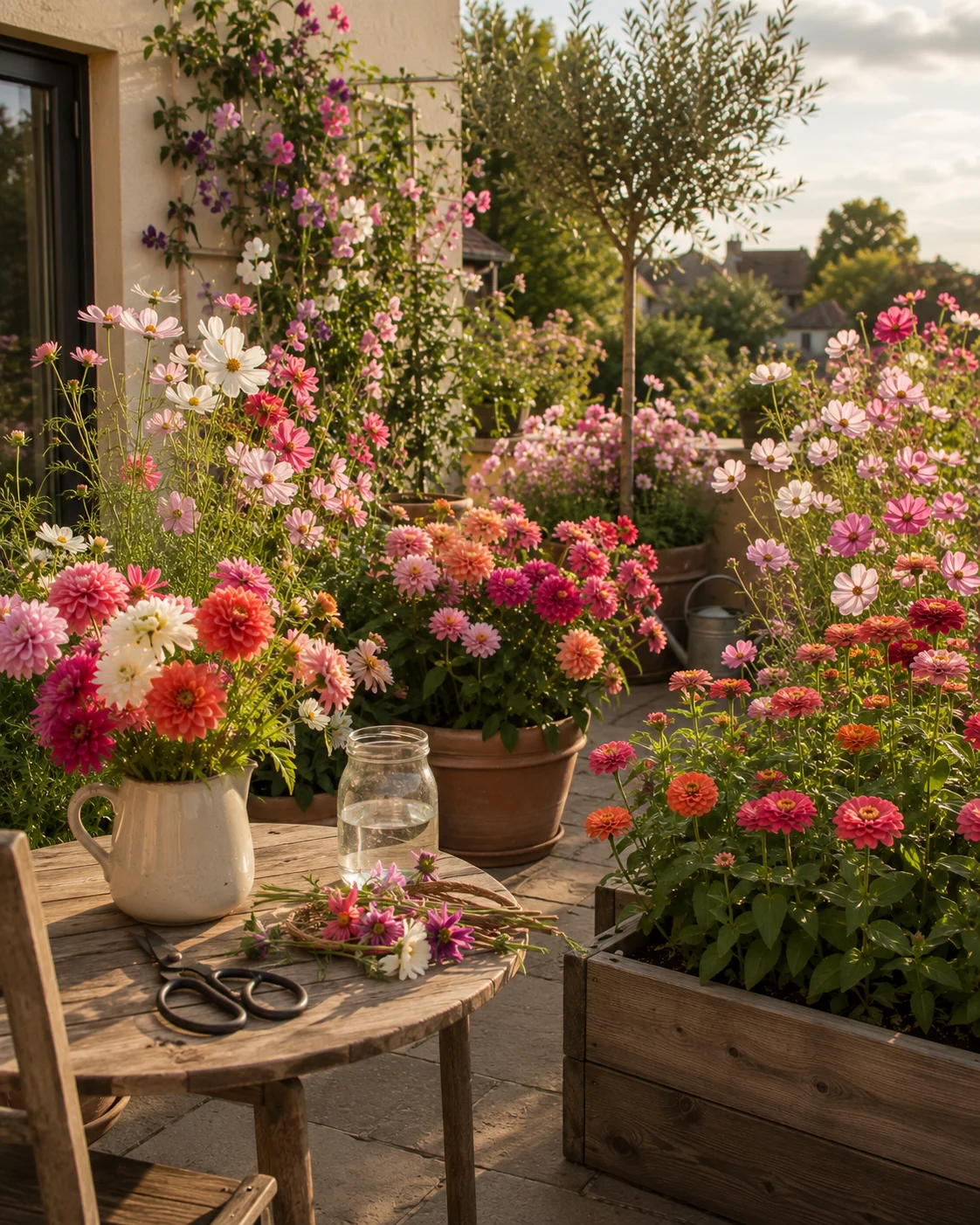
Plant the terrace specifically for cutting — sweet peas up a frame, cosmos in deep pots, dahlias in large containers, sunflowers in raised beds, zinnias in windowboxes. A cut flower terrace provides fresh flowers for the house from July to first frost and looks spectacular throughout the growing season from outside.
Cut flower plants are typically fast-growing annuals that need full sun and regular deadheading. The more you cut, the more they produce — the whole system rewards use rather than just looking at it.
26: The Recycled and Upcycled Containers
Olive oil tins, wooden wine crates, galvanised feed buckets, old colanders, vintage dairy crates, chimney pots, and weathered timber boxes all make effective and characterful terrace containers at zero or minimal cost. The contrast between rough, found containers and well-grown plants creates an aesthetic that expensive matching pots rarely achieve.
Drill drainage holes in anything without them. Line wooden containers with polythene (with drainage holes) to prevent wood rot. Use galvanised or terracotta as-found, since both are naturally weather-resistant.
27: The Lighting Design
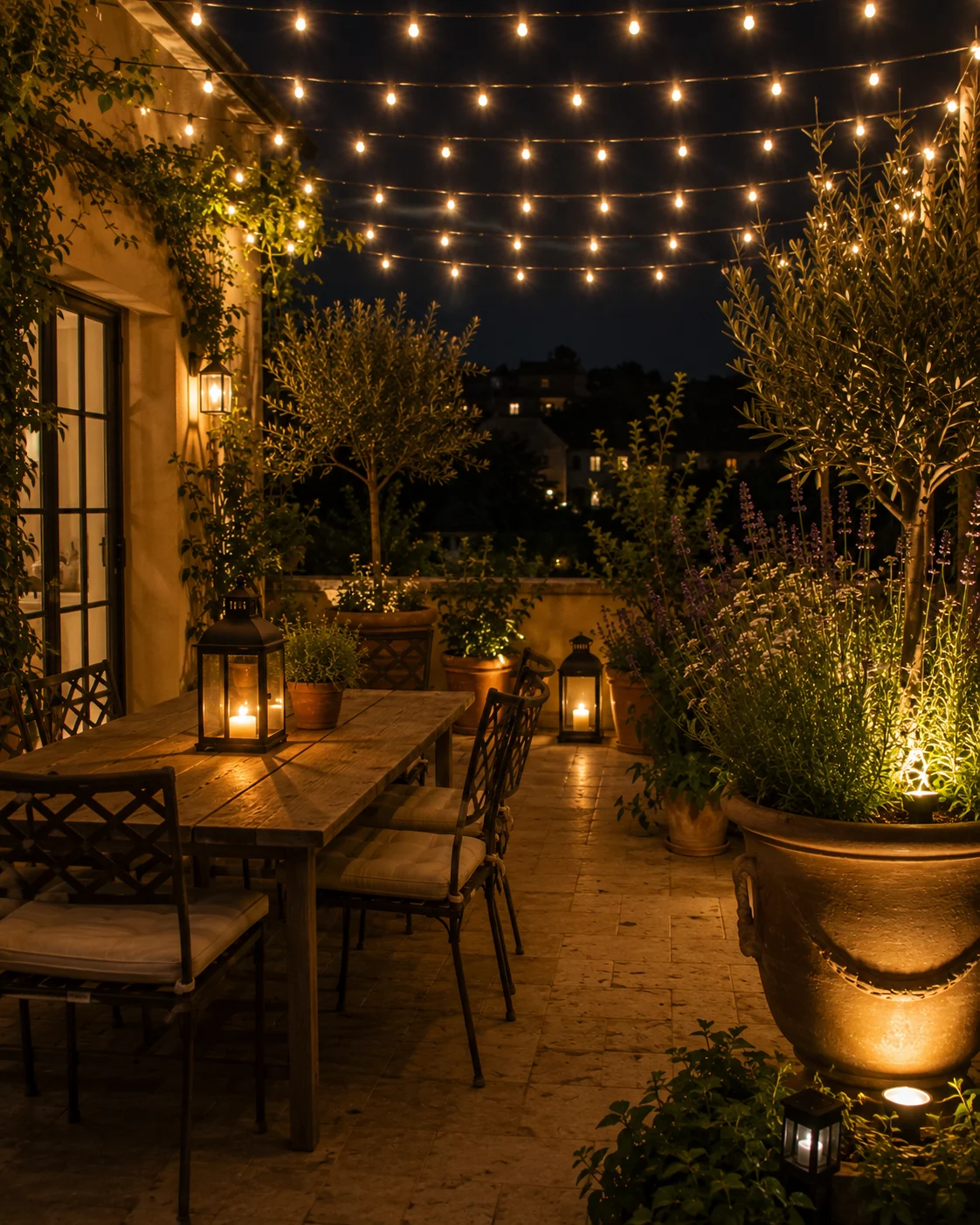
Terrace lighting is not just functional — it is the single most effective way to extend the usable hours of the space through spring and autumn. Consider three layers: ambient (string lights overhead or wall-mounted lanterns), task (a table lantern for dining), and accent (a solar uplighter on a statement pot, LED strip under a raised bed edge). The combination of all three creates a terrace that feels genuinely designed after dark rather than simply illuminated.
Solar string lights have improved enormously in quality and run time. For key positions, low-voltage plug-in systems are more reliable than solar in sheltered positions with limited sun.
28: The Seating Built Into the Structure
A built-in bench seat along one or two walls of the terrace — with a hinged lid and storage below — provides permanent, weatherproof seating that takes up far less visual space than freestanding chairs while offering practical storage for cushions, tools, and outdoor equipment. It also makes the terrace feel architecturally considered rather than furnished as an afterthought.
Build from exterior-grade hardwood, marine ply, or composite decking boards. Hinge the seat lid with stainless steel piano hinges for long-term reliability. Line the interior storage with pressure-treated timber to handle damp cushion storage.
29: The Winter Terrace
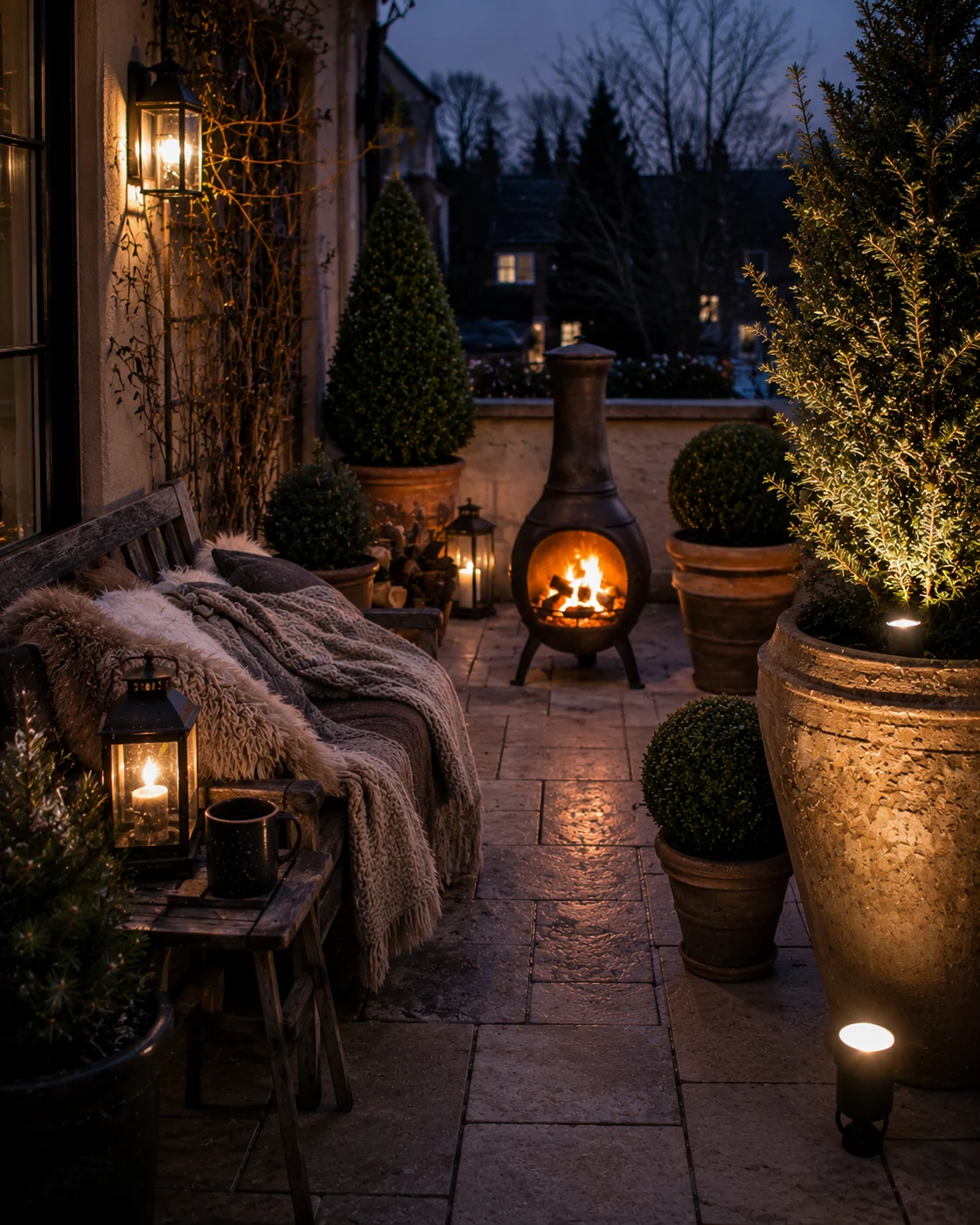
Most terraces are essentially abandoned from October to March, which represents half the year wasted. A terrace designed for winter use — with an outdoor heater, heavy outdoor blankets, a fire pit or chiminea, wind protection on the prevailing wind side, and evergreen planting that maintains structure through the cold months — becomes usable twelve months of the year rather than six.
Winter terrace planting: evergreen clipped topiary for structure, ornamental cabbages and kale for colour, winter-flowering heathers and hellebores for ground level interest, and bare-stemmed dogwood for its coloured winter stems.
30: The Four-Season Terrace
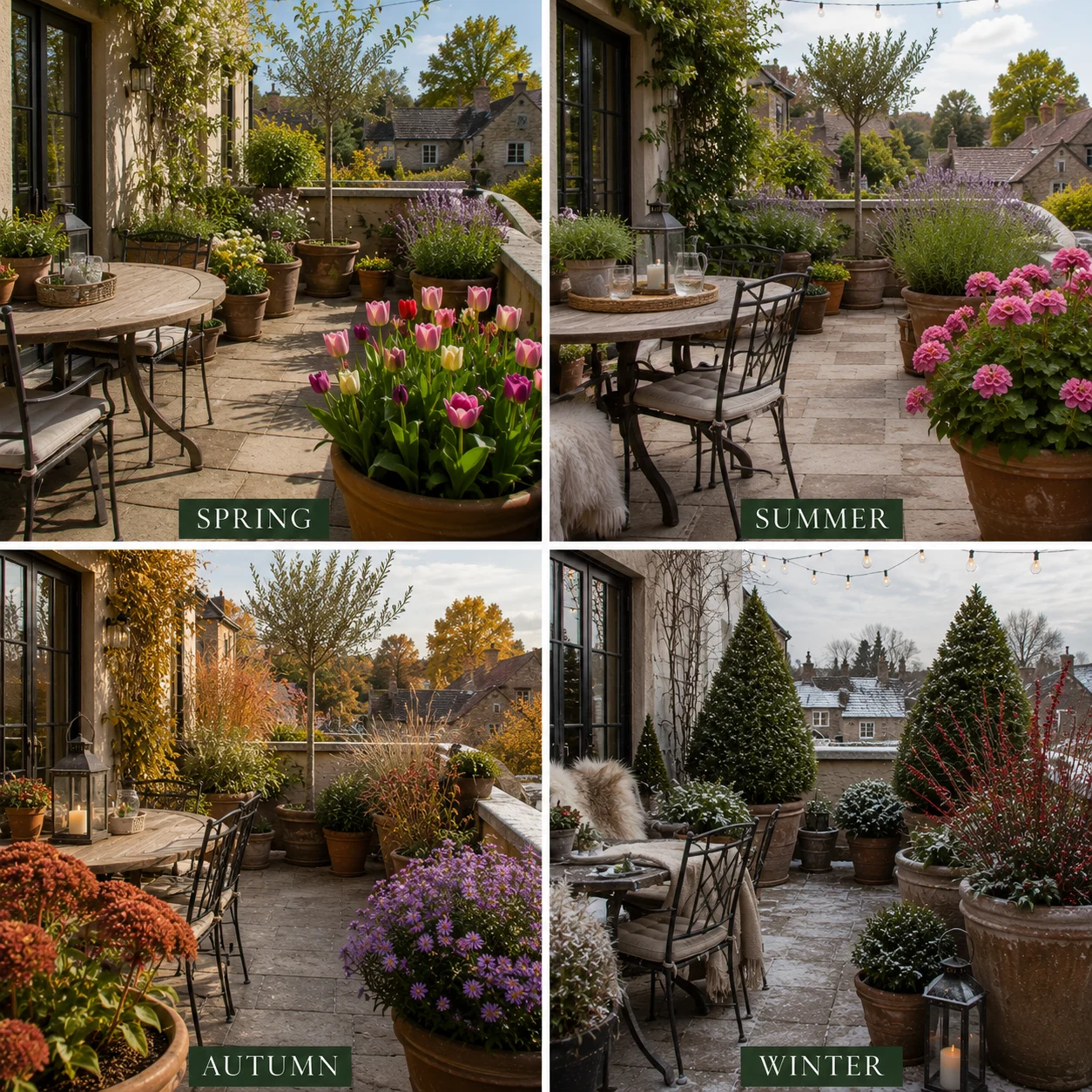
The most ambitious and most rewarding approach: design the terrace container planting as a complete four-season sequence so it is genuinely worth spending time in every month of the year. Spring bulbs in terracotta — tulips, muscari, alliums — give way to summer perennials in large pots, which transition to autumn asters and sedums, which are replaced by winter evergreens, berry stems, and early snowdrops.
This requires planning the seasonal rotation in advance, keeping replacement plants growing in a sheltered corner until needed, and committing to the replanting moments that keep the sequence moving. The effort is real but the result — a terrace that never looks bare or abandoned — makes every other investment in the space worthwhile.
For a complete framework for sequencing bloom through the entire year in a container setting, the same principles used in The Four-Season Pollinator Garden: A Beekeeper’s Blueprint for Nonstop Bloom apply directly to terrace container planting, with the seasonal structure adapted for pots rather than borders.
Making It Work: The Decisions That Matter
The most common terrace garden mistake is buying plants before solving the structural questions. Before spending anything on planting, answer four practical questions clearly.
What is the weight limit? A terrace over a basement or lower floor has a structural load limit. Large pots of wet compost are heavy — a 60-litre pot of saturated compost weighs 60–80kg. Distribute weight across the terrace rather than concentrating it in one corner, and use lightweight growing media (perlite-heavy mixes, or specialist lightweight compost) in the largest containers.
How much sun does it get? Most flowering terrace plants need 4–6 hours of direct sun minimum. A north-facing terrace in permanent shade needs a completely different plant palette — ferns, hostas, astilbes, and hellebores rather than lavender, tomatoes, and roses.
What is the watering situation? Containers dry out faster than borders — often daily in summer heat. A drip irrigation system connected to an outdoor tap with a timer is the most practical solution for a terrace with more than ten containers. Without it, summer watering becomes a significant time commitment.
What is the primary use? A terrace used mainly for dining has different furniture and planting priorities than one used mainly for relaxing, growing food, or morning coffee. Solve the primary use case first. Layer additional functions onto it only once the essential design is working.
The same spatial planning logic that applies to any small outdoor space — defining zones clearly, scaling furniture correctly, and layering uses without overcrowding the space — is covered in more detail in 42 Small Patio Designs You’ll Want to Copy (Whatever Your Budget), which addresses the same fundamental design challenges at a similar scale.
A terrace garden is not a compromise version of a garden. It is its own design format with its own logic, its own strengths, and its own pleasures — the intimacy of a contained space, the flexibility of container planting, and the satisfaction of making something beautiful in a place that most people leave as plain paving. Start with one good decision and build from there. 🌿