
Most garden boundaries waste space.
A wooden fence blocks the view. A row of identical evergreens blocks the view slightly more attractively. A clipped hedge may provide shelter, but it usually flowers once—if it flowers at all—and then contributes almost nothing to pollinators for the rest of the year.
A multi-layered boundary hedgerow works differently.
Instead of planting one repeated shrub in a straight line, you combine small trees, tall shrubs, medium flowering shrubs, perennials, grasses, groundcovers, and climbers. Each layer performs a different job, and each group of plants flowers at a different time.
The result can provide:
- Privacy without a solid wall
- Shelter from wind
- Multiple heights of wildlife cover
- Flowers from early spring through fall
- Berries and seeds later in the year
- More usable habitat than a single-species hedge
- A natural fly-up barrier near backyard beehives
Hedgerows are dense linear plantings traditionally built from woody plants, but modern pollinator hedgerows can also include perennial flowers and grasses. Xerces describes them as long-lasting living boundaries that may combine trees, shrubs, forbs, and grasses rather than relying on one uniform hedge species. (Xerces)
The key is not simply planting more.
It is arranging plants in layers and sequencing their flowering periods so the boundary keeps working after spring ends.
What Makes a Hedgerow “Multi-Layered”?
A standard hedge is usually one species, one height, and one repeated shape.
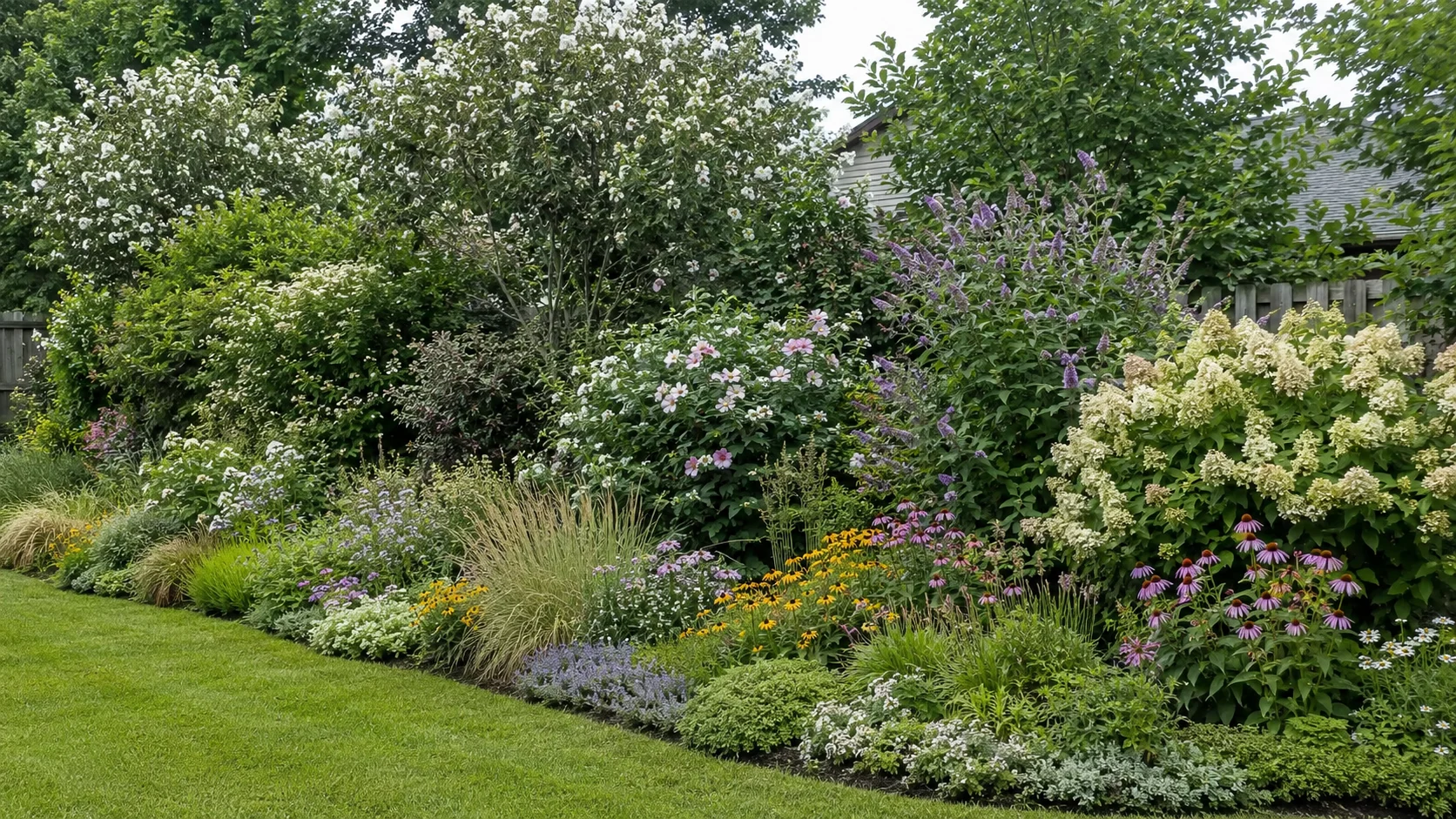
A layered hedgerow has depth.
Viewed from the side, it resembles the edge of a woodland:
- Small trees form the highest canopy.
- Tall shrubs fill the upper-middle layer.
- Medium shrubs close gaps at eye level.
- Perennials and grasses cover the base.
- Groundcovers protect the soil.
- Climbers weave through selected sections.
This structure matters because a boundary with plants at several heights provides more flowers, more shelter, and better visual screening than a single thin row.
It also helps you use the available vertical space. A 5-foot-wide planting strip can support ground-level flowers, waist-high shrubs, and taller flowering branches simultaneously. A clipped evergreen hedge occupying the same footprint usually offers only foliage.
Hedgerows can also function as windbreaks, erosion control, and wildlife habitat. University of Minnesota Extension identifies those functions as core benefits of hedgerows planted along boundaries and field margins. (University of Minnesota Extension)
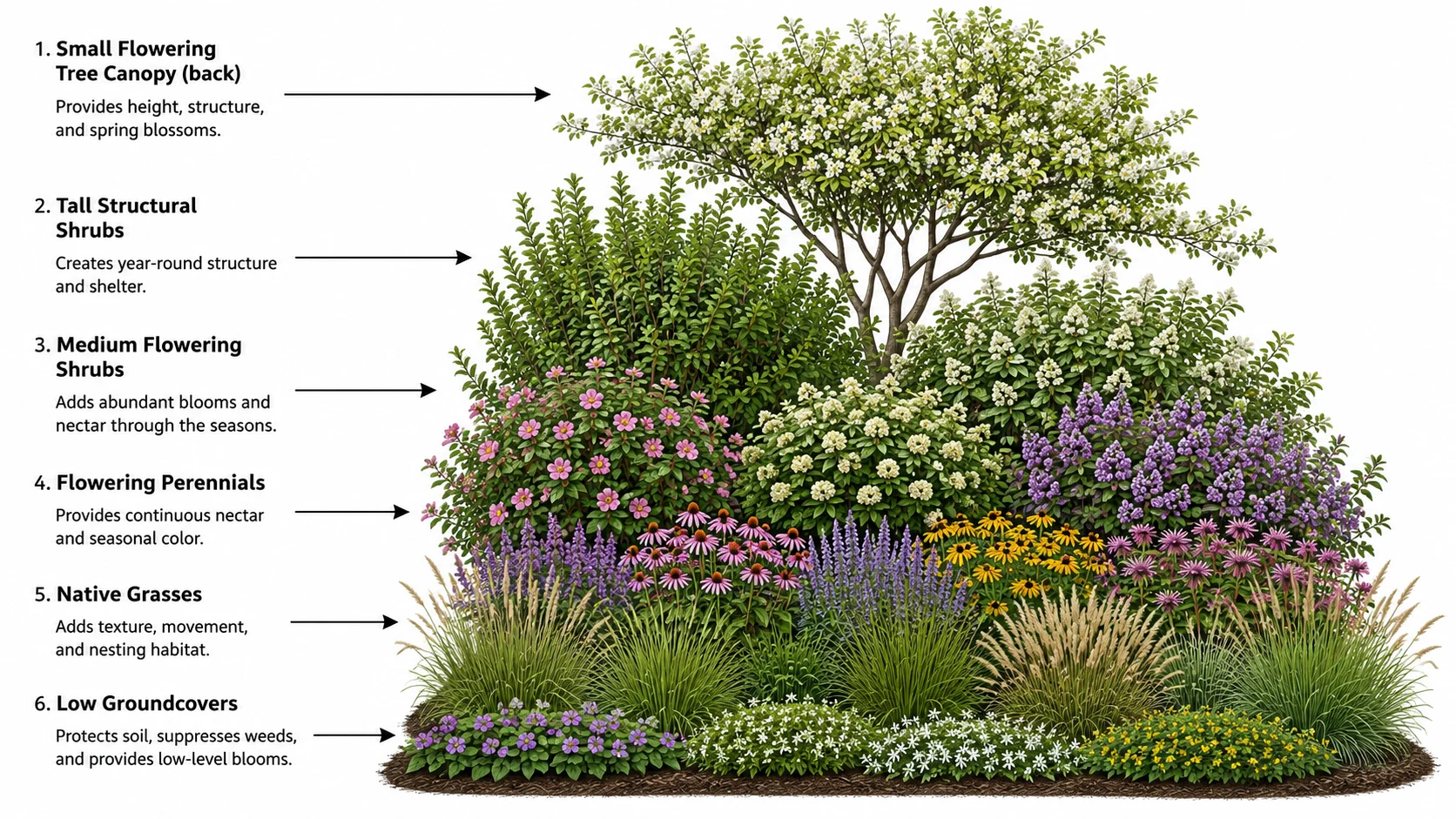
The Six Layers of a Bee-Friendly Boundary Hedgerow
You do not need all six layers in every yard. Small gardens may use only three or four. The point is to avoid creating one flat wall of identical plants.
Layer 1: Small Flowering Trees
Small trees create the upper structure of the hedgerow.
They provide early flowers above the shrubs, cast partial shade, interrupt views from neighboring upper windows, and give birds places to perch. Their roots also occupy a different soil zone than many shallow-rooted perennials.
Depending on your region, possible choices may include:
- Serviceberry
- Eastern redbud
- Crabapple with accessible single flowers
- Hawthorn
- Fringe tree
- Desert willow in suitable warm, dry regions
- Native plum species
- Small native willow species where moisture allows
Choose trees based on mature size, not the size of the container at the nursery. A tree that reaches 30 feet wide does not belong three feet from a property line or utility cable.
Use them as occasional anchors rather than planting a continuous row. In many residential hedgerows, one small tree every 15–25 feet is enough.
Layer 2: Tall Structural Shrubs
This is the privacy layer.
Tall shrubs create the dense body of the boundary, slow wind, and provide the woody framework around which smaller plants can be arranged.
Possible choices include:
- Elderberry
- Serviceberry grown as a multi-stem shrub
- Arrowwood viburnum
- Nannyberry
- Blackhaw viburnum
- American hazelnut
- Wax myrtle in suitable regions
- Native holly species
- Large shrub dogwoods
Shrubs are often underused in pollinator planting even though many provide flowers, nesting cover, fruits, and winter structure. Penn State Extension highlights native shrubs as valuable habitat for honey bees, native bees, butterflies, moths, beetles, flies, and other wildlife. (extension.psu.edu)
Do not line them up like soldiers. Offset them slightly and allow their mature canopies to overlap. That creates screening without making the design look like a municipal parking-lot hedge.
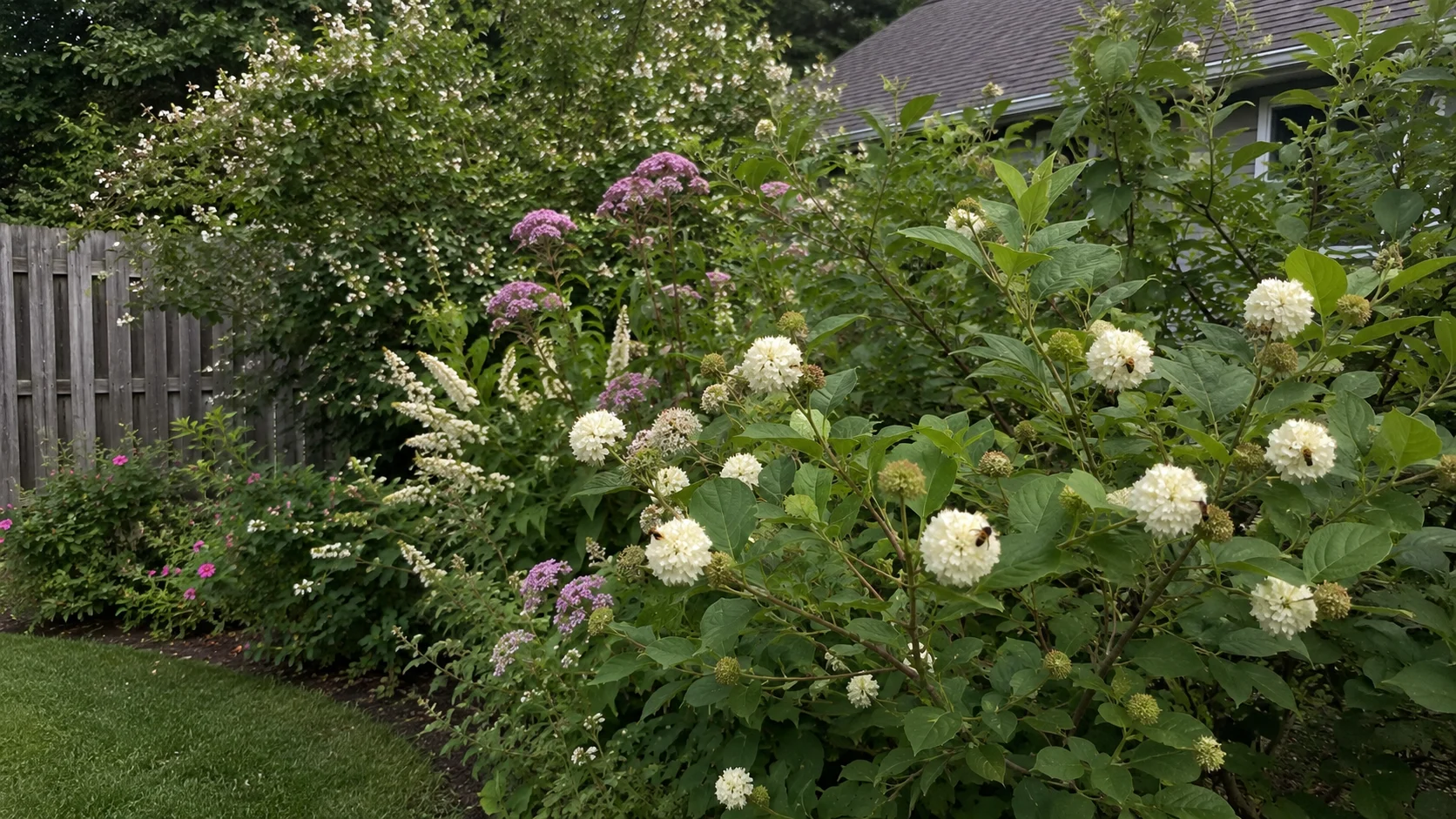
Layer 3: Medium Flowering Shrubs
This layer carries much of the season-long flower display.
Medium shrubs fill the lower gaps between taller plants and can be chosen specifically to cover periods when the structural shrubs are not blooming.
Depending on region and site conditions, options may include:
- Spicebush
- Summersweet
- New Jersey tea
- Chokeberry
- Buttonbush in moist soil
- Shrubby St. John’s wort
- Native roses
- Blueberry in acidic soil
- Ninebark
- Beautyberry in suitable warm regions
A good medium shrub layer should not peak all at once.
For example:
- Spicebush can cover early spring.
- Chokeberry and viburnum can cover later spring.
- Summersweet and buttonbush can cover midsummer.
- Beautyberry can add summer flowers followed by fall fruit.
This is where a layered hedgerow becomes more useful than a conventional hedge. Instead of one two-week bloom, you create a relay.
Layer 4: Flowering Perennials
Perennials fill the sunny edge at the base of the hedgerow.
They are especially important during summer because many spring-flowering trees and shrubs have already finished. NRCS recommends using hedgerows with a broad range of plants and overlapping bloom periods to support bees throughout the growing season. (Natural Resources Conservation Service)
Useful groups may include:
Early season
- Golden Alexanders
- Wild geranium
- Columbine
- Woodland phlox
- Native violets
Midsummer
- Mountain mint
- Bee balm
- Milkweed
- Culver’s root
- Anise hyssop
- Coneflower
- Joe-Pye weed
Late season
- Goldenrod
- Asters
- Sneezeweed
- Ironweed
- Late boneset
Plant these in visible groups, not as isolated single specimens. The US Forest Service recommends using a wide range of plants from early spring into late fall and arranging flowers in clumps so pollinators can locate and use them more easily. (US Forest Service)
Three mountain mint plants together are useful.
One mountain mint plant hidden between six unrelated ornamentals is mostly decoration.
Layer 5: Native Grasses and Sedges
Grasses do not provide much nectar, but that does not make them useless.
They contribute:
- Nesting and overwintering structure
- Support for taller flowers
- Root density that helps stabilize soil
- Cover at the base of shrubs
- Winter texture
- Competition against unwanted weeds
Possible choices include:
- Little bluestem
- Prairie dropseed
- Switchgrass cultivars of appropriate size
- Pennsylvania sedge
- Appalachian sedge
- Purple lovegrass
- Regional bunchgrasses
Use grasses as the connective tissue of the planting, not as the dominant feature. A pollinator hedgerow composed mostly of ornamental grass is visually fashionable but nutritionally weak.
Layer 6: Groundcovers and Low Edge Plants
Bare soil between young shrubs quickly becomes weed territory.
Low plants protect that soil while adding another flowering layer.
Possible choices include:
- Wild strawberry
- Self-heal
- Native violets
- Pussytoes
- Creeping phlox
- Wild ginger in shade
- Low sedges
- Foamflower
- Regional native geraniums
Avoid covering the entire bed with landscape fabric and decorative rock. That may suppress weeds temporarily, but it also creates a hot, rigid planting bed that becomes difficult to revise as the shrubs mature.
A living ground layer changes with the hedgerow and allows leaves to accumulate between plants.
Optional Layer: Climbers
Climbers can fill narrow vertical gaps without requiring another large shrub.
Possible choices include:
- Coral honeysuckle
- Native clematis
- Native climbing roses
- Crossvine in suitable regions
- Virgin’s bower
- California pipevine in its native range
Use support wires or trellises rather than allowing vigorous vines to bury young shrubs. A climber is useful only while it remains subordinate to the structure.
Why Bloom Sequence Matters More Than Flower Count
A hedgerow containing 20 flowering species can still fail bees if 17 of them bloom in May.
What matters is not just diversity. It is timing.
The USDA recommends native plants partly because they provide nectar, pollen, shelter, and other ecological benefits while being adapted to regional conditions. (USDA) But even an all-native planting needs deliberate seasonal planning.
Divide the bloom calendar into four working periods.
Early spring: wake-up forage
Early flowers support insects emerging when the wider landscape may still be sparse.
Possible contributors:
- Willow
- Serviceberry
- Redbud
- Spicebush
- Native plum
- Violets
Late spring: peak shrub bloom
This is often the easiest window to fill.
Possible contributors:
- Viburnum
- Chokeberry
- Blueberry
- Ninebark
- Elderberry
- Native rose
Midsummer: the dangerous gap
This is where weak designs collapse.
Possible contributors:
- Buttonbush
- Summersweet
- Mountain mint
- Bee balm
- Milkweed
- Culver’s root
- Joe-Pye weed
Late summer and fall: winter preparation
Late flowers help extend forage after many garden plants have stopped blooming.
Possible contributors:
- Goldenrod
- Asters
- Ironweed
- Sneezeweed
- Late boneset
Do not select plants from memory and hope the sequence works. Create a simple calendar before buying anything.
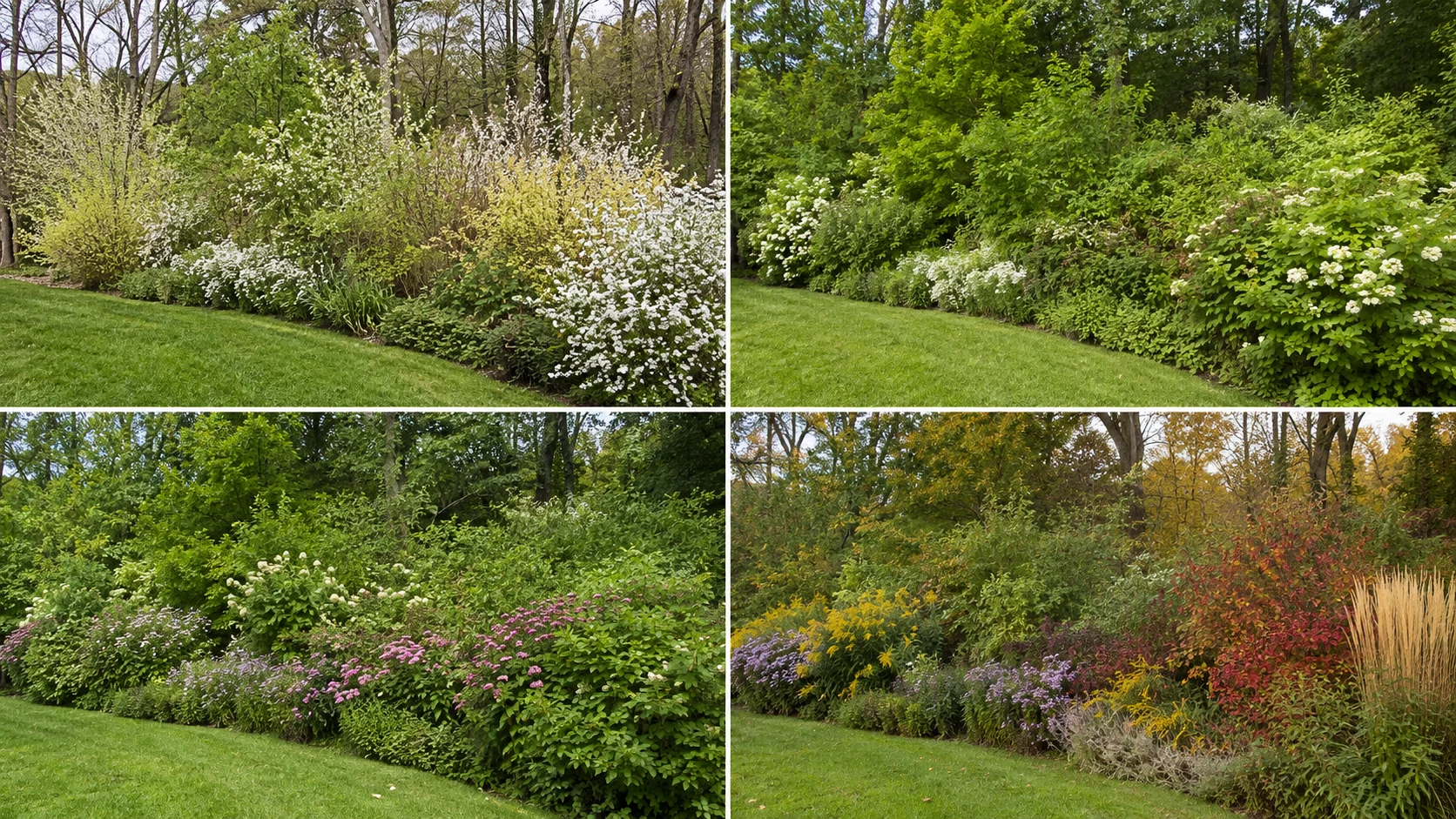
A Simple Bloom-Planning Table
| Season | Upper Layer | Shrub Layer | Ground and Perennial Layer |
|---|---|---|---|
| Early spring | Willow, serviceberry, redbud | Spicebush | Violet, wild geranium |
| Late spring | Native plum, hawthorn | Viburnum, chokeberry, blueberry | Columbine, golden Alexanders |
| Early summer | Elderberry | Ninebark, native rose | Milkweed, bee balm |
| Midsummer | — | Buttonbush, summersweet | Mountain mint, Culver’s root, Joe-Pye weed |
| Late summer | — | Beautyberry flowers | Ironweed, sneezeweed |
| Fall | Fruit and seed structure | Berries and hips | Goldenrod, asters, late boneset |
This is an example, not a universal shopping list. Native ranges, winter temperatures, rainfall, soil drainage, and local invasive-species rules differ across the United States.
Use regional extension plant lists and native-plant databases before finalizing the palette.
Design the Hedgerow for Depth, Not Just Length
A one-row hedge may screen a boundary, but it cannot provide the same structural diversity as a layered planting.
For a full residential hedgerow, aim for approximately:
- Back row: small trees and tall shrubs
- Middle row: medium shrubs
- Front row: perennials, grasses, and groundcovers
A practical depth is often 5–10 feet, depending on plant choices.
That sounds wide until you compare it with the amount of lawn many yards waste along their property lines. A lawn strip that is rarely walked on produces almost nothing. Converting part of it into a layered boundary can add privacy and habitat without sacrificing the usable center of the yard.
For narrow gardens, reduce the design to three layers:
- Tall flowering shrubs
- Medium compact shrubs
- Perennials and sedges
Do not force large trees into a 3-foot bed. That is not ambitious design. It is future removal work.
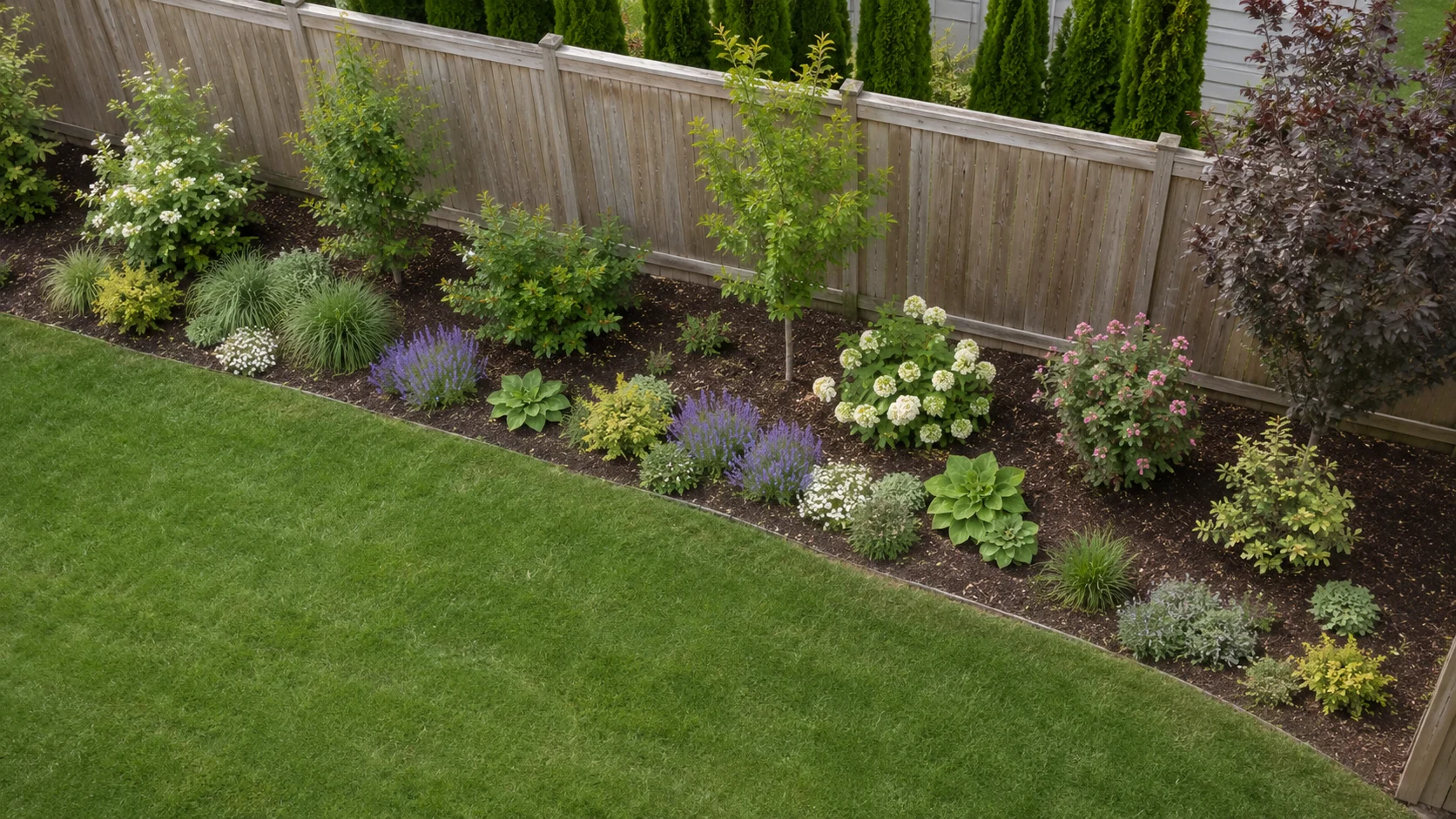
Use Repetition Without Creating a Monoculture
Pure randomness looks messy. Pure repetition creates a sterile hedge.
The better approach is repeated groups.
For example:
- Repeat elderberry three times along a long boundary.
- Repeat summersweet in groups of three.
- Run mountain mint through several sunny sections.
- Repeat asters at intervals near the front.
- Use one grass species to visually connect the whole planting.
This gives the garden rhythm while preserving species diversity.
A useful ratio is:
- 3–5 structural species
- 4–7 flowering shrub species
- 6–10 perennial and grass species
You do not need 40 species in a small yard. A smaller palette repeated well will look intentional and be easier to manage.
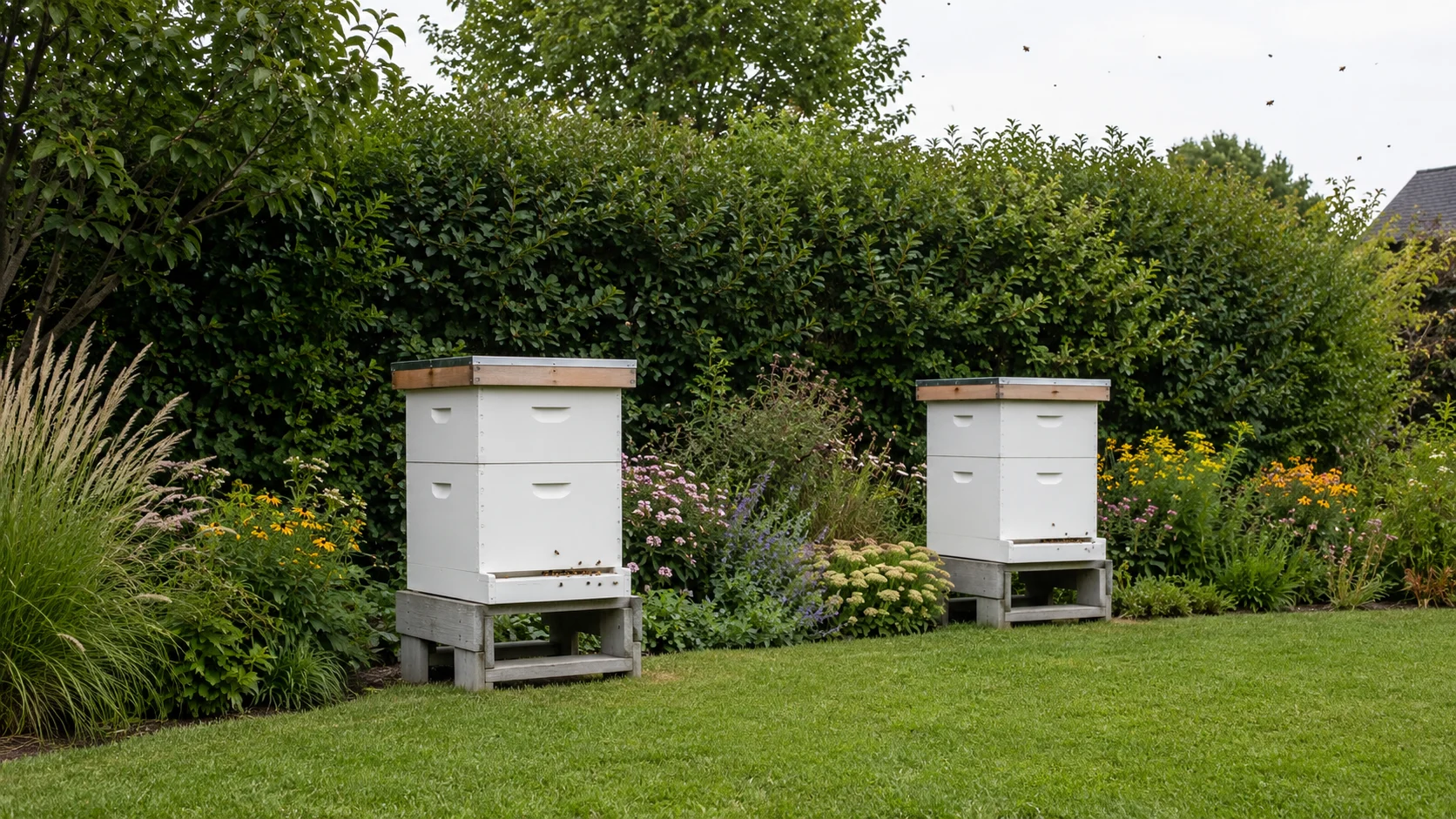
How a Layered Hedgerow Helps a Backyard Apiary
Near a backyard beehive, a layered boundary can do more than produce flowers.
It redirects flight
A tall, dense boundary can encourage departing bees to gain altitude before crossing a walkway or neighboring property.
It reduces wind
Woody boundaries can slow wind around the hive zone. Hedgerows and other agroforestry plantings are recognized for providing wind protection and pollinator habitat. (US Forest Service)
It adds close-range forage
A backyard hedgerow will not feed an entire colony by itself. Pretending otherwise is nonsense. Honey bees forage across a much larger landscape.
However, a flower-rich boundary can provide reliable nearby forage during particular bloom periods and can also support native bees, butterflies, hoverflies, beetles, and other insects.
It creates privacy
The vegetation can screen inspections and hive equipment from neighbors without making the yard feel boxed in.
Keep the immediate working area around the hives open. Branches, flowers, and vines should not obstruct the landing board or prevent you from lifting boxes safely.
Planting the Hedgerow Without Creating a Maintenance Disaster
A layered planting is lower-maintenance only after it establishes. The first two years require work.
Step 1: Remove aggressive weeds
Do not plant expensive shrubs directly into bindweed, invasive grass, or established ground ivy and expect them to win.
Clear the planting strip properly before installation.
Step 2: Mark mature plant widths
Place shrubs based on mature spread, not the gaps visible on planting day.
Crowding everything together creates quick fullness followed by disease, tangled access, and expensive removal.
Step 3: Plant the woody structure first
Install trees and shrubs before adding perennials. It is easier to position the large plants while the bed is open.
Step 4: Fill with repeated perennial groups
Use clumps and drifts around the woody plants while leaving room for shrub expansion.
Step 5: Mulch during establishment
Use an appropriate organic mulch around young plants while groundcovers establish. Keep mulch away from trunks and stems.
Step 6: Water deeply
New woody plants need consistent establishment watering. Shallow daily sprinkling encourages weak surface roots.
Step 7: Replace failures quickly
A dead shrub creates a gap that weeds will occupy. Replace failed plants during the next suitable planting season.
Mistakes That Ruin Layered Hedgerows
Planting everything at the same height
That creates a flower border, not a layered hedgerow.
Choosing plants only for spring
A spectacular May hedge followed by four flowerless months is not season-long habitat.
Ignoring mature width
The planting may look empty in year one. Do not solve that by cramming shrubs together.
Using only cultivars with double flowers
Highly modified double flowers can make nectar and pollen harder for insects to access. The Forest Service advises avoiding many doubled modern hybrids in pollinator gardens. (US Forest Service)
Planting invasive shrubs because they grow quickly
Fast growth is not automatically an advantage. Check regional invasive lists before planting privet, burning bush, barberry, multiflora rose, or non-native honeysuckles.
Removing every fallen leaf and dead stem
A hedgerow is habitat, not a hotel lobby. Allow some leaf litter under shrubs and retain safe standing stems through winter where practical.
Expecting instant privacy
A functioning mixed hedgerow takes time. Buying larger plants can accelerate screening, but good structure still develops over several growing seasons.
A Practical Small-Yard Hedgerow Example
For a sunny 30-foot boundary, a manageable design might include:
Structural layer
- Two serviceberries
- Three arrowwood viburnums
- Two elderberries
Medium shrub layer
- Three chokeberries
- Three summersweets
- Two compact native roses
Perennial layer
- Three groups of mountain mint
- Three groups of bee balm
- Two groups of milkweed
- Goldenrod and asters repeated along the front
Connecting layer
- Clumps of little bluestem
- Wild strawberry or sedges between larger plants
The exact plants should change by region, but the logic remains the same:
- Upper flowers in spring
- Shrub flowers in late spring and summer
- Perennials carrying bloom through midsummer
- Goldenrod and asters finishing the season
- Grasses and stems holding the structure together
Conclusion: Make the Boundary Do More
A boundary should not merely mark where your property ends.
A properly designed multi-layered hedgerow can screen the yard, slow wind, soften noise, cover bare soil, support wildlife, and provide a sequence of flowers from spring through fall.
The design rule is simple:
Build upward, outward, and through the seasons.
Use small trees selectively. Let tall shrubs create structure. Fill gaps with medium flowering shrubs. Carry summer and fall with perennials. Use grasses and groundcovers to connect everything.
Most importantly, stop designing around one perfect month.
A boundary that flowers heavily in May and starves pollinators in July is incomplete. Choose overlapping bloom periods so each layer hands the job to the next.
That is the real trick.
Not more plants.
Better timing, better structure, and a boundary that keeps working all year.
Keep Reading 🐝
- The Living Fence: How to Build a Bee-Friendly Boundary That Doubles as Forage — compare hedgerow design with a simpler living privacy screen.
- Best Plants to Grow Near a Backyard Beehive — select flowers, shrubs, and herbs for each part of the season.
- The July Nectar Crash: Why Your Hive Can Struggle in Midsummer — understand why the middle layer must include reliable summer bloom.
- The No-Mow May Survival Guide: What to Let Grow and What to Pull — connect your boundary planting to a more deliberate lawn-management strategy.