
There is a particular kind of neighbor shame that settles in around this time of year. The lawn next door is a crisp, uniform green — edged with surgical precision, free of dandelions, clover, or anything that might suggest the grass has opinions of its own. And then there’s yours. A little long. A few wildflowers doing what they want. Some patches where the clover has clearly won the argument. A corner that you keep meaning to clear but somehow never do.
Here is what the science says about your lawn versus your neighbor’s: yours is better. Not aesthetically, perhaps — that is a matter of taste. But ecologically, biologically, and in terms of its actual contribution to the living world around it, the imperfect lawn consistently outperforms the perfect one by every meaningful measure.
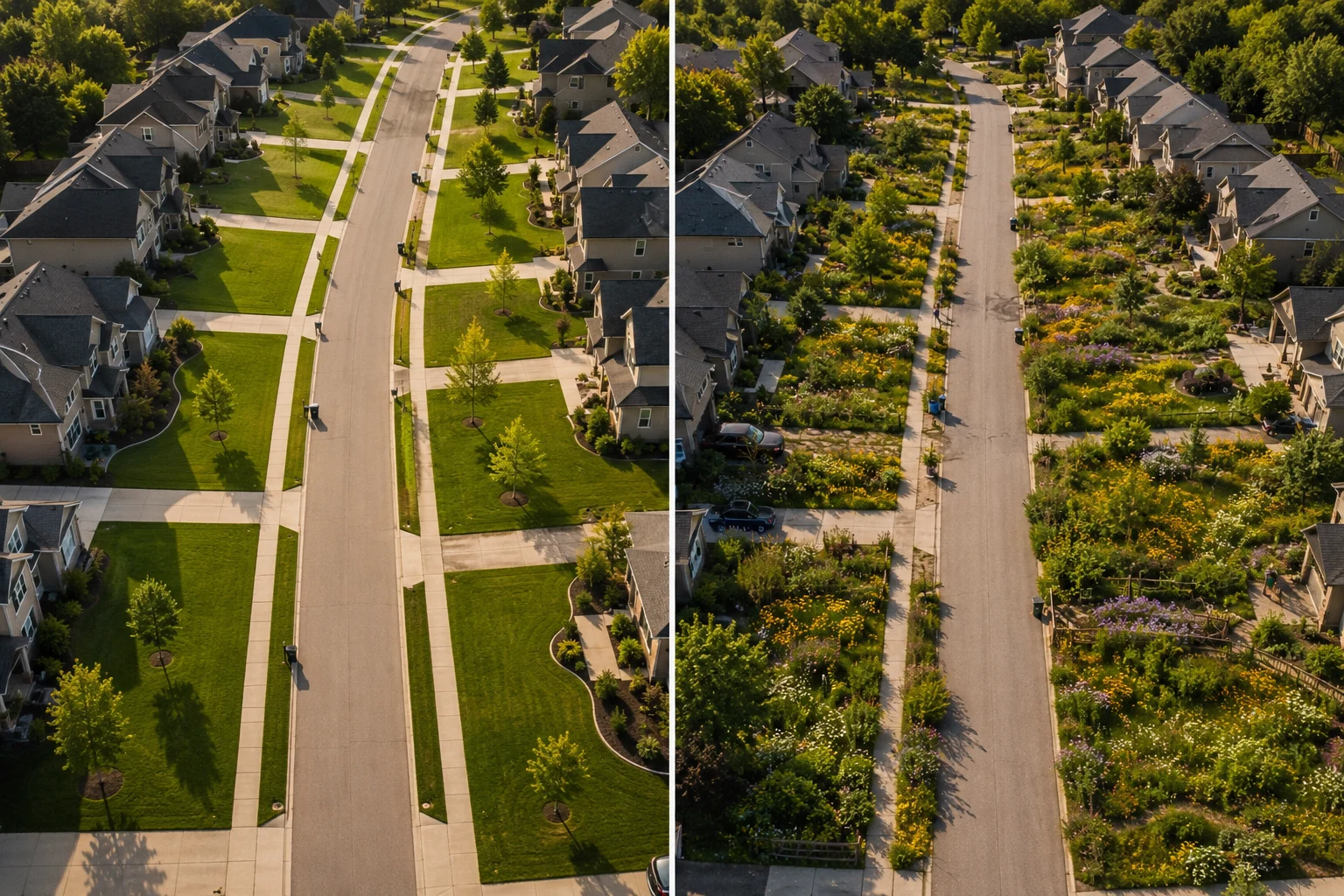
The perfectly manicured American lawn — the 40 million acres of it that we collectively maintain at enormous expense of time, water, fuel, and pesticide — is, from a pollinator’s perspective, a green desert. It provides nothing to eat, nowhere to nest, and no shelter from weather or predators. It is the most widespread monoculture in North America, maintained at a cost that would astonish most people if they added it up, in exchange for an aesthetic that has only been culturally dominant for about 70 years and has no ecological justification whatsoever.
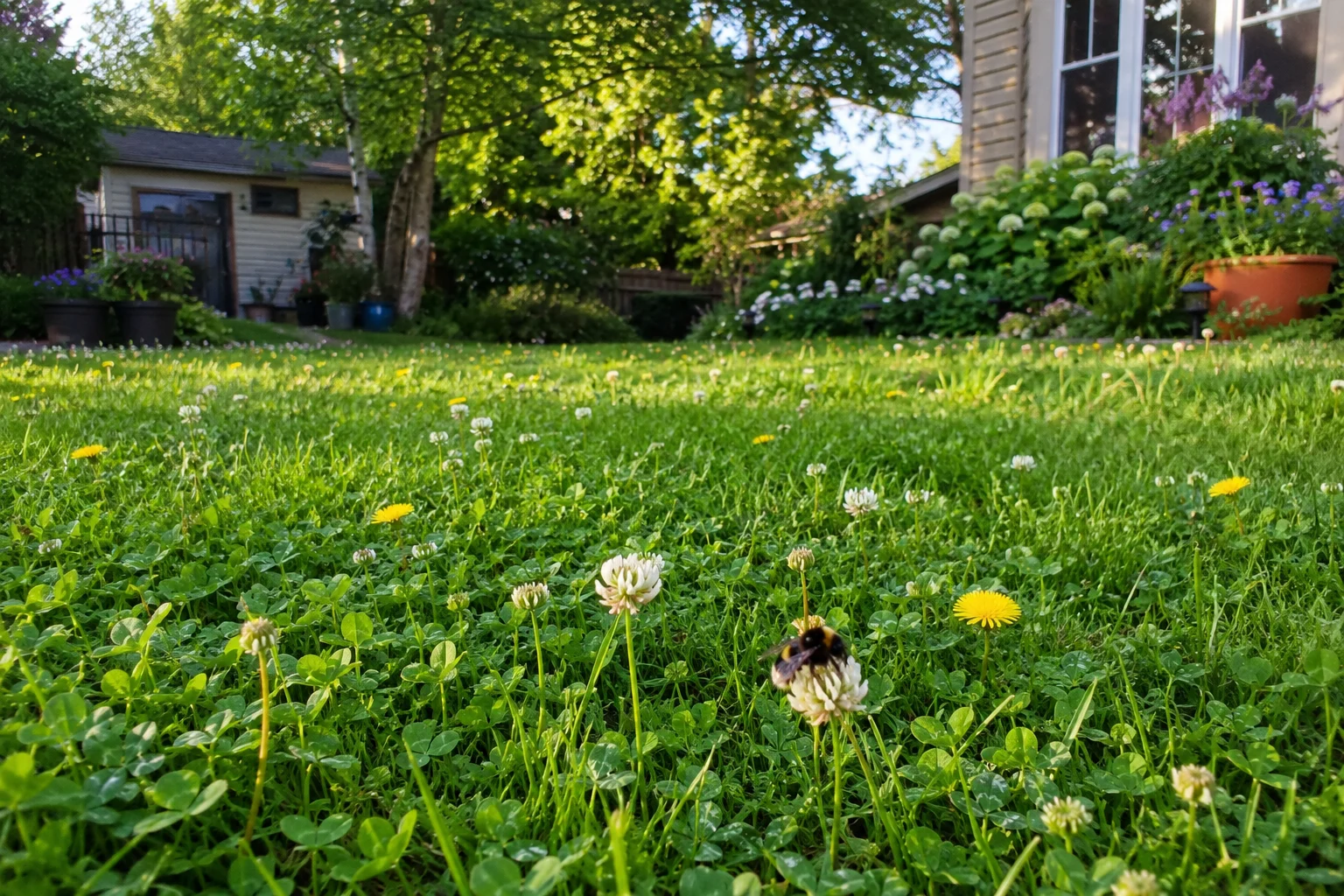
The imperfect lawn, by contrast, is doing something. Every dandelion is feeding a queen bumblebee trying to found her spring colony. Every clover patch is a working food source for a dozen bee species simultaneously. Every unmown corner is potential nesting ground for the ground-nesting solitary bees that constitute the majority of North America’s 4,000 native bee species. Every seed head left standing through winter is a food source for birds and a hibernation site for native bees that overwinter as adults inside hollow stems.
This post is your scientific permission slip. We’ll cover exactly what the research shows about lawn ecology and pollinator health, which specific “weeds” are doing the most ecological work in your yard, what to stop mowing and what to stop removing, how to manage the transition from conventional lawn to pollinator habitat without your yard looking abandoned, and how to have the conversation with neighbors, HOA boards, or your own internalized voice that keeps telling you to mow everything down.
The American Lawn: A Brief History of a Biological Desert
Understanding why the perfect lawn is ecologically empty requires a brief look at where it came from — because the manicured grass lawn is not an ancient tradition, a natural landscape, or an inevitable outcome of human habitation. It is a mid-20th century cultural construct, and a remarkably recent one.
Before World War II, most American residential yards were functional spaces — kitchen gardens, fruit trees, mixed plantings of edibles and ornamentals, and patches of rough grass that served as play areas rather than aesthetic statements. The uniform grass lawn as a status symbol and aesthetic norm emerged in the postwar suburban expansion of the 1950s, driven by a combination of factors: the availability of affordable gas-powered lawnmowers, the expansion of the chemical industry (including pesticide companies whose wartime production capacity needed peacetime applications), and the marketing of lawn care products to a newly suburban middle class with disposable income and a desire for visible prosperity.
The cultural idea that a perfect lawn signals a good homeowner — and that anything growing in it that wasn’t planted there deliberately represents a failure of care — is approximately 70 years old. It is younger than most of the trees in your neighborhood. And it has cost the North American landscape an ecological price that researchers are only now beginning to fully quantify.
A 2020 study published in Science of the Total Environment estimated that the total area of lawn in the contiguous United States exceeds 40 million acres — more than three times the area devoted to any single irrigated crop. This lawn consumes approximately 9 billion gallons of water per day, requires 70 million pounds of pesticides per year, and produces virtually zero ecological value in return. It supports almost no native insect species, provides no food for pollinators, and offers minimal structural habitat for any wildlife.
The 4,000+ species of native bees in North America evolved over millions of years in landscapes of native flowers, diverse grasses, bare soil patches, and woody debris. They did not evolve for the Kentucky bluegrass monoculture. And their populations — down significantly across most monitored species over the past several decades — reflect that mismatch with painful clarity.
What Your “Weeds” Are Actually Doing
The plants that appear uninvited in a conventional lawn and trigger the most anxiety in homeowners are, with very few exceptions, the most ecologically valuable plants in the entire yard. Understanding what each one actually provides changes how you look at them permanently.
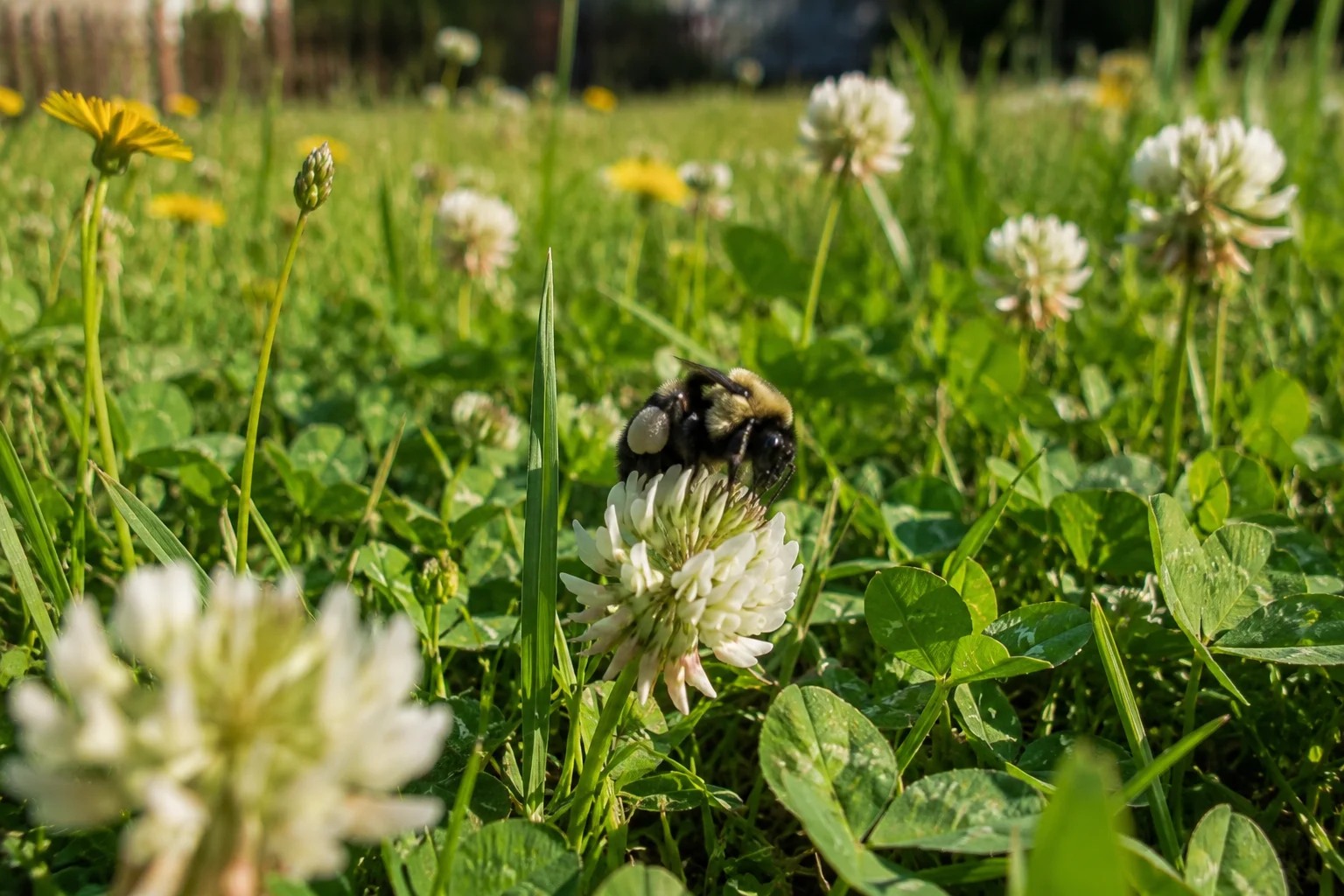
Dandelions (Taraxacum officinale) are the single most important early-spring nectar source for pollinators in most of North America. They bloom from March through May — precisely when queen bumblebees are emerging from winter dormancy and desperately need caloric resources to found their colonies. A single queen bumblebee emerging in March needs to consume enough nectar to sustain herself, build a small wax pot, lay her first eggs, and incubate them — all before her first workers emerge to help her. A lawn full of dandelions in March is not a failed lawn. It is a queen bumblebee rescue station. Research from the Xerces Society for Invertebrate Conservation consistently identifies dandelions as critical early-season resources, particularly for specialist bee species whose emergence timing is tightly synchronized with early spring bloom.
Beyond bees, dandelions support over 100 species of insects in North America. Their deep taproots break up compacted soil and bring minerals from lower soil layers to the surface, improving soil structure for every plant around them. Their seeds feed goldfinches, sparrows, and dozens of other songbird species through late spring. The dandelion is not a weed. It is doing more ecological work per square foot than any lawn grass species ever will.
White clover (Trifolium repens) was deliberately included in American lawn seed mixes until the 1950s — when broadleaf herbicide manufacturers discovered that their products killed clover along with other “weeds” and decided, conveniently, that clover should be reclassified as a weed rather than as a lawn constituent. Before that reclassification, clover was a valued part of the lawn for its nitrogen-fixing properties (it improves soil fertility for surrounding grass without any chemical input), its drought tolerance, and its attractive appearance. Honeybees, bumblebees, and dozens of native bee species work white clover continuously throughout its long June-to-September bloom period. A clover patch is a working bee restaurant. The research behind designing garden beds that bees actually find and return to reliably — including the critical role of massed low-level planting consistently identifies white clover as one of the most productive nectar sources per square foot available to any American gardener.
Wild violets (Viola species) are among the most common lawn “weeds” in the eastern US and among the most valuable. They provide early spring nectar when little else is blooming, support specialist mining bee species (Andrena violae) that depend on violet pollen for larval development, and serve as the sole larval host plant for several fritillary butterfly species including the Great Spangled Fritillary and the Meadow Fritillary. A lawn free of violets is a lawn that cannot support these butterfly species. A lawn with violets is a butterfly nursery.
Self-heal (Prunella vulgaris) is a low-growing perennial that thrives in mown lawns and is barely noticeable when short — until it blooms in small purple spikes that bumblebees work intensively. It tolerates mowing, spreads gently, and provides mid-summer nectar at exactly the point in the season when the July dearth is most keenly felt by bees. We’ve covered the dangerous mid-summer nectar gap in detail in why the July nectar crash is the most critical period in the bee calendar and how to plant around it — self-heal in your lawn is one of the lowest-effort ways to help close that gap.
Wild strawberry (Fragaria virginiana) — the native ancestor of the garden strawberry — produces small white flowers in April and May, edible berries in June, and provides ground cover that supports soil moisture and a range of small invertebrates. Bees, birds, and small mammals all benefit from it. It spreads by runners to fill bare patches in the lawn. Most people pull it out of their lawns without realizing what it is.
The Ground-Nesting Bees You’ve Never Seen — But Are Definitely Evicting
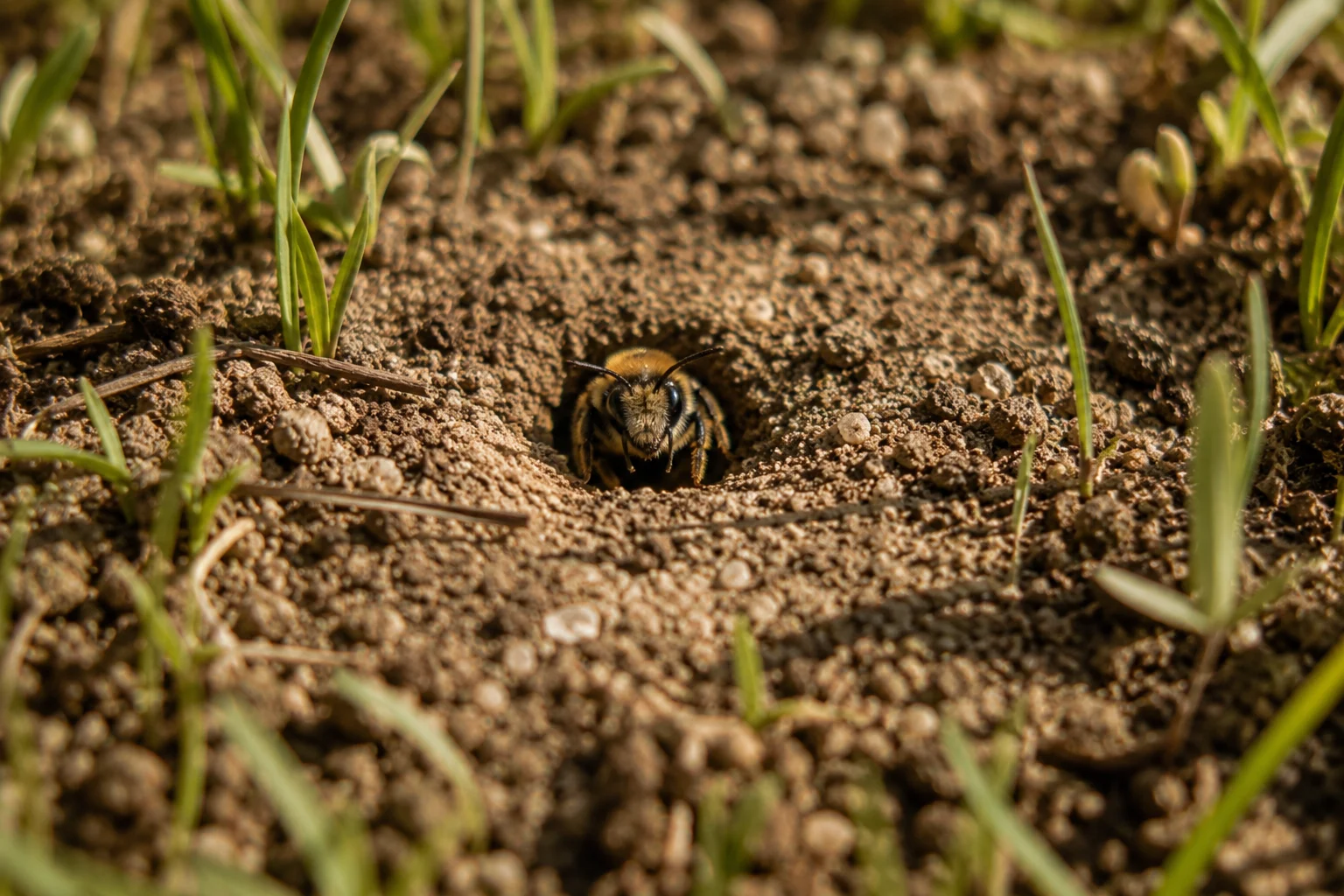
Here is the most important ecological fact about American lawns that almost no homeowner knows: approximately 70% of North America’s 4,000+ native bee species nest in the ground. Not in hives, not in bee hotels, not in hollow logs — in the ground. In bare or sparsely vegetated patches of loose, well-drained soil, typically in sunny locations.
The conventional lawn — thickly turfed, chemically treated, and regularly disturbed by mowing — is hostile to ground-nesting bees in every possible way. The dense grass root mat prevents bees from excavating nest tunnels. Pesticides contaminate the soil and kill larvae. Regular mowing destroys the sparse vegetation that ground-nesters prefer at the surface above their nests. And the cultural imperative to remove any “bare patches” in the lawn eliminates the exact habitat feature ground-nesting bees require most.
Mining bees (Andrena species), sweat bees (Lasioglossum and Halictus species), digger bees (Centris and Anthophora species), and ground-nesting bumblebees all require the same basic habitat: bare or sparsely vegetated soil, ideally south-facing for warmth, loose and well-drained in texture, and undisturbed through the nesting season from March to August. A single square yard of bare soil in a sunny corner of your yard can support dozens of nesting females across multiple species simultaneously.
The simple act of leaving one corner of your yard unmown, allowing the grass to thin naturally in the sunniest spot, or creating a small deliberate bare-soil patch — even just a 12-inch circle of loosened soil in a sunny border edge — provides habitat that the surrounding landscape may offer nowhere else within foraging distance.
What to Stop Mowing: A Practical Zone System
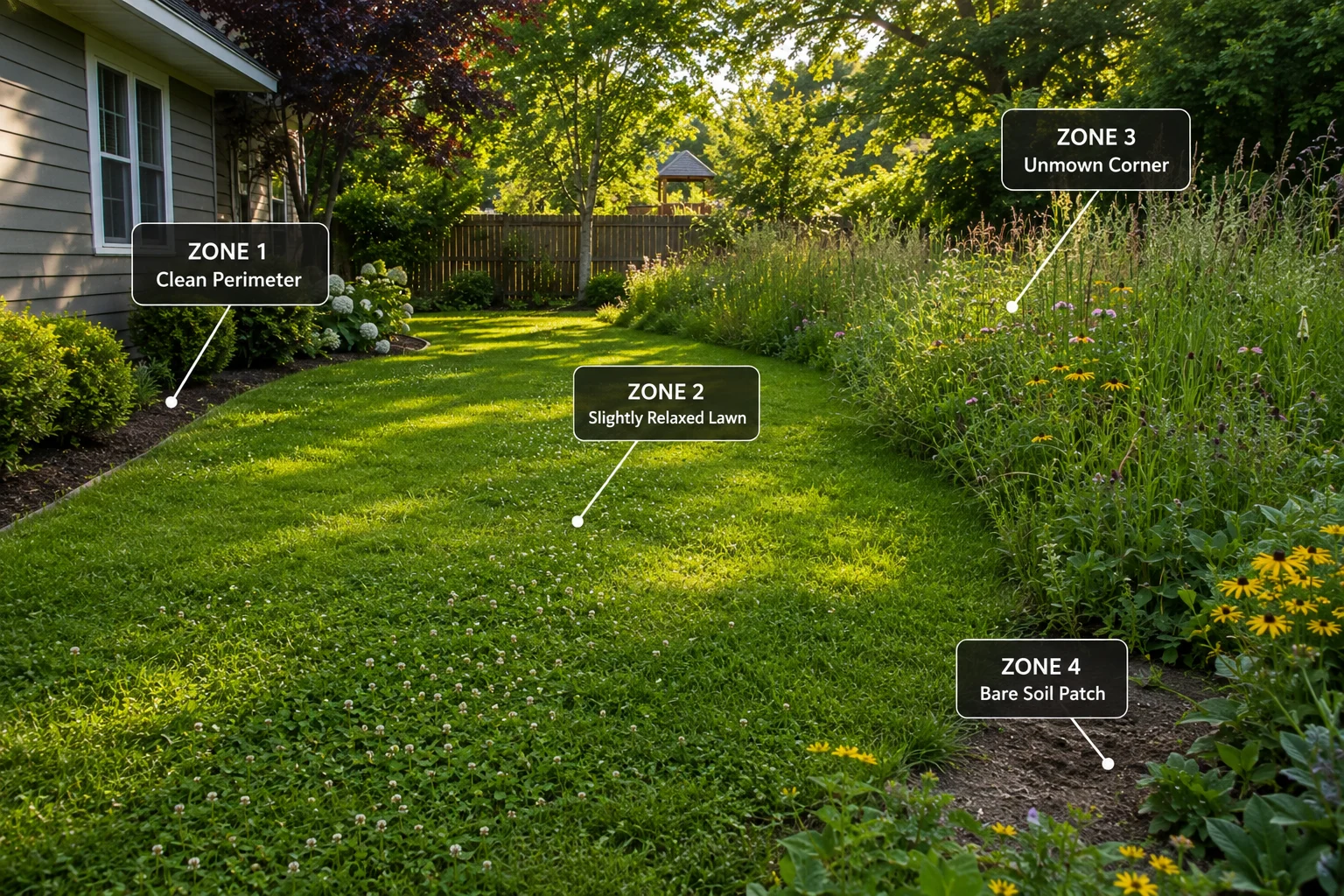
The transition from a conventional lawn to a pollinator-supportive one doesn’t require converting your entire yard to wildflowers overnight — a change that most neighborhoods, HOAs, and family members would find alarming. It requires a zone-based approach that introduces ecological value incrementally while keeping the overall property looking intentional rather than abandoned.
Zone 1 — The Maintained Perimeter: Keep the edges of your lawn cleanly mowed. The visual cue of a sharp edge signals intentionality — a clean edge around a relaxed interior reads as a deliberate garden choice, not as neglect. This single design principle is the most effective way to manage neighbor perception of a less-mown lawn.
Zone 2 — The Low-Mow Center: Raise your mowing height to 4 inches across the main lawn area. At this height, clover, self-heal, and wild violets can bloom between mowings, providing nectar windows even within a regularly maintained lawn. Grass cut at 4 inches is also more drought-resistant, needs less water, and stays greener through summer heat than grass cut short. You are doing less work and getting a better-looking, more ecologically functional lawn.
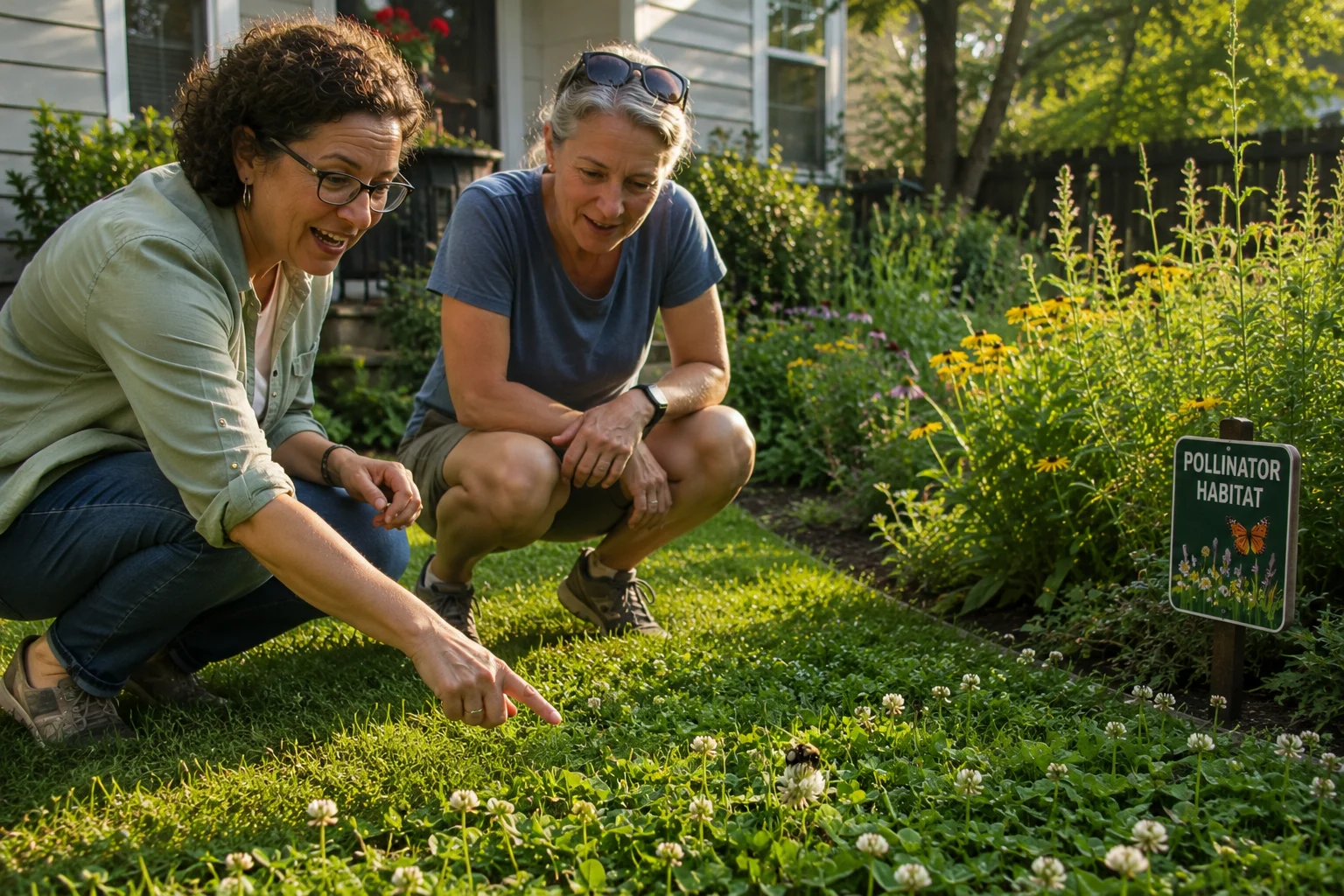
Zone 3 — The No-Mow Patch: Designate one area — ideally a sunny corner or a strip along a fence — as a no-mow zone from April through August. Mark it with a simple low edging or a small sign (“Pollinator Habitat — Please Don’t Mow”) so the intention is legible to anyone who might otherwise be tempted to tidy it up. This zone will develop its own spontaneous plant community over two to three years — native grasses, wildflowers, and early successional species that support a disproportionate share of pollinator diversity relative to their area.
Zone 4 — The Intentional Bare Patch: In the sunniest corner of your yard, create a 2-foot square of deliberately loosened, unplanted bare soil. Remove the grass, loosen the soil to 6 inches depth, and leave it exposed. This is ground-nesting bee habitat. Resist the urge to plant it, mulch it, or “improve” it in any way — bare loose soil is the entire point.
These four zones together, implemented across a typical suburban yard, represent perhaps 20–30% less mowing than a conventional maintenance schedule — less fuel, less time, less noise, less expense — in exchange for a meaningfully richer habitat that supports dozens of bee species and the broader food web they sustain.
The “Messy” Garden Conversation: HOA, Neighbors, and Your Own Head
The practical and social dimensions of letting your lawn relax deserve honest attention, because in many American neighborhoods, a less-mown lawn is not merely an aesthetic divergence — it can trigger HOA violations, neighbor complaints, or municipal code enforcement.
The legal landscape has been shifting in favor of pollinator-supportive landscaping. As of 2024, Florida, Maryland, Virginia, Nevada, New Mexico, and several other states have enacted “right to garden” or “bee lawn” legislation that restricts HOAs and municipalities from prohibiting native plantings and pollinator-supportive landscape practices. Minnesota has enacted specific protections for lawns containing clover and native species. The trend is clearly toward greater legal protection for ecologically motivated landscaping, and more states are considering similar legislation each year.
If you live in a jurisdiction or HOA that currently restricts unmown vegetation, the most effective strategies are documentation and design. Document your plantings — a simple list of species with their ecological functions, submitted to an HOA with a note about their role in pollinator support, often converts a violation notice into a productive conversation. Design for intentionality — the clean-edge principle mentioned above, combined with visible signage (“Native Pollinator Garden”) and a generally well-maintained surrounding property, shifts the perception of your lawn from neglect to purpose.
For the internal conversation — the voice that says your lawn reflects on you, that the neighbors are judging, that a proper adult mows on schedule — the most effective counter is the ecological ledger. Your unmown corner is providing nesting habitat for native bees that pollinate roughly one-third of the American food supply. Your dandelions are feeding queen bumblebees that would otherwise have nothing to eat in March. Your clover is fixing nitrogen into the soil, reducing your need for synthetic fertilizer, and feeding pollinators from June to September. You are not being lazy. You are running a habitat.
Before finalizing what to keep and what to remove, it’s also worth checking which common garden plants are actually harmful to pollinators despite looking bee-friendly — some lawn plants make this list — a few popular ornamentals are worth removing specifically to make room for the ecologically valuable volunteers that will replace them.
What to Add: Turning Imperfect Into Intentional
Beyond what to stop doing — stop mowing so short, stop removing clover, stop pulling dandelions — there are specific additions that amplify the ecological value of a relaxed lawn dramatically without making it look unmanaged.
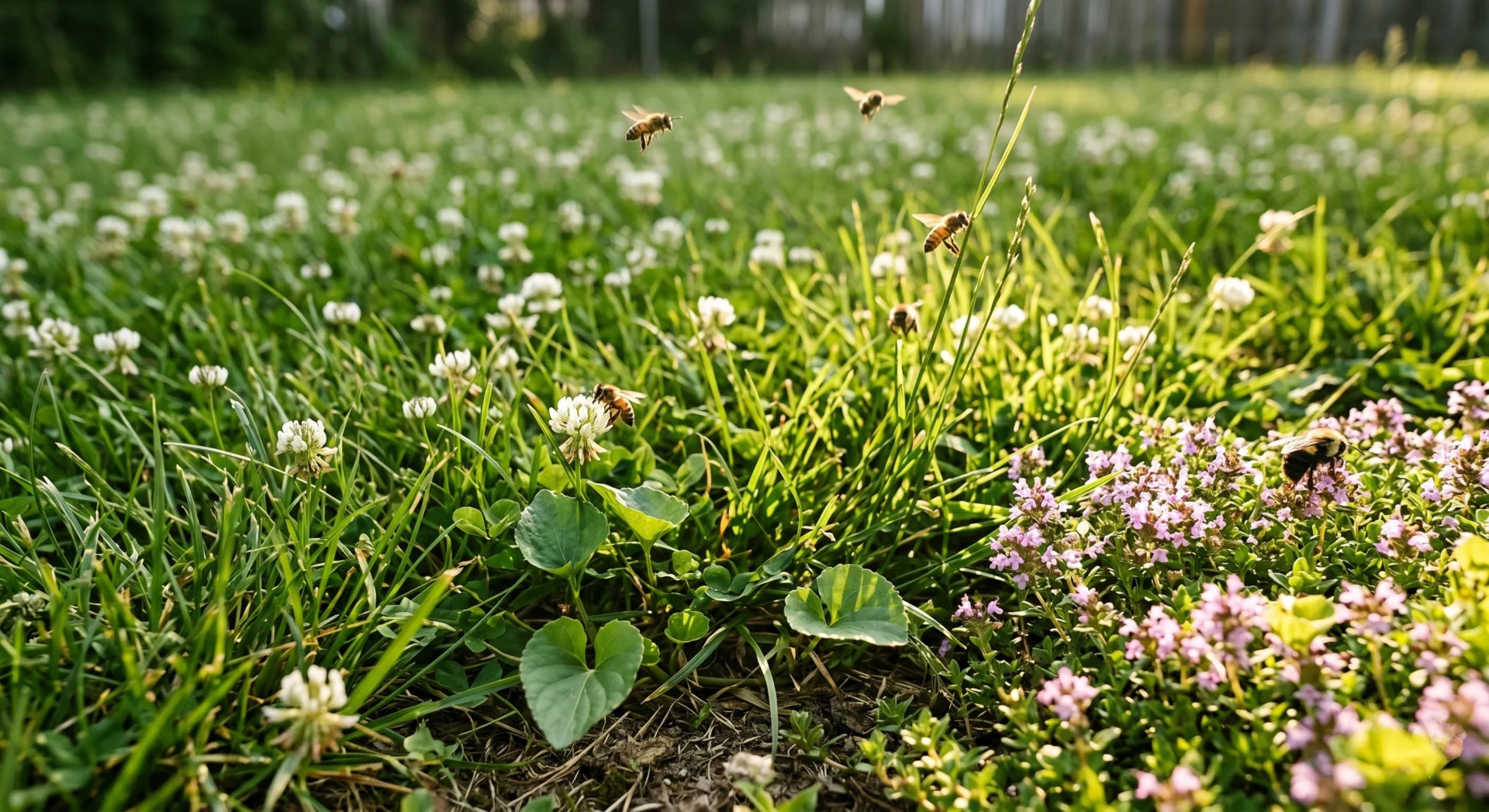
Dutch white clover seed (Trifolium repens) oversown into an existing lawn in early spring or fall is the single highest-return investment in pollinator support per dollar available to any American homeowner. A one-pound bag covers approximately 1,000 square feet and costs less than five dollars. The clover establishes within six weeks, begins blooming in its first season, fixes nitrogen into the soil (reducing or eliminating the need for lawn fertilizer), and transforms a grass monoculture into a working pollinator habitat. It tolerates mowing at 4 inches and regrows quickly after cutting.
Native violet plugs planted into thinning areas of the lawn establish a self-spreading ground cover that feeds specialist bees and supports fritillary butterflies. Viola sororia (common blue violet) and Viola pubescens (downy yellow violet) are the most widely available native violet species in the eastern US and both establish readily in partially shaded lawn areas.
Creeping thyme (Thymus serpyllum) planted as a lawn alternative in the sunniest, most traffic-prone areas provides a low, fragrant ground cover that tolerates foot traffic, blooms profusely in June and July, and is worked intensively by honeybees, bumblebees, and many native bee species. At its peak bloom, a creeping thyme patch looks like it is moving — covered in bees from morning to dusk.
Native grass plugs introduced into the no-mow zone — little bluestem (Schizachyrium scoparium), prairie dropseed (Sporobolus heterolepis), or Pennsylvania sedge (Carex pensylvanica) depending on your region — provide structure, winter interest, and nesting material for cavity-nesting bees that use dry grass stems for nest construction. These are not the aggressive ornamental grasses that escape into wild areas — they are well-behaved, regionally appropriate species that establish without becoming problematic.
For the planting areas bordering the lawn itself, the complete drift planting guide with exact plant lists and weekend implementation plan gives you the framework for turning whatever borders your lawn into a connected foraging network that multiplies the ecological value of the lawn habitat you’re creating.
The Ecological Ledger: What Your Imperfect Lawn Is Actually Worth
Here is a concrete accounting of what a single imperfect American lawn — half an acre, with clover, dandelions, violets, a no-mow corner, and a bare soil patch — contributes to its local ecosystem over the course of one year:
Early queen bumblebee support in March and April from dandelions — potentially dozens of colony-founding queens that will each produce 50–500 workers and support pollination across the entire neighborhood through summer. Native mining bee nesting habitat in the bare soil patch — potentially 20–50 individual nests representing multiple bee species, each female provisioning 5–15 larval cells with pollen from local flowers. Continuous nectar provision for honeybees, bumblebees, and native bees from June to September via white clover. Fritillary butterfly larval habitat from violet plants. Bird seed production from dandelion and grass seed heads through late spring. Soil improvement from clover nitrogen fixation — equivalent to one pound of synthetic nitrogen fertilizer per 1,000 square feet annually, representing a real cost saving alongside its ecological value. And a reduction in water consumption of 30–50% compared to a closely mown conventional lawn, because taller grass shades the soil, retains moisture, and reduces the need for irrigation.
None of these contributions show up in any measure of lawn quality that American lawn care culture currently recognizes. They are invisible to the conventional judgment that says a good lawn is a short, green, weed-free one. But they are real, they are measurable, and they are contributing to the ecosystem services that the natural world depends on to function — including the pollination of the food crops that feed every person in every house on your street, whether those households have imperfect lawns or not.
Conclusion: Your Imperfect Lawn Is Perfect Enough
The guilt about the unmown corner, the dandelions, the clover, the patch that got away from you — let it go. The science is clear and it is on your side. The imperfect lawn is doing work that the perfect one cannot do, supporting life that the monoculture cannot support, and contributing to the ecological health of your neighborhood in ways that are genuinely significant even at the scale of a single yard.
The key takeaways: dandelions are the most important early-spring pollinator food source in North America — stop removing them. White clover is a working bee restaurant and soil improver — oversow it, don’t kill it. Ground-nesting native bees need bare, loose, sunny soil — leave one patch undisturbed. Raise your mowing height to 4 inches and let the lawn breathe between cuts. Create a no-mow corner and edge it cleanly so it reads as intentional. Add clover seed, native violets, and creeping thyme to amplify what’s already happening naturally.
You are not a bad homeowner. You are running a habitat. And the bees know the difference even if the neighbors don’t yet. 🐝
Keep Reading 🐝
These posts give you the tools to build on what your imperfect lawn has started:
- 🌿 complete drift planting guide — how to turn your garden borders into a connected foraging network that amplifies your lawn habitat — The natural next step after you’ve sorted the lawn.
- 📅 Why July is the most dangerous month for pollinators — and how self-heal and clover in your lawn help close the gap — The seasonal context that explains why your lawn weeds matter most in summer.
- ☠️ Before you decide what to keep in your lawn, check which common garden plants are actually harmful to pollinators — A few popular additions make things worse, not better.
Your lawn is already doing something good. Now help it do more. 🌻