
You’re elbow-deep in your garden beds when a buzzing insect lands nearby. Your instinct kicks in — do I swat, or do I stand still? The answer depends entirely on whether you’re looking at a honeybee or a wasp. Getting this wrong can mean an unnecessary sting, a panicked retreat, or worse — accidentally harming one of the planet’s most critical pollinators.
This guide will teach you exactly how to tell them apart. You’ll learn to identify each insect by sight, sound, and behavior; understand the role each plays in your garden ecosystem; and know how to respond calmly and safely when you encounter either one. Whether you’re a casual gardener or a budding beekeeper, this is knowledge worth having.
Why Getting the ID Right Actually Matters
Misidentifying bees and wasps isn’t just a trivia problem — it has real consequences:
- For pollinators: Honeybees are responsible for pollinating roughly one-third of the world’s food supply, according to the Food and Agriculture Organization of the United Nations. Swatting or killing them out of fear contributes to their decline.
- For your safety: Wasps, particularly yellow jackets, are far more aggressive than honeybees and are responsible for the majority of insect sting-related hospitalizations.
- For your garden: Knowing who’s who helps you make smart decisions — like whether to call a pest removal service or contact a local beekeeper.
The distinction seems small. The implications are anything but.
Physical Appearance: The Fastest Way to Tell Them Apart
This is your first and most reliable checkpoint. Even a quick glance can reveal the difference if you know what to look for.
Body Shape & Build
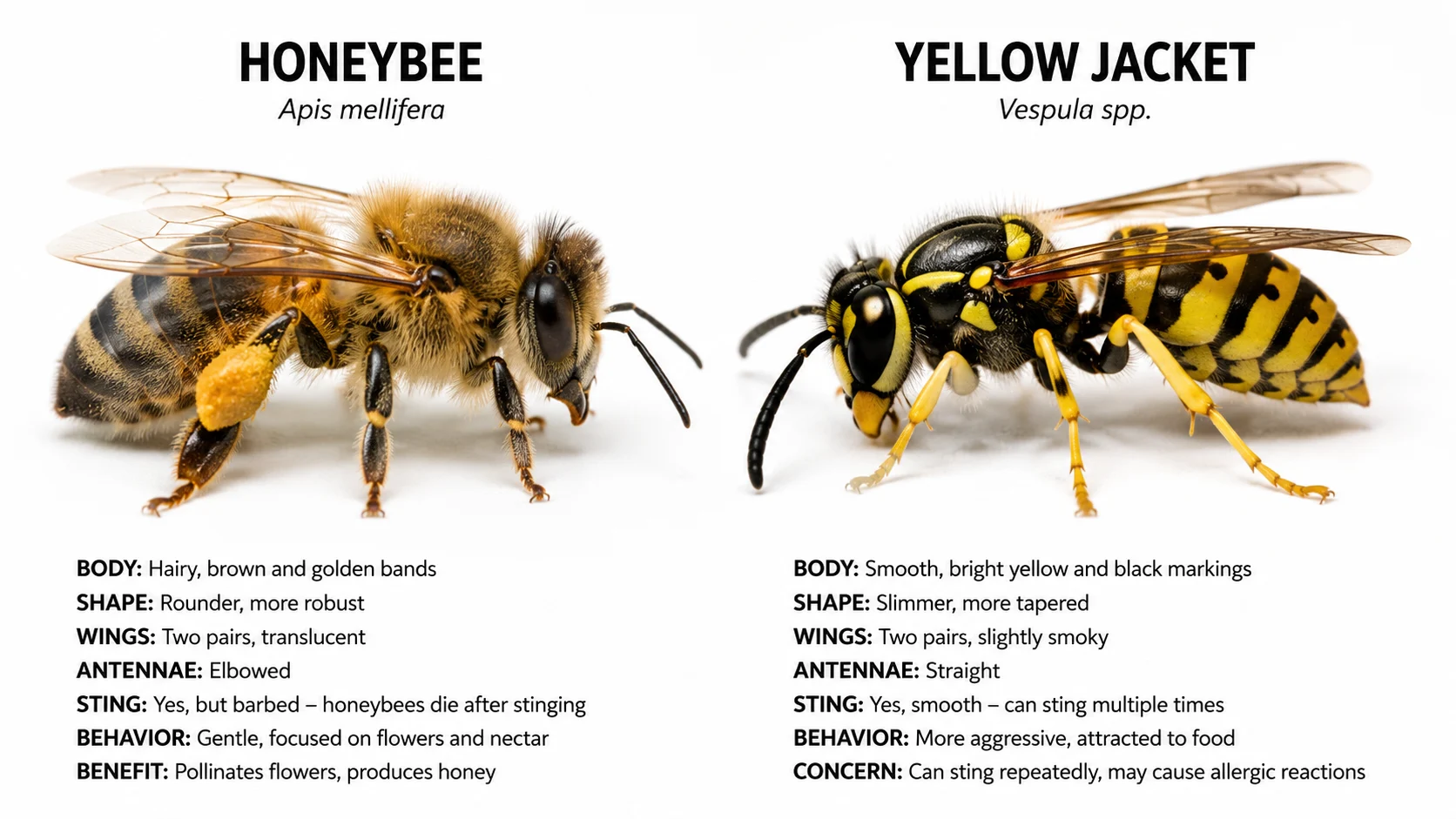
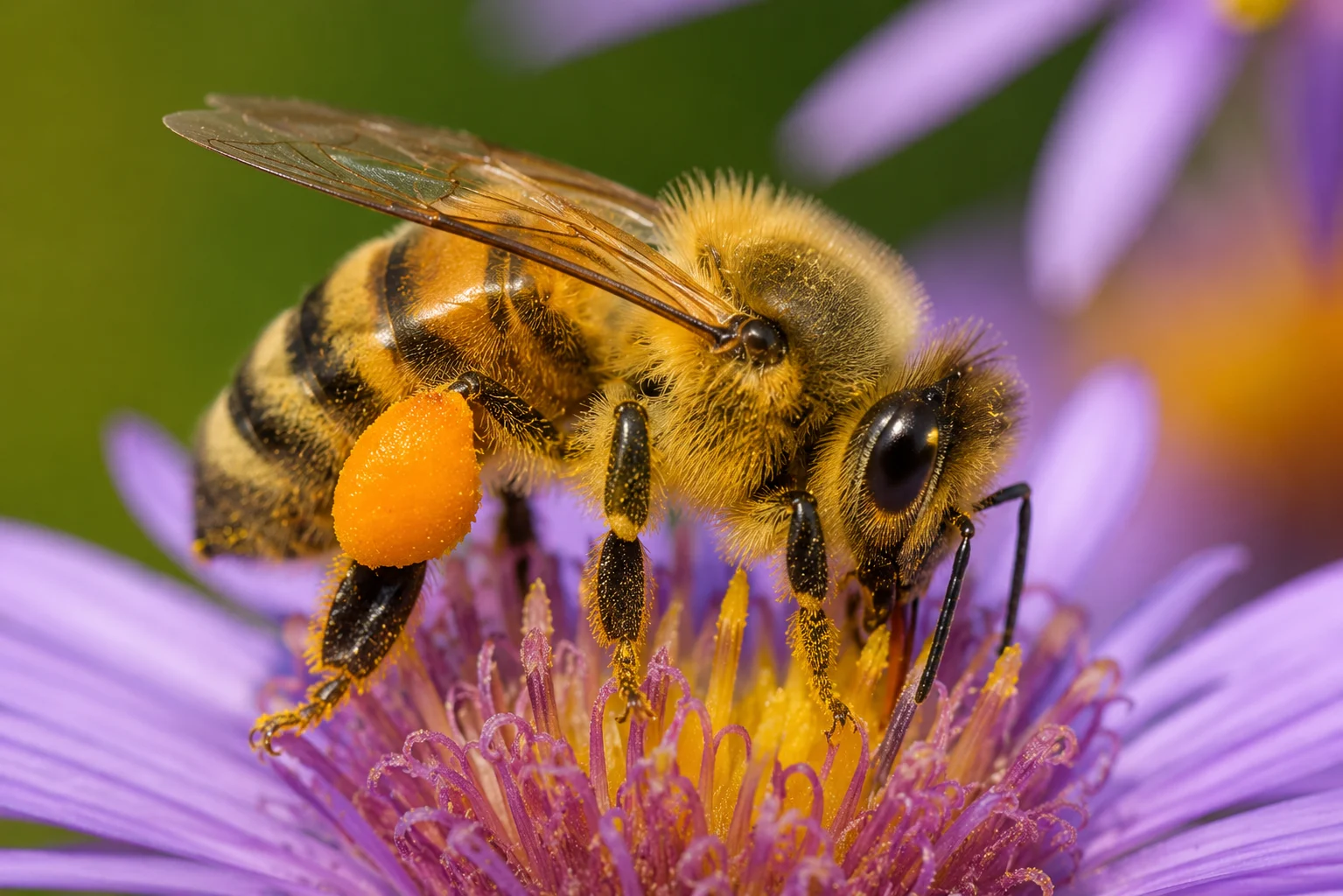
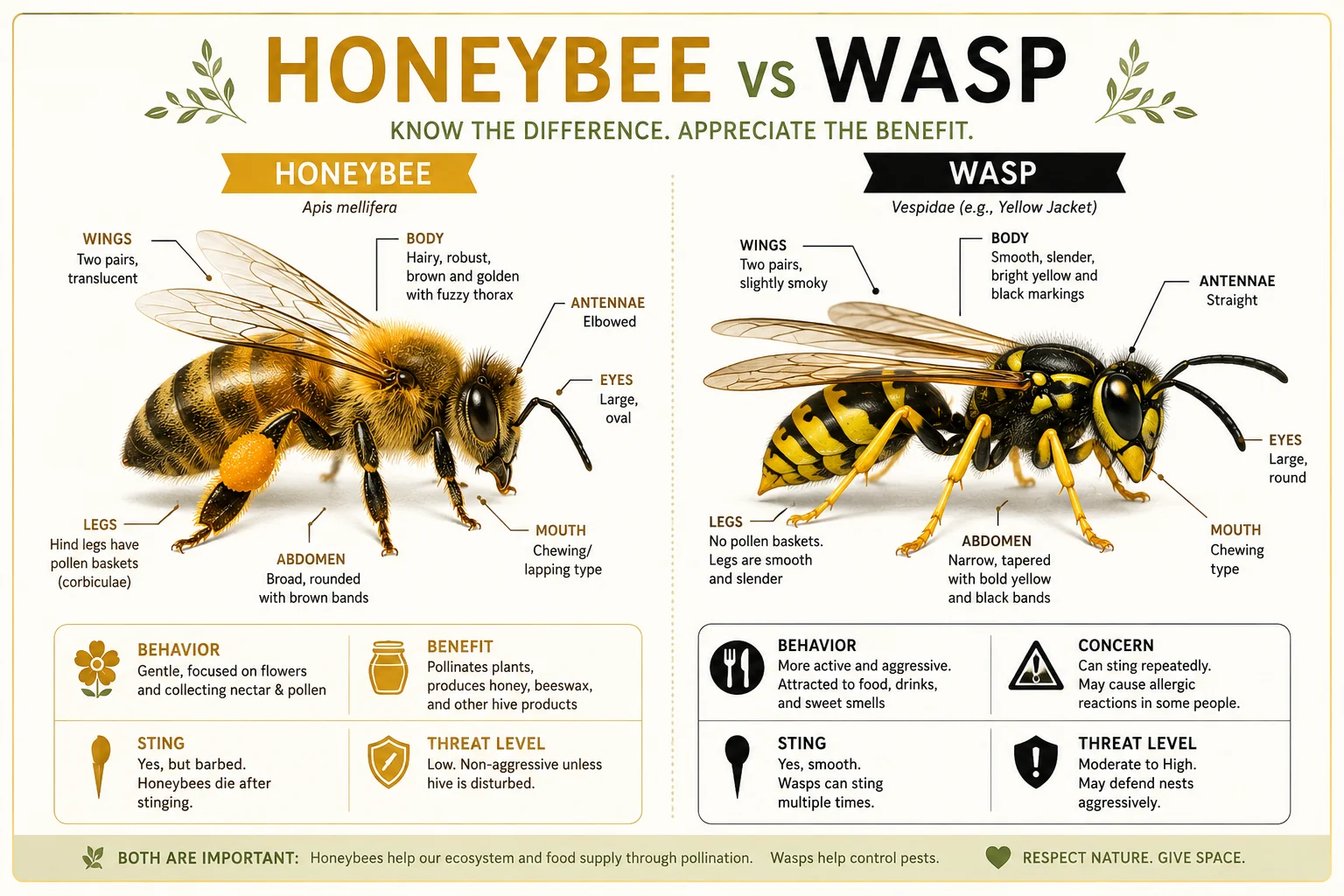
- Honeybees have a robust, rounded, and slightly hairy body. They look almost fluffy up close, especially on the thorax and abdomen. Their overall shape is compact and oval.
- Wasps (including yellow jackets, paper wasps, and hornets) have a sleek, shiny, and smooth body with a dramatically narrow “waist” — the pinched connection between the thorax and abdomen is unmistakable.
Quick rule: If it looks like it’s been to the gym and has a cinched waist, it’s a wasp. If it looks round and fuzzy, it’s a bee.
Coloring & Markings
| Feature | Honeybee | Common Wasp (Yellow Jacket) |
|---|---|---|
| Body color | Amber/golden-brown with dark bands | Bright yellow with sharp black bands |
| Surface texture | Hairy / velvety | Smooth and shiny |
| Legs | Flat, pollen-coated (often yellow or orange) | Long, slender, dangling in flight |
| Waist | Gradual taper | Sharply pinched |
Honeybees tend toward earthier tones — amber, tawny brown, with muted banding. Wasps are typically bolder and brighter, with high-contrast yellow-and-black patterns that scream warning.
The Legs Tell a Story
When in flight or at rest, a foraging honeybee often carries visible pollen baskets (corbiculae) on her hind legs — little orange or yellow pellets packed tight. This is a dead giveaway. Wasps, being carnivorous and not pollen-feeders, have no such cargo. Their legs are long, thin, and hang loosely below the body during flight.
Behavioral Differences: How They Act in Your Garden
Appearance gets you halfway there. Behavior closes the gap.
Foraging Patterns
- Honeybees move methodically from flower to flower, spending several seconds at each bloom collecting nectar and pollen. They are focused, deliberate, and almost entirely unbothered by your presence unless you disturb their hive.
- Wasps are opportunistic. You’ll often see them hovering near open food, sugary drinks, fallen fruit, or rubbish bins. They’re more erratic in flight and will investigate you, your food, or your pet’s water bowl with equal enthusiasm.
Aggression Levels
This is critical:
- Honeybees are non-aggressive by nature. A worker bee away from the hive is almost never a threat. She will sting only if she feels directly threatened — stepped on, grabbed, or swatted. And when she does sting, she dies, which evolution has made her very reluctant to do.
- Wasps can sting multiple times without dying. Yellow jackets in particular become highly aggressive in late summer and autumn when their colonies peak in size and food sources dwindle. They are far more likely to sting unprovoked, especially near nests.
Nesting Habits
Knowing where they live helps you manage risk:
Honeybees:
- Live in large colonies (20,000–80,000 bees)
- Build wax combs in tree hollows, wall cavities, or — if kept — in wooden Langstroth hives
- Colonies are perennial; they overwinter and survive year to year
Wasps:
- Yellow jackets nest underground or in wall voids; paper wasps build exposed papery combs under eaves and branches
- Colonies are annual — queens overwinter alone and start fresh each spring
- Nests can grow to several thousand individuals by late summer
Flight & Sound: What Your Ears and Eyes Tell You
Once you’ve spent time around both insects, the sensory differences become intuitive:
- Honeybees produce a steady, low hum — the iconic sound of a productive hive. Individual bees in flight have a softer, more consistent buzz.
- Wasps tend to have a higher-pitched, more erratic buzz. Their flight patterns are more darting and unpredictable.
In terms of flight, wasps appear more “aggressive” even when neutral — faster, more angular, more reactive to movement. Honeybees are the patient commuters of the insect world.
What To Do When You Spot Each One
If It’s a Honeybee
Stay calm. Seriously. A lone foraging honeybee has zero interest in you. Here’s how to coexist:
- Don’t swat — sudden movements trigger defensive responses.
- Move away slowly if you’re near a swarm or established hive.
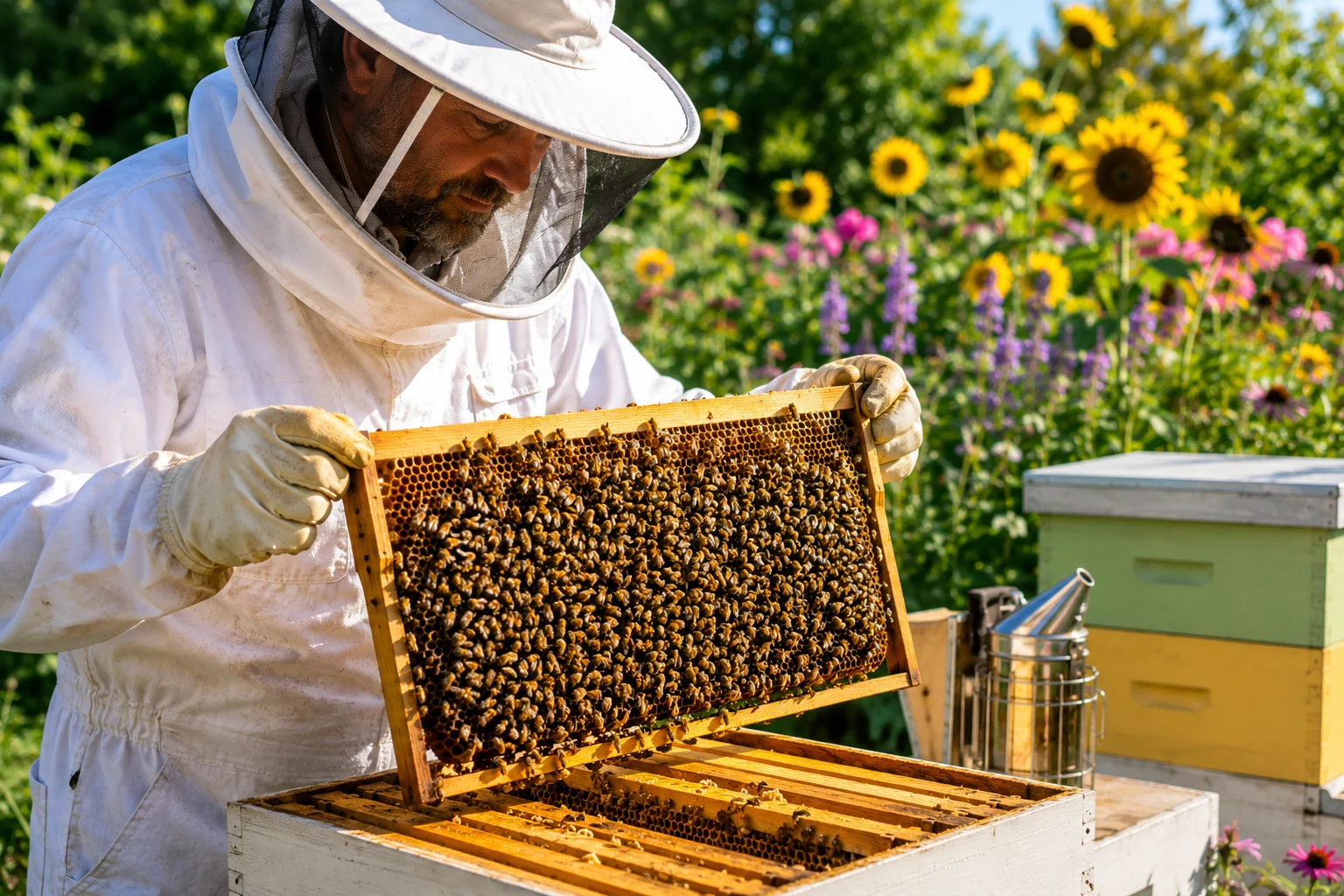
- If a swarm appears in your garden, contact a local beekeeper. Swarms are not aggressive and a beekeeper can often relocate them for free.
- If bees have colonized a wall or structure, consult a professional removal service that works with beekeepers to rehome the colony rather than exterminate it.
For more guidance on safe swarm management, the British Beekeepers Association maintains a directory of swarm collectors across the UK — a model that many countries have adopted.
If It’s a Wasp
Stay calm here too, but take it more seriously near the end of summer:
- Don’t swat — an agitated wasp releases alarm pheromones that can summon others.
- Cover food and drinks at outdoor gatherings.
- Locate and avoid nests — give them wide berth. Nest removal is a job for professionals or early spring, when colonies are tiny.
- If you disturb a nest, move away quickly and steadily. Don’t flail.
A Quick-Reference Identification Cheat Sheet
Use this in the garden when you need a fast answer:
- Fuzzy + round + amber-toned + carrying pollen? → Honeybee ✅
- Sleek + pinched waist + bright yellow-black + no pollen? → Wasp ⚠️
- Near flowers, moving methodically? → Likely a bee
- Near your sandwich or fizzy drink? → Almost certainly a wasp
- Aggressive, darting flight in late summer? → Wasp, probably a yellow jacket
The Bigger Picture: Why Bees Deserve Your Protection
Understanding the difference between bees and wasps is ultimately about building a healthier relationship with your garden ecosystem. Honeybees are essential pollinators for fruit and vegetable crops. Wasps, while often unwelcome at picnics, are also valuable — they prey on caterpillars, aphids, and other garden pests, acting as a natural pest control service.
Neither deserves panic or reflexive extermination. Both play roles. And the more clearly you can identify what’s buzzing around you, the more confidently and safely you can share your outdoor space with them.
For those inspired to go further — to not just observe honeybees but to keep them — learning the basics of identification is genuinely the first step. Many experienced beekeepers trace their passion back to a moment of curiosity in a garden, just like yours.
Conclusion: Know What’s Buzzing Around You
Here’s what to take away from this guide:
- Shape and texture are your fastest visual clues — fuzzy and round for bees, sleek and pinched for wasps.
- Coloring helps: earthy amber tones point to bees; bright, sharp yellow-and-black points to wasps.
- Behavior seals the deal — pollen-carrying and flower-focused means bee; food-hovering and erratic means wasp.
- Neither is your enemy. Both deserve calm, informed responses rather than fear.
Spend time in your garden with this guide in mind and within a season, the identification becomes second nature. You’ll start seeing your outdoor space differently — as a habitat full of fascinating, purposeful life.
Want to Go Deeper? Keep Exploring 🐝
Now that you can tell your bees from your wasps, there’s so much more to discover. Here are a few reads from the blog to keep the curiosity going:
- 🌸 The July Nectar Crash: How to Design a “Bridge Bloom” Garden — Learn which flowers to plant to keep pollinators fed through the summer gap.
- 💀 The Gruesome Truth About Bee Stings — and Why Wasps Are Worse — A deep dive into what actually happens when a bee or wasp stings you.
- 💙 The Brilliant Mystery of Blue Bees — Meet one of the most stunning and overlooked pollinators on the planet.
- 🌿 Is Your Garden Truly Safe? 7 Common Toxic Plants to Avoid — Not everything in your garden is bee-friendly. Find out what to swap out.
The more you know, the better gardener — and neighbour to bees — you become. Happy gardening. 🌻