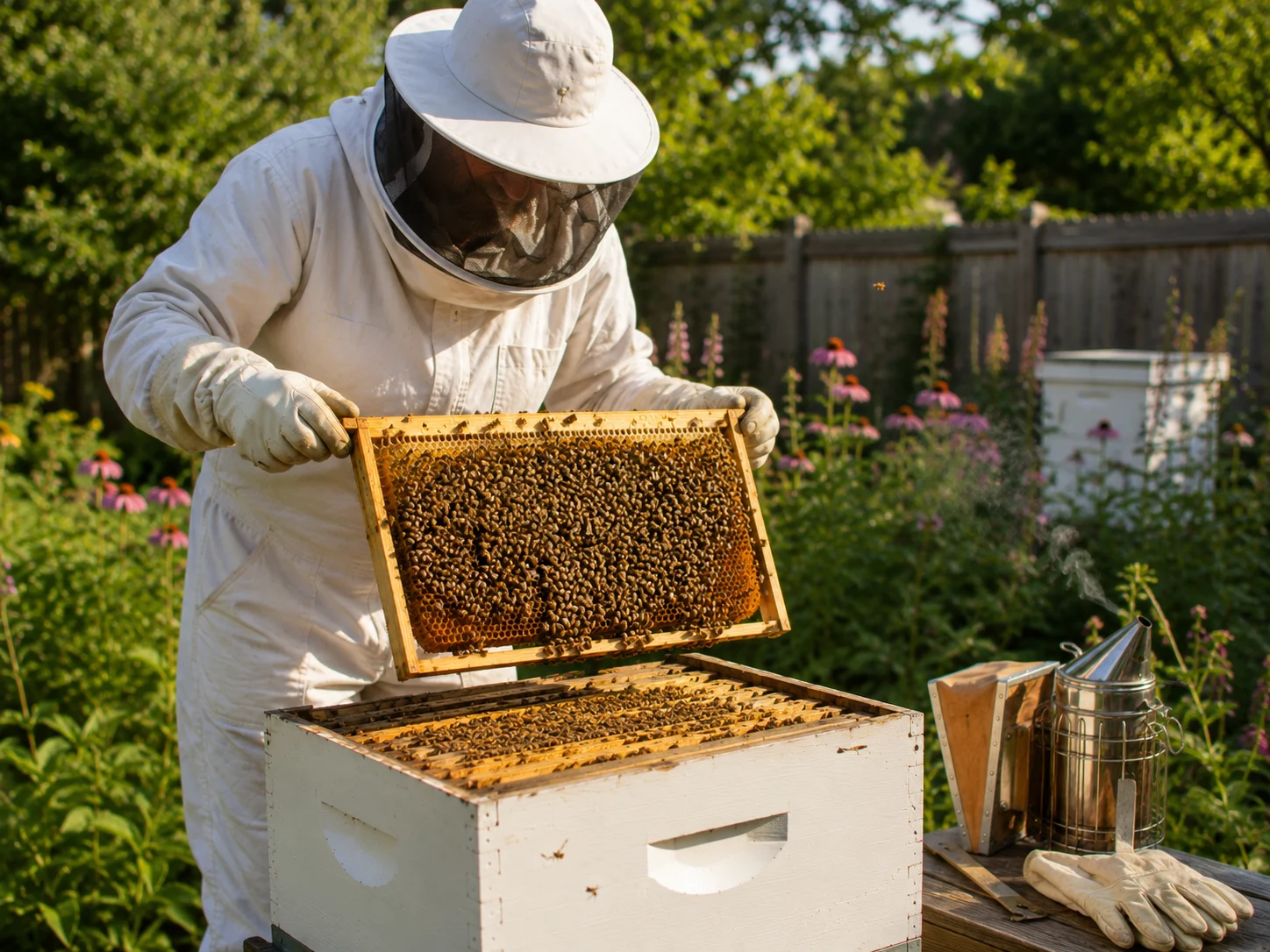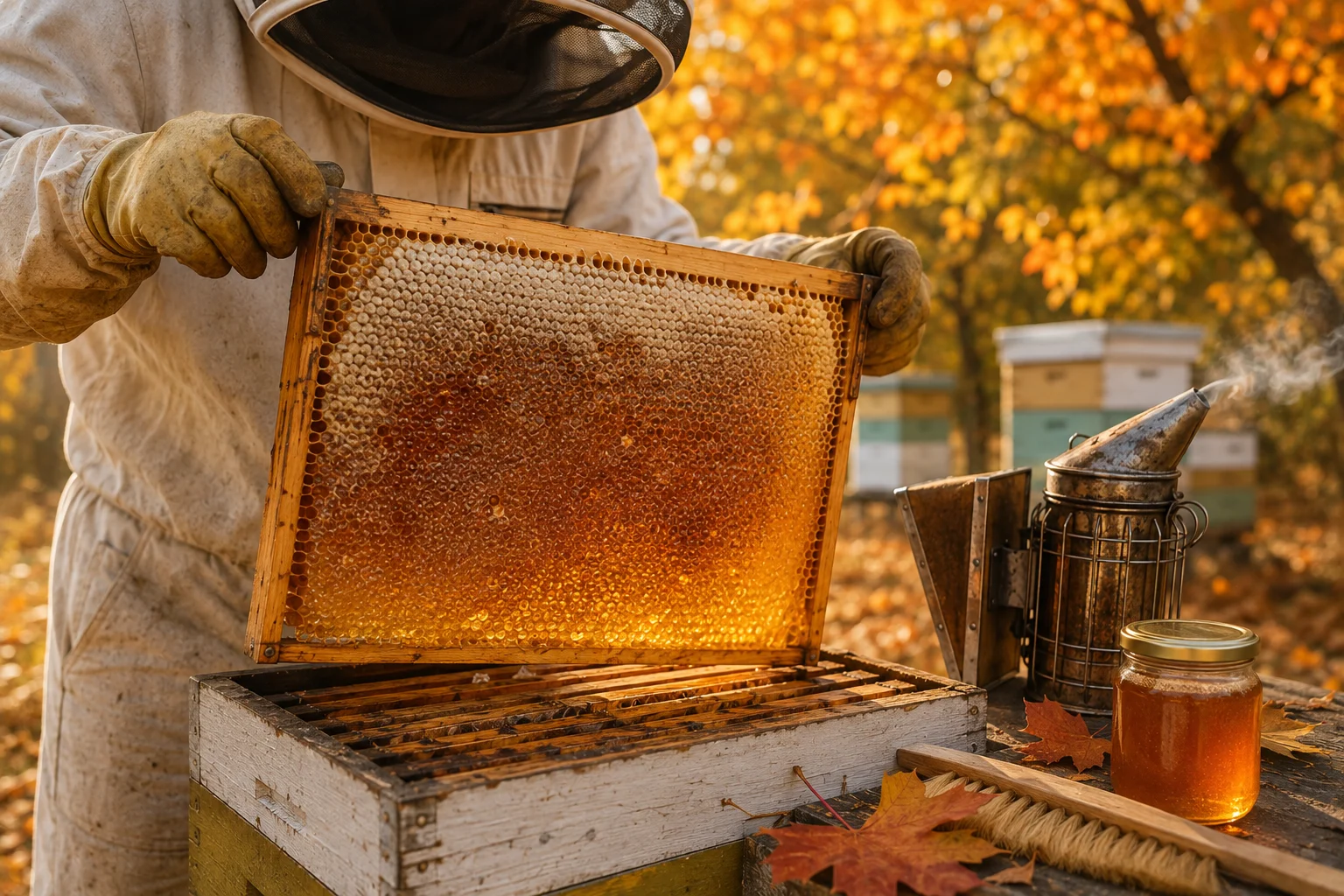

Did you think that all bees are yellow and black? Well, think again.
Over dozens of years in the world of apiculture (the scientific study of bees), few discoveries capture the imagination quite like the moment you realize nature has a completely different color palette hidden deep in the jungle. If you picture a bee in your mind right now, you almost certainly imagine a fuzzy, buzzing little insect wrapped in bright golden-yellow and black warning stripes. We are so conditioned by honey bees and bumblebees that anything else seems impossible.
But deep in the humid tropical rainforests of the Eastern Hemisphere, there is a creature that looks less like a bug and more like a real-life glitch in the matrix: The Blue Carpenter Bee.
Prepare to have your mind blown by nature’s living sapphire, a gentle giant that proves the natural world still holds breathtaking secrets.
What Exactly Is a Blue Bee?
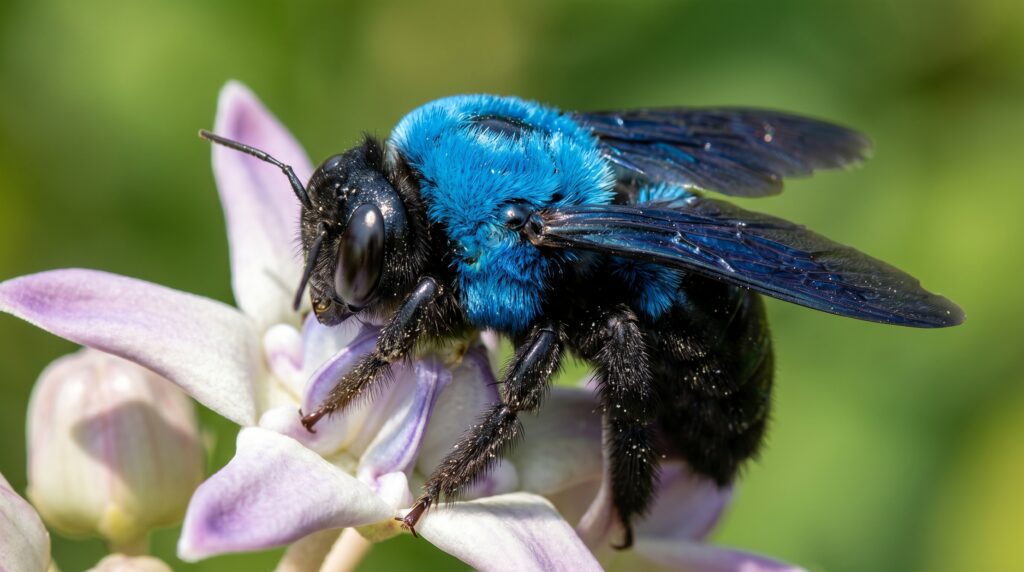
Known to the scientific community as Xylocopa caerulea, the Blue Carpenter Bee is a massive, heavily built species of carpenter bee.
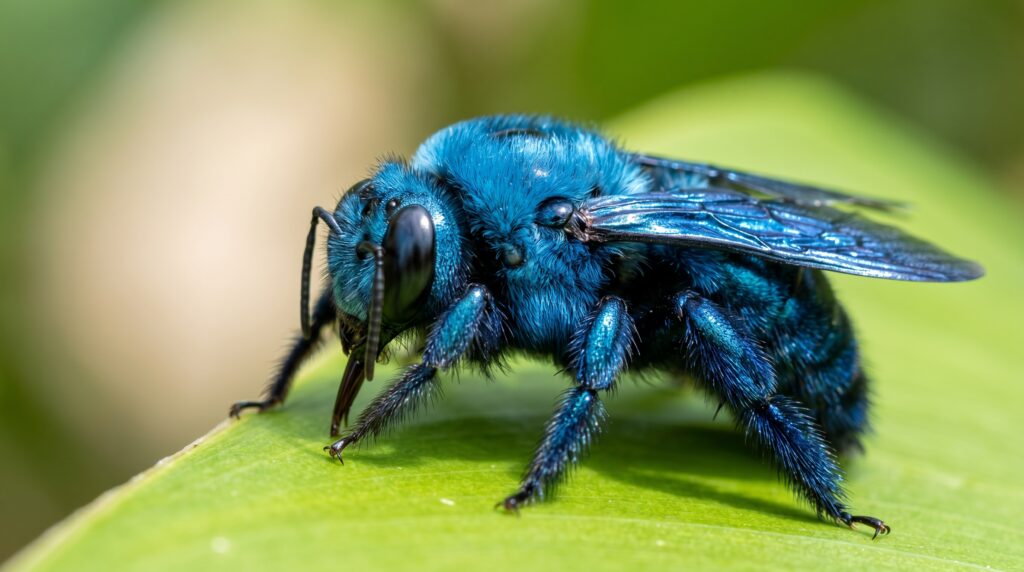
Unlike the tiny, delicate honey bees buzzing around your local clover patches, Blue Carpenter Bees are absolute giants of the insect world. They can grow up to a full inch long (nearly 2.5 centimeters) and feature a heavy, robust, dome-like shape.
When they take flight, they don’t sound like a high-pitched mosquito or a typical backyard bee. Because of their sheer size and mass, their wings beat at a different frequency, producing a deep, heavy, bass-filled humming sound that vibrates through the air and commands attention. You will often hear a Blue Carpenter Bee approaching long before you actually see its brilliant colors flash in the sunlight.
Where in the World Do They Live?
You won’t find these stunning insects in the United States or Europe. The Blue Carpenter Bee requires a very specific, highly humid tropical climate to survive. They are indigenous to Southeast Asia, with populations thriving in:
- India
- Southern China
- Indonesia (especially Sumatra and Java)
- Malaysia
- Singapore
They prefer to live in dense, primary rainforests, though they are occasionally spotted in tropical botanical gardens or at the edges of rural jungle villages where exotic flowers are abundant.
The Physics of Sapphire: Structural Coloration
Why on earth would a bee evolve to be bright blue? In the animal kingdom, true blue is actually an incredibly rare color. In fact, most animals cannot produce blue pigment through their diet or biology.
The brilliant, glowing blue of the Xylocopa caerulea is not a chemical dye or pigment. Instead, it is created by a fascinating physics phenomenon known as structural coloration.
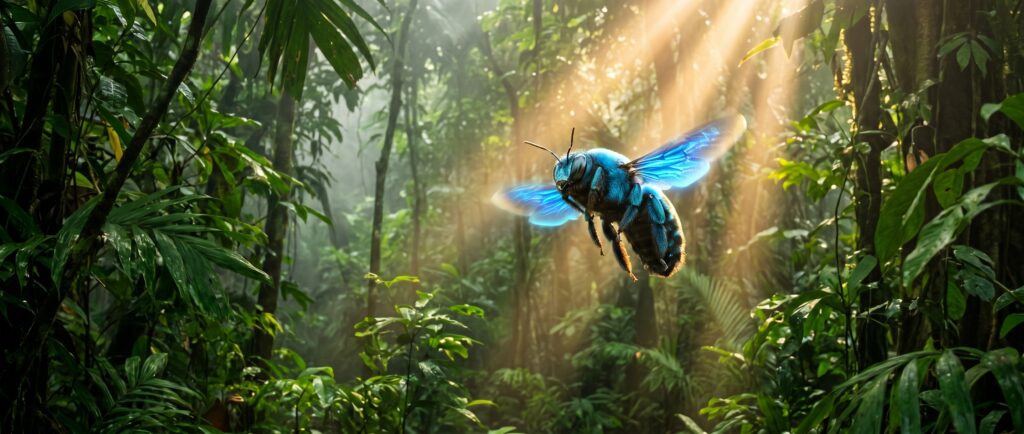
Here is how it works: The microscopic structure of the thick hairs covering the bee’s thorax is shaped with intricate, repeating nanoscale patterns. When sunlight hits these microscopic structures, they act like tiny prisms. They absorb the red and yellow wavelengths of light and perfectly bounce only the blue wavelengths back to our human eyes.
This means that when the bee moves through the dappled sunlight of the jungle canopy, it shimmers and changes shades depending on the angle you view it from. It looks like a glowing, faceted gemstone with wings. This is the exact same optical illusion that gives peacock feathers, Morpho butterflies, and blue jays their incredible, vibrant colors!
Do Blue Bees Make Blue Honey? The Solitary Lifestyle
Because they look so magical, one of the most common questions people ask when they see a photo of one is, “Do they make blue honey?”
The answer is no, because they don’t make honey at all!
Honey is a winter food storage system for bees that live in freezing climates. Because Blue Carpenter Bees live in the tropics where flowers bloom year-round, they simply fly out every day to drink fresh nectar for energy. Furthermore, they are “solitary bees.” This means they do not have a Queen, they do not live in massive swarms of thousands of bees, and they have no worker bees to help them.
Instead, every female Blue Carpenter Bee is an independent, single mother. Her entire life’s mission is to find a safe nesting site, gather enough food, and raise her offspring entirely on her own without the help of a worker colony.
Nature’s Tiny Drillers: How They Build Nests
If they don’t build wax hives, where do they live? This is where they get the “Carpenter” part of their name.
Female Blue Carpenter Bees are equipped with incredibly strong mandibles (jaws). When it is time to build a nest, she finds a piece of dead, rotting wood or a thick bamboo stalk in the jungle.
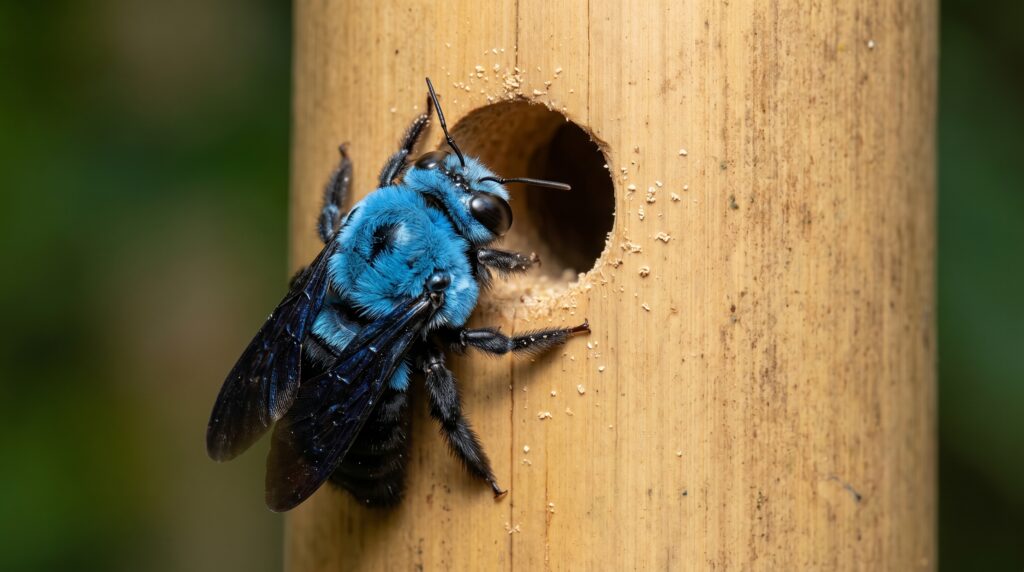
Using her jaws, she literally vibrates and chews her way into the wood, creating a perfectly round, smooth entrance hole. Inside the wood, she excavates a long tunnel. However, she doesn’t actually eat the wood—she spits it out or uses it like sawdust to build walls.
Once the tunnel is dug, she flies out to gather massive amounts of pollen and nectar. She mixes this together into a dough-like ball called “bee bread.” She places the bee bread at the back of the tunnel, lays a single giant egg on top of it, and then builds a wall out of chewed-up wood to seal the baby inside. She repeats this process, creating a line of private “nursery cells” until the tunnel is full!
Their Secret Superpower: “Buzz Pollination”
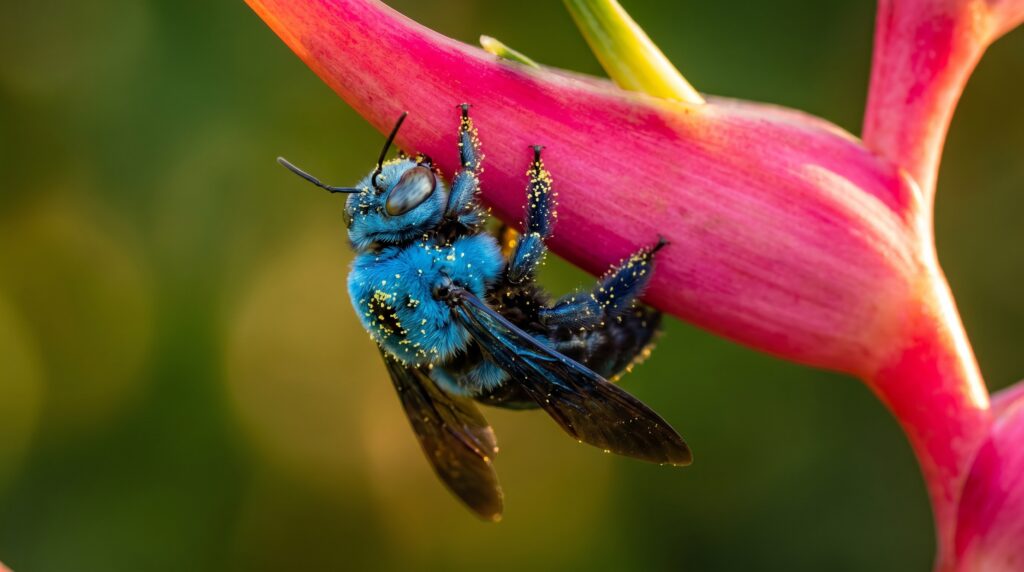
Beyond their looks and their architectural skills, Blue Carpenter Bees possess a rare botanical superpower known as sonication, or “buzz pollination.”
Many tropical plants (including wild tomatoes, eggplants, and certain exotic orchids) hide their pollen deep inside tightly closed tubes. A regular honey bee cannot reach it. But the Blue Carpenter Bee has a trick up her sleeve.
She lands on the flower, bites onto the petals with her jaws, and violently vibrates her powerful flight muscles without moving her wings.
Are They Dangerous? (The Gentle Giants)
Because of their massive size, heavy bodies, and loud, deep buzzing sound, encountering a Blue Carpenter Bee in the wild can trigger instant panic. If a one-inch-long blue insect flew directly at your face, you would probably run! But are they actually dangerous to humans?
Absolutely not. These bees are widely considered to be the “Gentle Giants” of the rainforest. Because they don’t have a giant hive full of sweet honey to protect from bears and badgers, they have almost no aggressive defensive instincts.
- The Males: The males of the species don’t even have stingers! They are completely physically incapable of hurting you. They are highly territorial and might hover aggressively near your face to investigate you, but they are all buzz and no bite.
- The Females: The females do possess a stinger, but they are so profoundly passive and focused on building their nests that you would essentially have to trap one and crush it in your bare hand to force it to sting you in self-defense.
Conservation: Are Blue Bees Endangered?
With their breathtaking beauty, many insect enthusiasts wonder if the Blue Carpenter Bee is in danger of going extinct.
While they are not currently listed as highly endangered, their populations are strictly tied to the health of the Southeast Asian rainforests. Because they absolutely require dead wood and bamboo to build their nests, deforestation and habitat loss are the biggest threats to these beautiful insects.
The clearing of primary rainforests for agriculture removes the dead trees and diverse floral life these solitary bees need to survive. Protecting the world’s tropical forests is the only way to ensure these living sapphires continue to fly for generations to come.
A Beautiful Reminder
The Blue Carpenter Bee (Xylocopa caerulea) is the ultimate proof that the natural world is far more bizarre, magical, and beautiful than we give it credit for. It is a brilliant reminder that we shouldn’t assume we know everything about the wild world right outside our doors.
So, the next time someone confidently tells you that all bees are just yellow and black… you know exactly what picture to show them to blow their mind!
💬 Frequently Asked Questions (FAQ)
Can I buy a Blue Carpenter Bee or keep one as a pet?
No. Because they do not live in hives or colonies, they cannot be “kept” by beekeepers. They are wild, solitary pollinators that require very specific tropical climates and natural wood habitats to survive and breed. Attempting to capture or import one will only result in its death.
Do they exist in the United States or Europe?
No, you will not naturally find the Xylocopa caerulea in the wild in the US or Europe. While North America and Europe have their own native species of large carpenter bees (like the Eastern Carpenter Bee), they are mostly black, with some sporting patches of yellow, white, or golden fuzz.
Do Blue Carpenter Bees damage houses?
In North America, local carpenter bees are sometimes considered pests because they bore holes into wooden decks and porches. However, because the Xylocopa caerulea lives deep in tropical jungles, they rarely interact with human-built wooden structures, strongly preferring natural bamboo and dead forest timber.
How long does a Blue Carpenter Bee live?
The lifespan of a Blue Carpenter bee is roughly one year. The female spends the majority of her adult life foraging for pollen and meticulously constructing the wooden tunnels to protect the next generation before her time is up.
What do you think?
Did you know that neon blue bees actually existed, or did you think this was just an AI-generated hoax the first time you saw it? Let us know in the comments below!
(If you found this discovery as magical as we did, use the share buttons below to send this article to a friend who loves nature, or pin it to your Pinterest boards!)