
You open Pinterest and save 200 garden ideas. Then you visit a nursery, see hundreds of plants, panic, and come home with a random collection that stops flowering by July.
That is how most beginner pollinator gardens are built. Not through design. Through plant-shopping anxiety.
Here is the truth: you do not need 40 species to start. You need five plant groups, each doing a different job, that together give your garden a flowering sequence from spring into fall.
For most of the eastern and central United States, that starter palette is:
- Serviceberry — early spring anchor
- Arrowwood viburnum — late spring shrub layer
- Mountain mint — midsummer pollinator magnet
- Goldenrod — late summer workhorse
- Native aster — fall finisher
These five will not create a complete ecological garden by themselves. They give you a backbone. Once that backbone is working, adding grasses, herbs, bulbs, and additional flowers becomes easy rather than overwhelming.
Why Fewer Plants Work Better at the Start
Plant diversity matters — but random diversity is not garden design.
A collection of 20 unrelated plants can still fail if everything blooms during the same three weeks, every plant is the same height, or individual flowers are scattered too widely for pollinators to locate efficiently. The US Forest Service recommends grouping flowers in clumps rather than planting isolated individuals, and overlapping bloom periods to provide more continuous food. Xerces Society regional planting guides make the same point consistently — repeated groups of one species are easier for pollinators to find than scattered single plants.
So “start with five plants” does not mean buying one lonely specimen of each. It means starting with five species and planting the perennials in visible, repeated groups. That gives you enough variety to cover the season without turning your first planting day into a landscaping breakdown.
Plant 1: Serviceberry — The Early Spring Anchor
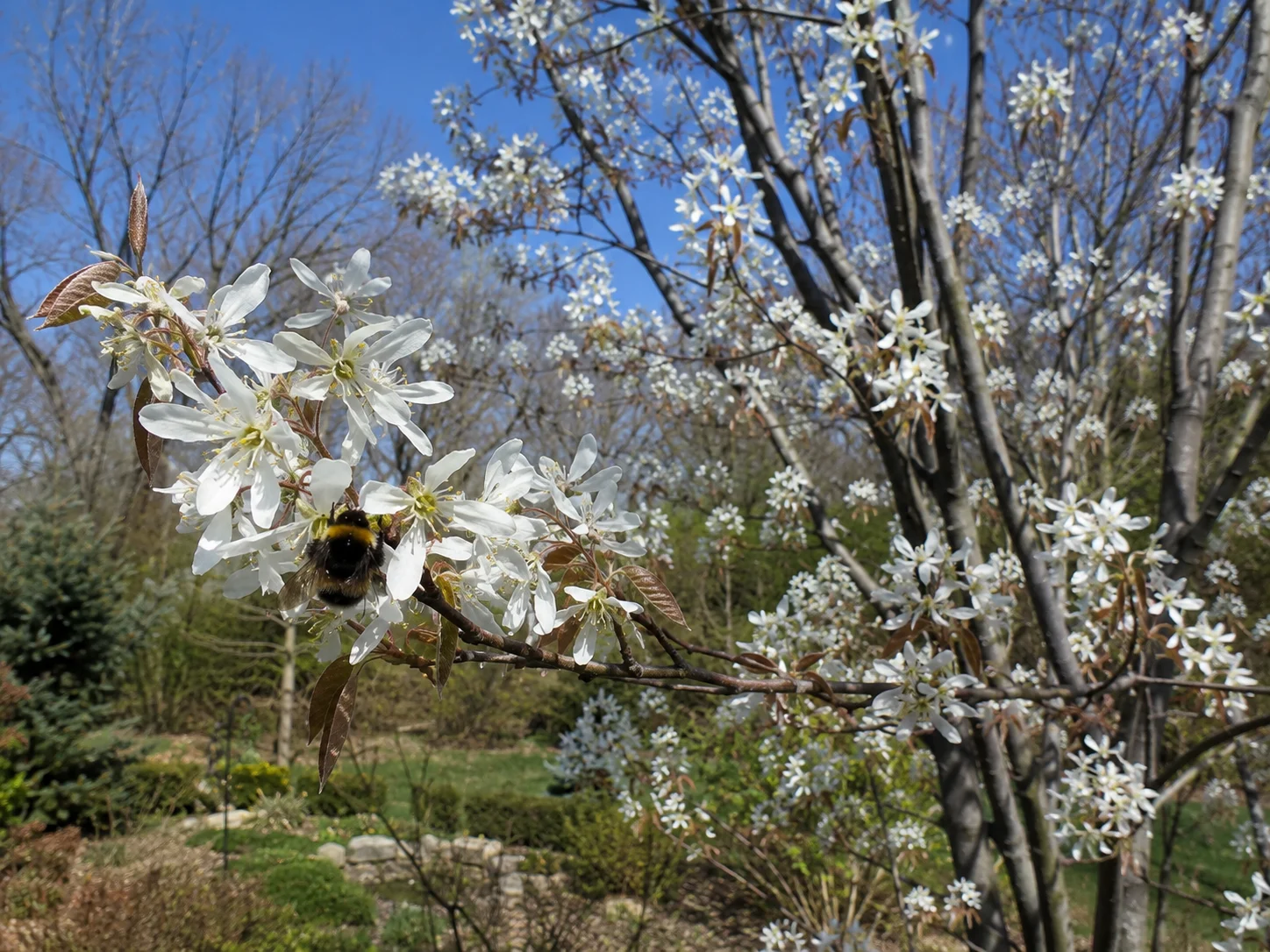
Serviceberry stops your garden from looking like a flat collection of flowers. Depending on the species, it grows as a large shrub or small multi-stem tree, producing clusters of white flowers in early spring — often before most perennials have even emerged — followed by edible purple fruit and attractive fall foliage.
University of Minnesota Extension describes serviceberries as excellent wildlife plants that attract pollinators and birds, with many forms flowering around April or May. For bees, serviceberry is critical: it provides pollen at the exact moment queen bumblebees are founding their spring colonies and honeybee colonies are beginning their spring build-up, when almost nothing else is blooming.
What serviceberry contributes to your garden: early flowers before competition, genuine height and vertical structure, a visual anchor around which smaller plants can be arranged, and spring interest before any perennial becomes impressive. Without a structural plant, new gardens tend to look good for six weeks and then collapse into an undifferentiated flat mass of flowers.
Placement: Position serviceberry toward the back or side of the garden where its mature canopy will not shade every sun-loving perennial. Check mature height and width before purchasing — a large serviceberry planted three feet from the house is a future removal bill. In smaller yards, choose a compact shrub-form serviceberry or a smaller native flowering shrub that fills the same structural role.
Plant 2: Arrowwood Viburnum — The Shrub Layer
The next plant is not there to sit beneath the serviceberry looking decorative. Arrowwood viburnum builds the garden’s middle structure — the layer between the tree canopy and the shorter perennials that most beginner gardens are missing entirely.
Penn State Extension describes arrowwood viburnum as one of the most adaptable native viburnums, generally reaching 6–10 feet and tolerating a wide range of growing conditions. It produces flat-topped white flower clusters in late spring, dense foliage through summer that provides shelter for wildlife, and berries that birds use into winter. For pollinators, it delivers a substantial late-spring bloom at exactly the point when serviceberry has finished and the perennials have not yet reached their stride.
The missing shrub layer is the most common structural mistake in new gardens. Without it, the planting jumps directly from one tree to 18-inch flowers, making the garden look thin and exposing weeds, fences, and neighboring properties. A real shrub gives the planting weight and solidity.
Planting warning: Arrowwood viburnums grow wider than most people expect. Do not plant them against paths or into a narrow strip. In regions where arrowwood is poorly adapted, choose a locally appropriate alternative: native ceanothus, wax myrtle, chokeberry, native blueberry, summersweet, or appropriate regional dogwood shrubs all fill the same structural role.
Plant 3: Mountain Mint — The Midsummer Pollinator Magnet
Mountain mint is the plant that makes the garden look alive when everything else has quieted down.
While the spring shrubs are finished and the fall plants haven’t started, mountain mint draws an extraordinary range of insects. North Carolina Extension describes mountain mints as native perennials that attract bees, butterflies, and other pollinators, with several species blooming from roughly June through August — making them especially useful exactly when gardens typically go quiet in midsummer. On a warm July morning, a patch of mountain mint in full bloom can be covered in honeybees, bumblebees, sweat bees, butterflies, and beneficial wasps simultaneously. The activity is visible from across the garden.
This is the plant for gardeners who say “my garden looks great in May but nothing is happening by July.” That gap is not unusual — it is the exact failure point that the July nectar crash guide explains and helps solve. Mountain mint addresses it directly.
Do not plant one: A single mountain mint hidden behind ornamental grasses is not a pollinator planting. The flowers are individually small, so the effect requires a visible group of at least three plants — preferably five or more. Spread management: Some mountain mint species spread by rhizomes and can become enthusiastic in a formal bed. Check the specific species before planting and either give it space to spread freely, remove outward-growing shoots in spring, or choose a more compact regional species.
Plant 4: Goldenrod — The Late Summer Workhorse
Goldenrod has been dismissed as a roadside weed for decades — which is unfortunate given how genuinely valuable the genus is for pollinators and garden structure in late summer and fall.
Penn State Extension lists goldenrod bloom from approximately August into November, noting that its flowers attract bees, butterflies, beneficial wasps, flies, and beetles. That bloom period covers exactly the season when most garden perennials are declining and pollinators are building their critical pre-winter reserves. For honeybee colonies preparing for winter, the late goldenrod flow is one of the most important nectar sources of the year. For the 4,000+ species of native bees in North America, it is an irreplaceable late-season resource.
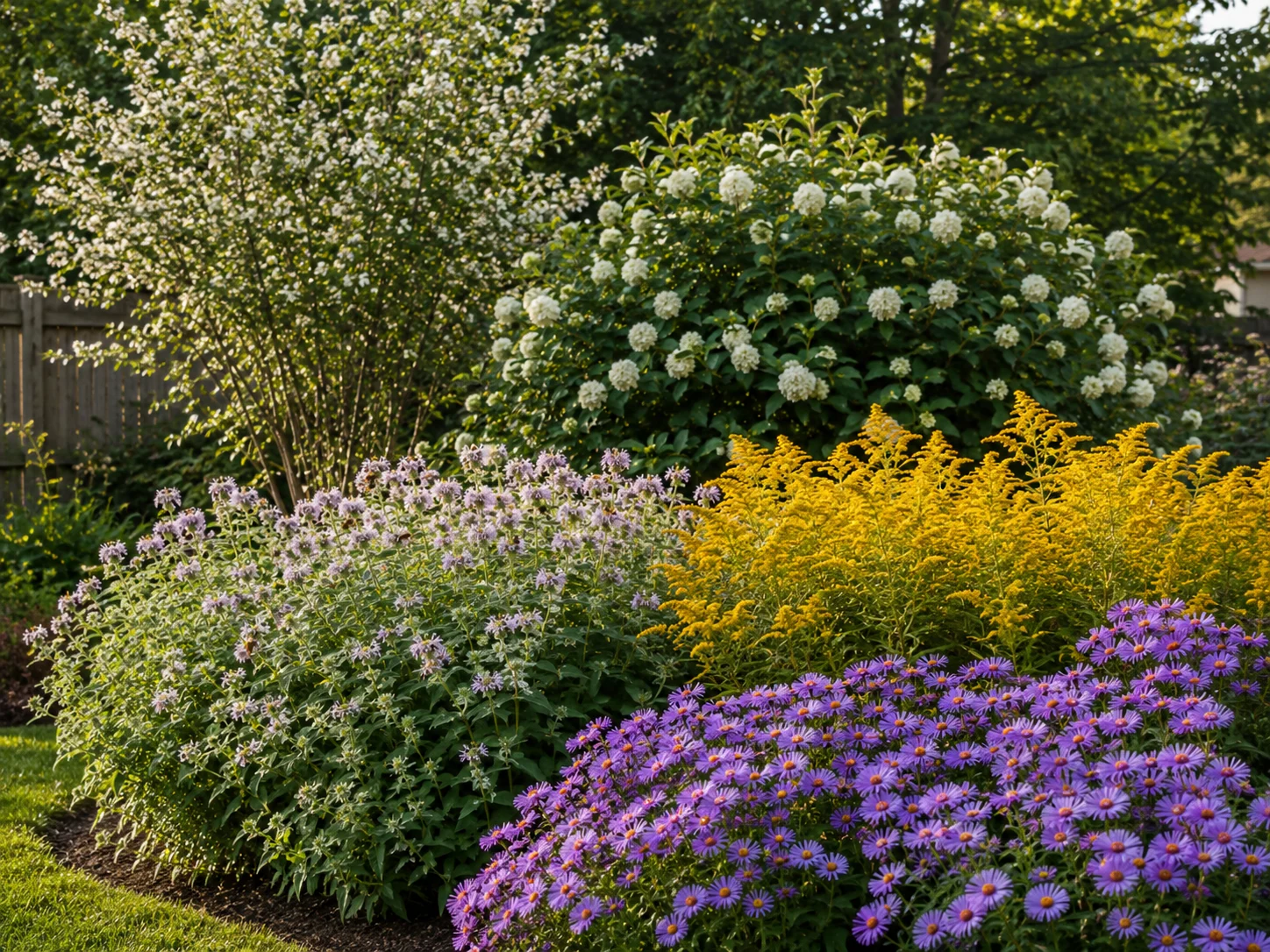
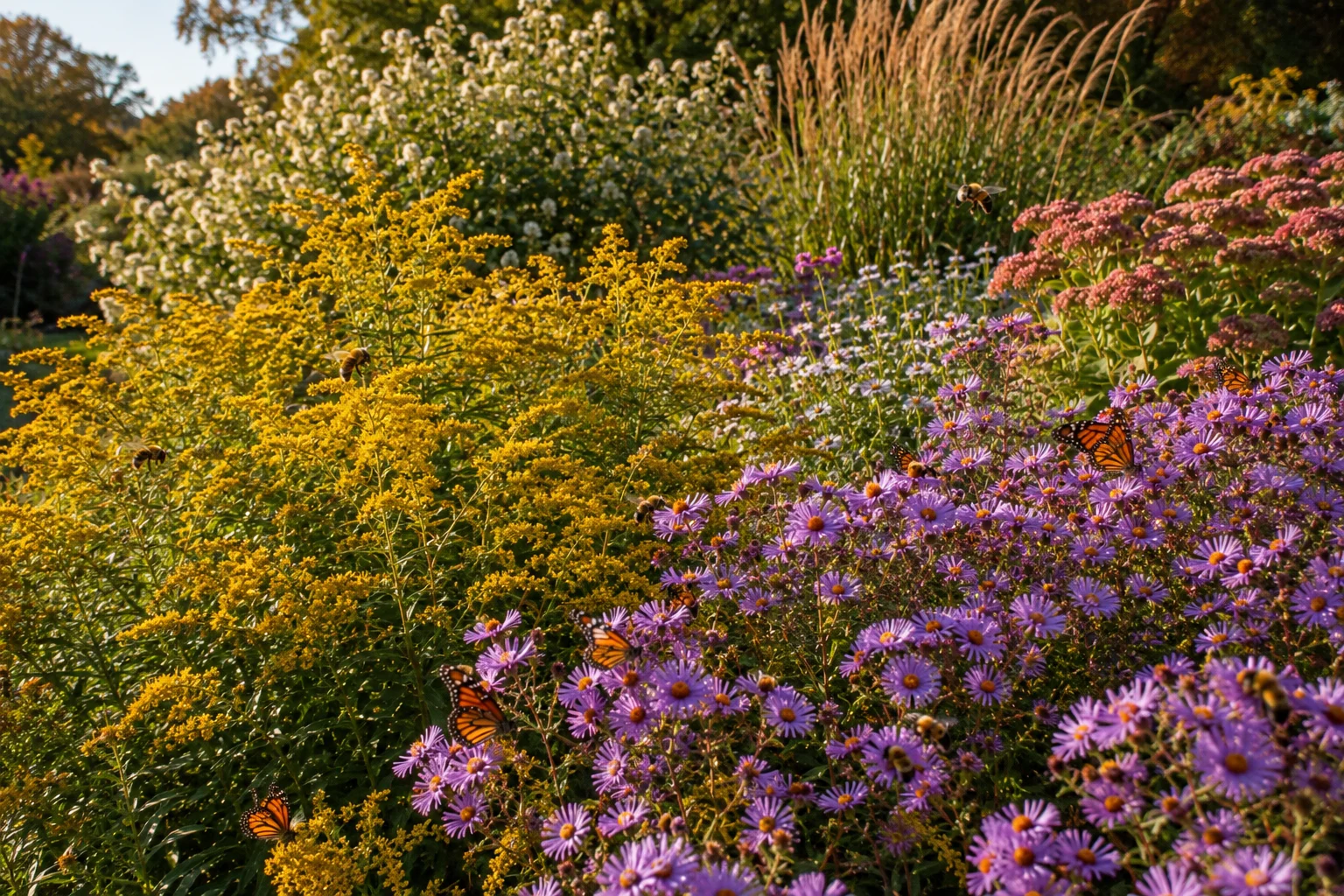
Goldenrod also works visually — its warm yellow flowers contrast beautifully with purple asters, which is why the two plants appear together repeatedly in well-designed fall gardens.
Choose the right species: “Plant goldenrod” is incomplete advice. The genus contains species adapted to different soils, moisture levels, and garden sizes — some aggressive spreaders, others restrained clump-formers. For smaller residential gardens, look for a locally native clump-forming species: showy goldenrod, zigzag goldenrod, stiff goldenrod, blue-stemmed goldenrod, or gray goldenrod depending on your region and conditions. Do not dig a roadside plant and drop it into a small border — match the species to the site.
On allergies: Goldenrod is regularly blamed for hay fever because it blooms when ragweed releases pollen. Ragweed is the actual culprit — it releases lightweight airborne pollen while goldenrod’s conspicuous flowers rely on insect pollination. This is not a reason to exclude goldenrod from a pollinator garden.
Plant 5: Native Aster — The Fall Finisher
Asters are the final handoff in this five-plant sequence. As mountain mint fades and goldenrod reaches peak bloom, native asters open in purple, blue, lavender, pink, or white, extending the garden’s productive season into October and sometimes November.
University of Maryland Extension and Xerces Society both identify late-flowering asters alongside goldenrods as among the most important pollinator forage during a period when fewer other flowers remain available. Their late bloom is not supplemental — for many bee species completing their final foraging before winter, it is essential. Native asters also provide overwintering habitat when left standing through winter, their hollow stems serving as nesting sites for cavity-nesting native bees.
Choose aster by conditions: Native asters are not one interchangeable plant. Aromatic aster suits sun and drier soil. New England aster performs best in taller, moist sunny beds. Smooth aster tolerates sun and average soil. Calico aster is suited to part shade and woodland edges. Match the species to your site rather than buying whatever is available. Tall asters can flop in rich soil — plant them in full sun, avoid heavy fertilizing, and consider choosing shorter species or cutting plants back once in late spring to create a more compact, self-supporting form.
[Image: Sweeping late-season garden border with goldenrod and native asters in peak bloom — warm yellow goldenrod contrasting with purple aster flowers, multiple bees and monarch butterflies visible foraging, the scene looking abundant and alive in early autumn light | Alt text: goldenrod native aster fall pollinator garden late season forage bees butterflies autumn US native plants]
The Five-Plant Bloom Relay
The value of this palette is the handoff — each plant takes over from the last, covering the season from early spring to first frost:
| Season | Plant Working |
|---|---|
| Early spring | Serviceberry |
| Late spring | Arrowwood viburnum |
| Midsummer | Mountain mint |
| Late summer | Goldenrod |
| Fall | Native aster |
Actual timing varies by region, weather, and species selected. There will be gaps between some bloom periods — that is fine. This is a starting framework, not a claim that five plants create perfect continuous forage in every zip code. Once these plants are established, you can see the calendar gaps clearly and fill them deliberately rather than guessing.
How to Arrange Them: Three Layers
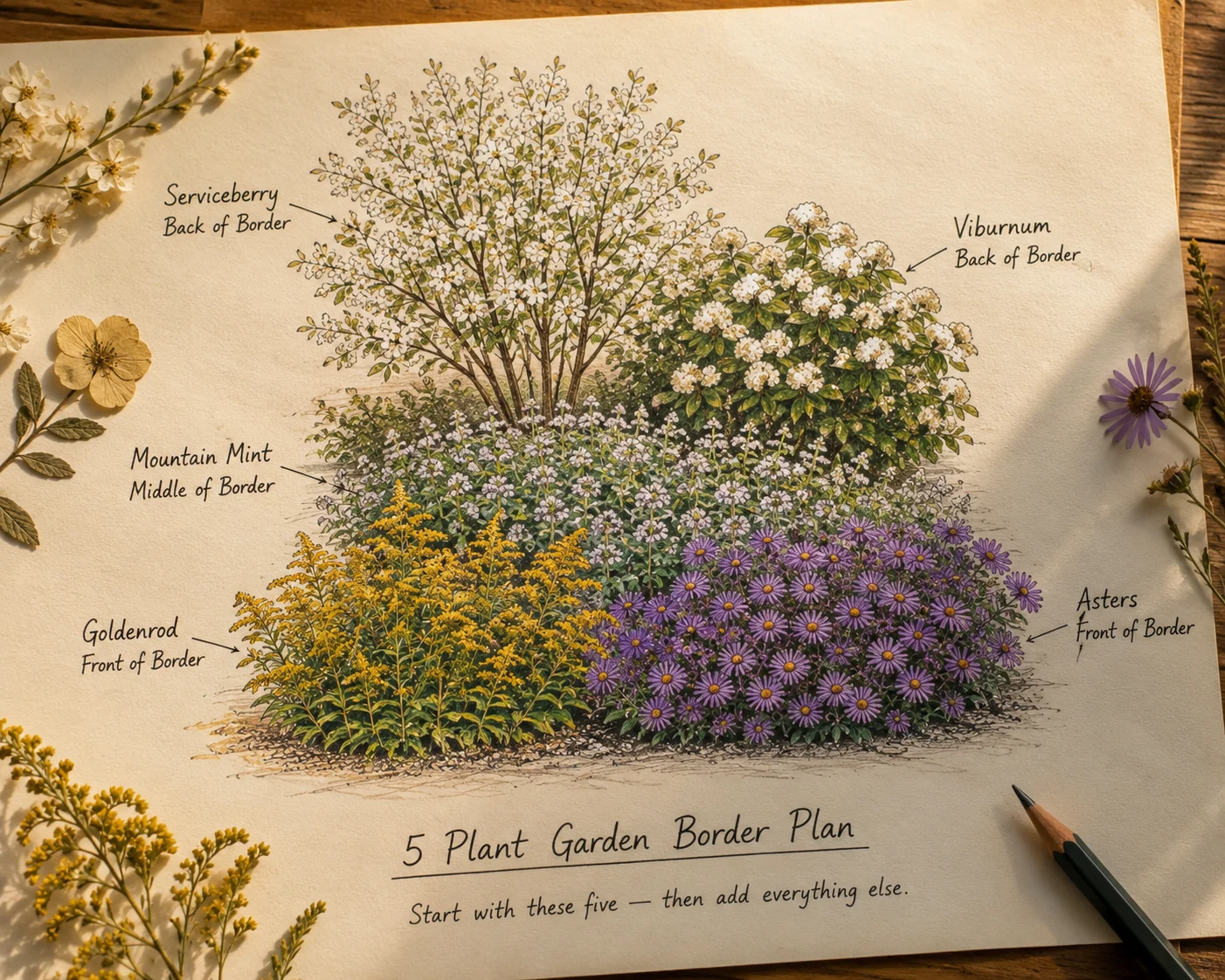
Place the serviceberry and arrowwood viburnums toward the back or along the boundary, giving them enough space to reach their mature size without swallowing a path. Use mountain mint as a repeated midsummer block in the middle of the border, where its activity can be watched from a path or patio. Plant shorter goldenrods and asters along the front and through the sunny gaps — in irregular overlapping groups, not alternated one-by-one in a striped line.
The result should feel repeated but not mechanical. Groups, not specimens. Overlapping, not regimented.
A Starter Shopping List
For a medium-sized sunny border, begin with these quantities and adjust based on mature plant size and available space:
- 1 serviceberry or equivalent structural shrub
- 2 arrowwood viburnums or regional flowering shrubs
- 3–5 mountain mint plants in a visible group
- 3–5 clump-forming goldenrod plants
- 5–7 native asters in mixed species or one reliable species
Woody plants can be used individually or in small groups. Perennials should be repeated. The garden should have visible masses, not one specimen of everything.
What to Add in Season Two
Once the starter five are growing, resist the urge to buy everything at once. Watch the garden for one full season. Then add plants to fill the specific gaps you actually observed — not the gaps you imagined.
For spring ground-level flowers: native violets, wild geranium, golden Alexanders, woodland phlox, or regionally appropriate spring bulbs. For early summer: penstemon, milkweed, native roses, coreopsis, or bee balm. For structure: little bluestem, prairie dropseed, regional sedges, or low native groundcovers. For midsummer backup: buttonbush, summersweet, Culver’s root, anise hyssop, or Joe-Pye weed.
For a larger boundary planting that needs more than a border can provide, the multi-layer approach in Multi-Layered Boundary Hedgerows: The Garden Design Trick That Feeds Bees All Season extends the same logic across a full garden boundary.
What Not to Do
Don’t buy only what is flowering today. Nurseries sell what looks impressive right now. If you shop only in May, you build a May garden. Plan from a bloom calendar before shopping, or visit the nursery in midsummer and fall to see what performs across the season.
Don’t ignore mature size. A crowded garden is not automatically a productive one. Overcrowding reduces airflow, hides weeds, and eventually forces you to remove expensive plants. Check the mature spread of every woody plant before you dig the hole.
Don’t plant outside the site conditions. A moisture-loving shrub in dry exposed soil is not low maintenance — it is dying slowly. Match the plant to what the site actually offers, not to what you wish it offered.
Don’t treat this list as universal. This five-plant palette is strongest for the eastern and central United States. Gardeners in California, the Southwest, the Pacific Northwest, Florida, or high-elevation regions should use regional equivalents that fill the same five roles: early-flowering structural plant, late-spring shrub, midsummer perennial, late-summer perennial, fall perennial.
Conclusion: Build the Backbone First
Feeling overwhelmed does not mean you need a more detailed shopping list. It usually means you are trying to make every garden decision at once.
Stop. Begin with five plant roles that give the garden structure and a season-long sequence. Plant the perennials in visible groups. Respect mature widths. Watch the garden for a full year. Then add plants where you see genuine gaps — not where you imagine them.
That is how a pollinator garden grows without becoming chaos. Not by buying everything. By building a useful backbone and making the next decision only after the first five plants have shown you what is actually missing. 🌿🐝
Keep Reading 🐝
- 🌸 How to design your garden beds so bees can actually find them — mass planting, scent corridors, and bloom sequencing — The design principles behind why grouped planting works so much better than scattered specimens.
- 📅 Why July is the most dangerous gap in the pollinator garden calendar — Mountain mint addresses this directly, but this post gives you the full seasonal picture.
- 🌿 The drift planting method — how to arrange your five plants and everything that comes after them for maximum ecological and visual impact — The next step once your backbone is planted.
Five plants. One season of watching. Then you’ll know exactly what to add. 🌱
Which of these five plants are already in your garden — and which are you adding this season? Tell us in the comments.