
Seeing wasps around a beehive in late summer is not something to ignore.
One or two wasps passing through the apiary is normal. A steady stream of wasps investigating hive entrances, crawling around cracks, hovering near weak colonies, or trying to slip past guard bees is different. That is pressure. And in late summer, pressure can turn into a real problem fast.
Wasps are not evil. They are predators, scavengers, and part of the garden ecosystem. Earlier in the season, many wasps help control caterpillars, flies, and other insects. But by late summer, their colonies are large, natural food patterns shift, and they become much more interested in sweet food sources. A beehive full of honey, syrup, and warm bee smells becomes an obvious target.
The mistake is either panicking and spraying everything, or doing nothing until a weak colony is overwhelmed. Both are bad beekeeping.
This guide will show you what wasp activity around a hive means, how to tell normal wasp presence from a serious threat, what to do immediately, what not to do, and how to reduce the problem before your apiary turns into a late-summer feeding station for every wasp in the neighborhood.
Why Wasps Become a Bigger Problem in Late Summer
Late summer is when wasp pressure often becomes more obvious.
By this point, many social wasp colonies are near their seasonal peak. There are more workers flying, more mouths to support, and more competition for easy food. University of California IPM notes that yellowjacket defensive behavior increases as the season progresses, colony populations grow, and food becomes scarcer. It also explains that by late summer, many wasps become especially interested in sweet foods. UC IPM guide to yellowjackets and other social wasps.
That timing overlaps badly with beekeeping.
Late summer can also bring:
- Nectar dearths
- Honey harvest
- Feeding syrup
- Weaker colonies or nucs
- Reduced forage
- Robbing pressure
- Open honey, wax, or comb smells
- Spilled syrup near hives
If you already know your area gets a summer forage gap, wasp pressure should not surprise you. It belongs in the same seasonal risk zone as robbing, weak colonies, and defensive apiary behavior. If your hives start struggling when local nectar drops, the problem may be bigger than wasps alone, which is why it connects directly with the July nectar crash and midsummer hive pressure.
Is It Really Wasps — or Robbing Bees?
Before you act, identify the problem.
Not every frantic insect at the entrance is a wasp. Late summer is also robbing season, and robbing bees can create chaos around a hive.
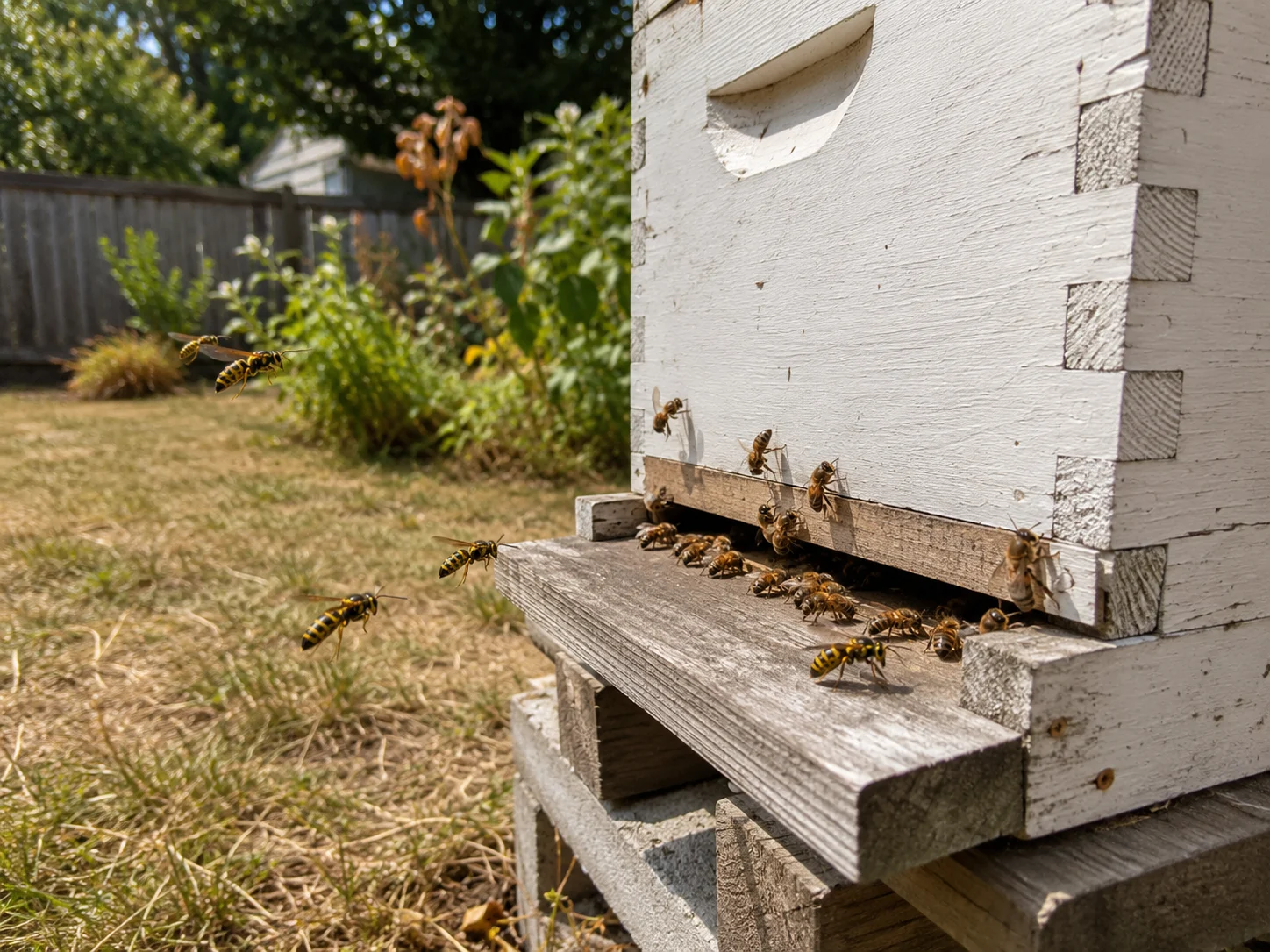
Signs You Are Seeing Wasps
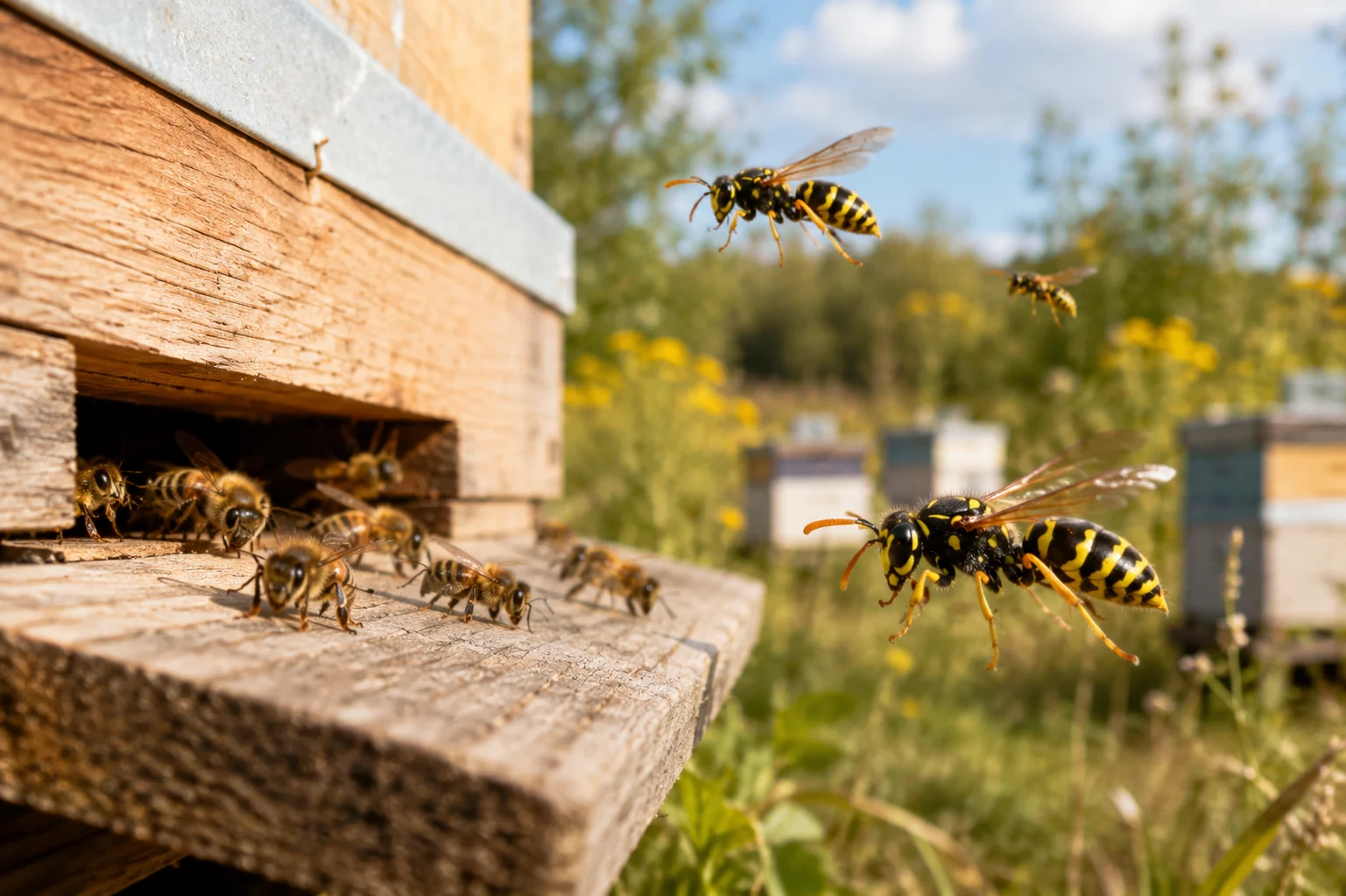
Wasps often look:
- Shinier than honey bees
- Less hairy
- More sharply yellow and black
- More narrow-waisted
- Faster and more direct in movement
- Interested in cracks, corners, hive joints, and weak entrances
They may crawl around the outside of the hive, test gaps, hover near the entrance, or try to dart in when guard bees are distracted.
Signs You Are Seeing Robbing Bees
Robbing bees are honey bees stealing honey or syrup from another colony. University of Florida IFAS explains that robbing can escalate quickly during nectar dearths and that weak colonies are especially vulnerable because they have fewer guards protecting the entrance. University of Florida IFAS guide to robbing behavior in honey bees.
Robbing signs include:
- Fighting at the entrance
- Bees trying to enter through cracks
- Wax cappings debris near the hive
- Unusual frenzy around one colony
- Bees searching around hive seams
- More dead bees at the entrance
- A colony suddenly becoming defensive
Wasps and robbing bees can happen at the same time. In fact, exposed honey and weak colonies can attract both. If the activity looks like a full-scale raid, use the same fast-response thinking covered in robbing bees in late summer.
When Wasps Around a Beehive Are Normal
A few wasps around the apiary does not automatically mean disaster.
Normal activity may look like:
- One or two wasps passing through
- Wasps visiting nearby flowers
- Occasional wasps near compost or fruit
- A wasp checking the outside of a strong hive and leaving
- No fighting at the entrance
- Guard bees calmly controlling access
If the colony is strong, queenright, and well-populated, it can usually handle occasional wasp pressure. Strong colonies defend their entrances. Weak colonies are the ones that get tested harder.
So do not lose your mind over one wasp. That is beginner panic.
But do not ignore a pattern.
When Wasps Around the Hive Are a Real Warning Sign
Wasp activity becomes serious when you see repeated attempts to enter the hive or when one colony is clearly being targeted.
Watch for:
- Wasps entering the hive repeatedly
- Guard bees fighting wasps at the entrance
- Wasps crawling under the lid or around box joints
- Multiple wasps hovering at a weak colony
- Wasps gathering near syrup feeders
- Wasps attracted to wet honey supers or exposed comb
- A nuc or small colony unable to defend itself
- Dead bees or wasps piling near the entrance
- A hive becoming unusually defensive
That means the wasps have found a reward or believe they can get one.
The colony may be too weak, the entrance may be too wide, there may be spilled syrup nearby, or the hive equipment may have gaps. Late summer exposes sloppy beekeeping. If there is a weakness, wasps and robbers will find it.
First Step: Reduce the Hive Entrance
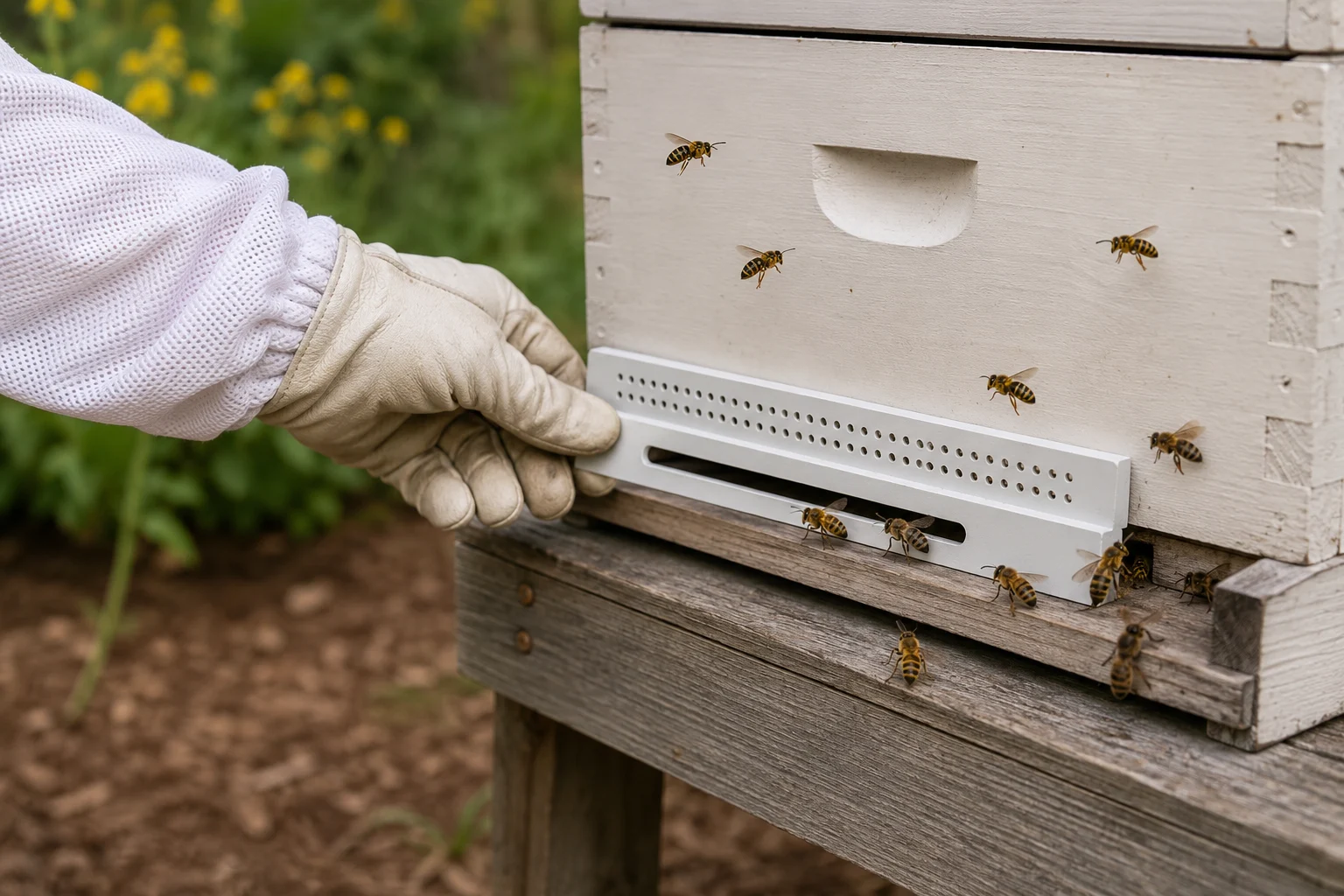
The fastest, most practical move is to reduce the entrance.
A wide-open entrance is fine for a strong colony during heavy flow. In late summer, especially for small colonies, it can become a liability. A smaller entrance gives guard bees a defendable doorway instead of a giant open gate.
Use:
- Entrance reducers
- Grass temporarily stuffed into excess space
- Foam strips
- Wooden blocks
- Mesh guards
- Robbing screens where appropriate
For weak colonies or nucs, reduce the entrance enough that only a few bees can pass at once. Do not block ventilation completely. Do not trap bees inside. Do not reduce so aggressively that traffic jams become a problem on hot days.
A good entrance reduction gives the colony control.
Seal Gaps Wasps Can Exploit
Wasps do not only use the front entrance.
They test:
- Loose lids
- Box joints
- Warped supers
- Gaps between boxes
- Cracks in old hive bodies
- Poorly fitting floors
- Feeder access points
- Holes in damaged equipment
Late summer is not the time to run junk equipment and hope for the best. If wasps can smell honey through a crack, they will investigate it.
Do this:
- Tighten hive straps if needed
- Replace warped boxes
- Repair cracks
- Close unnecessary upper entrances on weak colonies
- Make sure feeders fit properly
- Keep crown boards and lids seated correctly
- Avoid leaving empty gaps above the colony
A strong colony in sound equipment is harder to attack. A small colony in leaky equipment is an invitation.
Stop Attracting Wasps to the Apiary
This is where many beekeepers sabotage themselves.
They complain about wasps, then leave honey residue, exposed comb, wet supers, syrup spills, fruit scraps, or open feeders near the hives. That is not bad luck. That is you feeding the enemy.
Remove attractants:
- Do not leave honey frames exposed.
- Cover supers during harvest.
- Clean syrup spills immediately.
- Avoid open feeding during wasp pressure.
- Keep wax scraps sealed.
- Do not leave cappings outside.
- Keep bins and compost sealed.
- Pick up fallen fruit near the apiary.
- Wash sticky hive tools away from the hive area.
UC IPM recommends removing attractive food sources such as uncovered food, open garbage, pet food, sweet drinks, and ripe fruit when managing yellowjackets around outdoor areas. UC IPM yellowjacket food-source guidance.
For beekeepers, the same principle applies more aggressively: do not let your apiary smell like free sugar.
Feed Bees Without Feeding Wasps
Late summer feeding can help bees, but it can also trigger wasps and robbing if done badly.
Use safer feeding habits:
- Feed inside the hive when possible.
- Avoid open feeding near the apiary.
- Keep feeder surfaces clean.
- Do not overfill feeders until they leak.
- Feed in the evening if wasp pressure is high.
- Reduce entrances before feeding weak colonies.
- Clean every syrup spill immediately.
- Avoid leaving syrup containers outside.
If you use entrance feeders during heavy wasp pressure, watch them carefully. They can advertise syrup right at the doorway. For a vulnerable colony, an internal feeder is often safer.
Do not use sweet poison baits near the hives. That can attract bees too, and it is a stupid risk around an apiary.
Use Wasp Traps Carefully
Traps can help reduce local wasp pressure, but they are not magic.
The University of Minnesota Extension notes that traps may catch only a small number of wasps and that the best strategy for nuisance yellowjackets is minimizing what attracts them. University of Minnesota Extension wasps and bees guide.
That does not mean traps are useless. It means you need realistic expectations.
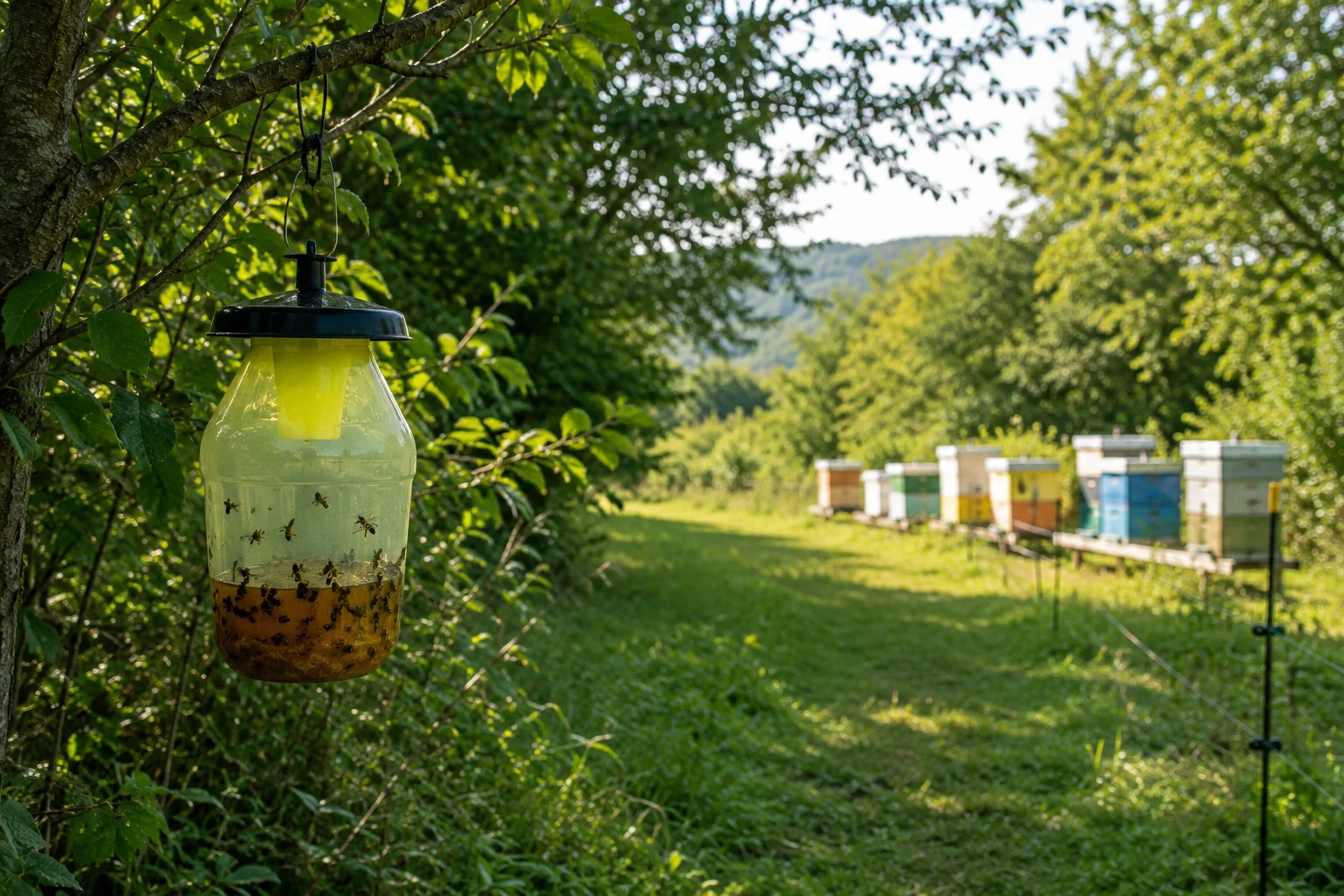
Use traps:
- Away from hive entrances
- Away from patio seating
- Along property edges
- Between likely wasp flight routes and the apiary
- Before the wasps are already concentrated at the hive
- With bait that does not attract honey bees
Do not hang a sweet trap directly beside a hive and act surprised when it increases insect traffic around the apiary. That is bad placement.
Protein baits may be more useful earlier in the season, while sweet attraction often increases later. Commercial traps and bait types vary by wasp species, so follow local guidance and product instructions.
Check Colony Strength
Wasps often reveal a colony problem.
If one hive is being targeted and the others are fine, inspect the vulnerable colony carefully when conditions allow.
Check for:
- Queenright status
- Brood pattern
- Adult bee population
- Food stores
- Signs of disease
- Varroa pressure
- Space the colony cannot defend
- Too many empty boxes
- Failing nucs
- Weak late-season splits
A colony that is too small for its equipment may not be able to defend the space. Remove excess supers or empty boxes the bees cannot patrol. Compress the colony into a defendable setup.
For new beekeepers, this is why hive placement, equipment condition, water, flight paths, and seasonal planning matter before the bees even arrive. A small backyard apiary needs practical setup, not just a hive dropped in a corner; that bigger preparation is covered in small backyard beekeeping setup before you start.
Protect Weak Colonies and Nucs First
Weak colonies need special attention.
Late summer is not forgiving. A nuc with a wide entrance, a light population, and syrup smell is an easy target.
For weak colonies:
- Reduce entrances heavily.
- Use robbing screens if needed.
- Feed internally.
- Keep inspections short.
- Avoid opening them during peak activity.
- Seal all gaps.
- Remove excess space.
- Consider moving them temporarily if pressure is severe.
- Combine with another colony if the unit is failing and cannot recover.
Do not let a doomed weak colony sit there attracting wasps and robbing bees into the whole apiary. That is how one bad hive becomes a yard-wide problem.
Do Not Spray the Hive Entrance
Spraying pesticides at or near the beehive entrance is one of the worst responses.
You may kill some wasps, but you can also contaminate the hive area, harm bees, create agitation, and make the situation more dangerous. Chemical repellents at the entrance are not a smart solution.
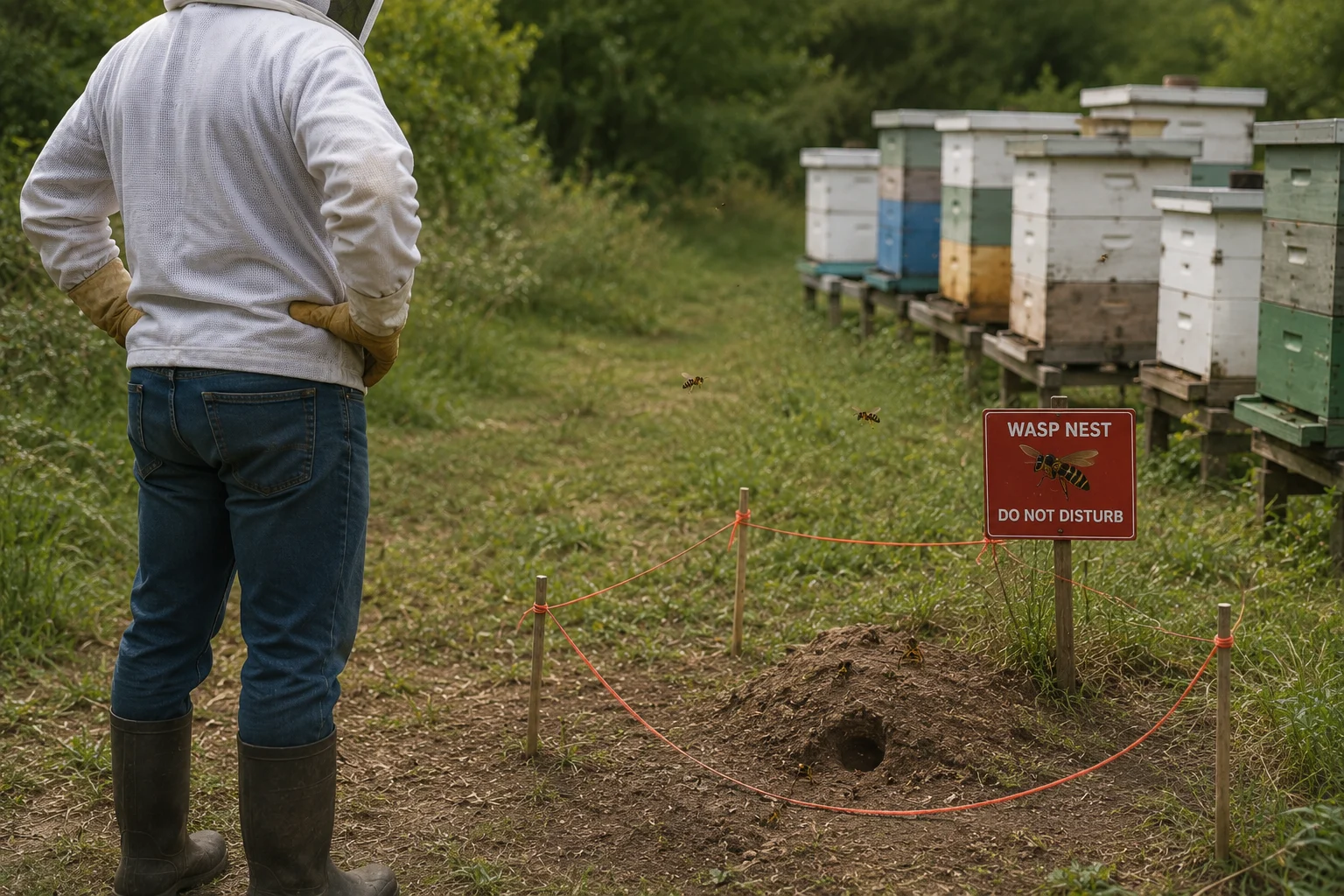
If there is a wasp nest creating a serious hazard, deal with the nest itself, not your hive entrance. If the nest is large, underground, inside a wall, or close to people, call a professional. UC IPM specifically advises professional help as the safest route for difficult nest situations and warns that wasps may attack when nests are treated. UC IPM guidance on wasp nest treatment.
Your beehive is not the place for reckless spraying.
Keep Inspections Short During Wasp Pressure
A long, messy inspection in late summer can make things worse.
When wasps and robbers are active:
- Open one hive at a time.
- Keep frames covered.
- Do not leave boxes exposed.
- Avoid dripping honey.
- Close the hive quickly.
- Work later in the day if needed.
- Have tools ready before opening.
- Avoid crushing comb or spilling syrup.
- Do not start unnecessary deep inspections during a frenzy.
Late summer inspections should be focused. Know what you are checking before you open the hive.
This is not the time to casually admire every frame while wasps circle the yard.
Quick Late-Summer Wasp Checklist for Beekeepers
Use this when you see wasps around a beehive.
Immediate Actions
- Reduce the entrance.
- Seal gaps in the hive.
- Remove exposed honey and wax.
- Clean syrup spills.
- Cover supers and frames.
- Check weak colonies first.
- Stop open feeding.
- Place traps away from hives if needed.
What to Watch
- Wasps entering repeatedly
- Fighting at the entrance
- Wasps around hive seams
- Weak colony defense
- Increased dead bees
- Robbing bee activity
- Hive suddenly becoming defensive
- Syrup feeder leaks
What Not to Do
- Do not spray the hive entrance.
- Do not leave wet supers outside.
- Do not use sweet poison baits near bees.
- Do not keep weak colonies wide open.
- Do not inspect multiple hives at once during pressure.
- Do not ignore repeated wasp entry.
Conclusion: Wasps Around a Beehive Are a Warning, Not a Reason to Panic
A few wasps near the apiary is normal. Constant wasp pressure at the hive entrance is not.
When you see wasps around a beehive in late summer, think like a beekeeper: reduce the entrance, seal gaps, remove attractants, feed carefully, protect weak colonies, and keep inspections short. Do not spray the hive. Do not leave honey exposed. Do not let one failing colony become a wasp magnet for the whole yard.
The best defense is a strong colony in tight equipment with a clean apiary around it.
Late summer rewards disciplined beekeeping and punishes sloppy habits. Fix the easy weaknesses first, and your bees have a much better chance of defending what they worked all season to store.
Ready to protect your bees through late summer and beyond? Explore the honeyroadblog.com shopping page for high-quality beekeeping supplies, whether you need entrance reducers, hive tools, feeders, protective gear, or equipment upgrades for a stronger, safer apiary.